Executive Overview
In the grand tradition of television comedy, the disastrous dinner party serves as an essential rite of passage—a narrative crucible designed to strip away the carefully curated veneers of young adulthood. From the infamous Thanksgiving episodes of Friends, where Rachel famously fused a traditional English trifle with a shepherd’s pie, to Hannah Horvath’s disastrous pad Thai evening in HBO’s Girls, the ruined meal is television’s shorthand for impending chaos.
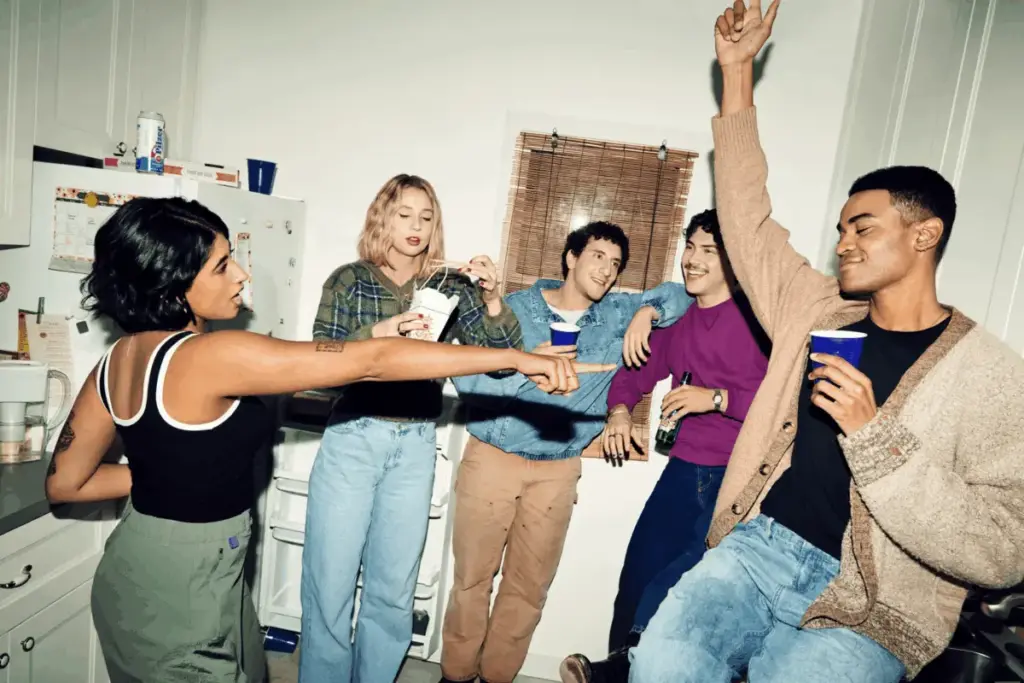
Enter Adults, the hit Disney+ sitcom executive produced by comedian Nick Kroll. Following its explosive sophomore season release, the series has cemented its status as a leading contender for the definitive hangout comedy of a new generation. Centering on a tight-knit circle of twenty-something New Yorkers—specifically Billie, Samir, Anton, Issa, and the endearing Paul Baker—the show subverts traditional coming-of-age tropes. Rather than striving for career dominance or corporate "Girl Boss" optimization, these characters lean entirely into the absurdities, humiliations, and radical un-productivity of modern youth.
By trading the sanitized, hyper-ambitious career ladders of the 2010s for unadulterated hedonism, relational fumbles, and genuine camaraderie, Adults captures the contemporary zeitgeist. It speaks directly to a generation that has largely abandoned work-centric identity in favor of survival, community, and existential humor.
Detailed Chronology: The Evolution of the Sitcom Catastrophe
To understand the cultural impact of Adults, one must examine the lineage of the modern ensemble comedy. For decades, the television landscape has utilized shared living spaces and social gatherings to mirror the shifting realities of coming of age.
The Blueprint: Friends and the Sanitized Metrolife
When Friends debuted in the 1990s, it established the template for the "eternal hangout" sitcom. While its vision of New York City was largely sanitized, economically frictionless, and sexually conventional, it provided an indispensable anchor for generations of viewers navigating their post-collegiate years. The show’s archetypes—the neurotic planner, the eccentric artist, the lovable simpleton—became foundational DNA for subsequent writers’ rooms.
The Deconstruction: Girls and Millennial Hustle Culture
A decade later, Lena Dunham’s Girls shattered the pristine gloss of its predecessor. It offered a raw, often uncomfortable look at millennial ambition, ego, and economic precarity in post-recession Brooklyn. However, Girls remained fundamentally tied to the hustle culture of the Obama era. Characters like Hannah Horvath desperately yearned to be "the voice of their generation," while Marnie chased ephemeral musical stardom. Their struggles were deeply intertwined with the workplace, identity validation, and the exhausting performance of early-2010s productivity.
The Subversion: Adults and Post-Career Nihilism
Adults strips away even the illusion of the hustle. In the series’ premier season, the core group squirts into Samir’s family home in Queens while his parents travel, culminating in a disastrous attempt to throw a "grown-up" dinner party. Billie (played by Lucy Freyer) attempts to prove to her forty-something teacher boyfriend—whom the group aptly christens "Mr. Teacher"—that at 25, she has her life together enough to roast a chicken.

The results are catastrophic. "Mr. Teacher" ingests a catastrophic quantity of ketamine, the chicken remains profoundly raw, and guest star Julia Fox, appearing as herself, vows never to return to Queens. The evening concludes not with a tidy resolution, but with a glum, liberating acceptance: none of them have their lives together, and that is entirely fine.
Supporting Context & Metrics: The Shift Away from Work-Centric Identity
The thematic divergence between Adults and earlier sitcoms is not merely a creative choice; it is a direct reflection of shifting socioeconomic realities and generational psychological shifts.
The Decline of Workplace Worship
In previous decades, television characters derived a significant portion of their self-worth from their professional lives. The office, the coffee shop, or the fledgling art career was where characters sought magic and meaning. Today, that worldview has eroded.
Recent sociological data underscores a massive cultural pivot regarding employment:
- Gen Z vs. Millennials: Recent labor and lifestyle statistics indicate that only 49 percent of Generation Z view work as central to their core identity.
- Historical Comparison: By contrast, 62 percent of Millennials reported that their careers served as primary anchors for their personal identity during a comparable life stage.
This disillusionment finds a natural home in Adults. The workplace does not hold the mystical solutions for Billie, Issa, Anton, Samir, and Paul. Instead, the characters direct their emotional energy inward, focusing on their interpersonal webs, domestic absurdities, and shared survival.
The "Millennial Optimism" Nostalgia Cycle
Ironically, while Adults is distinctly a product of the Gen Z television boom, it channels a strange comfort reminiscent of the early 2010s. TikTok has recently experienced a wave of millennial nostalgia, celebrating the Obama-era hipster aesthetic—complete with drawn-on finger moustaches, American Apparel disco pants, and heavy Instagram filters.
Dubbed the "millennial optimism" movement, this trend looks back at a period that, despite following a devastating financial crash, felt structurally hopeful. Adults captures a parallel emotional resonance. Its soundtrack—featuring tracks like "Bad Advice" by bby—evokes the hazy, unburdened freedom of indie sleaze, reminding older viewers of a time before mortgage contracts, municipal bin schedules, and existential career dread took over.

Character Archetypes: A New Pantheon
For viewers raised on ensemble comedies, watching Adults inevitably triggers a matching game. Modern audiences find themselves mapping classic tropes onto the show’s chaotic roster:
- The Paul Baker Archetype (The Heart of Gold): Played by Jack Innanen, Paul Baker is the quintessential "granola bro" whose unwavering sweetness anchors the group. Much like Joey Tribbiani from Friends, his intellectual processing speeds are often outpaced by his emotional loyalty. (As series lore dictates, he must always be referred to by his full name).
- The Issa Archetype (The Unapologetic Free Spirit): Portrayed by Amita Rao, Issa channels a modern Phoebe Buffay energy. Whether she is dramatically reimagining "I Dreamed a Dream" in season two or demanding to know, "When are they going to realise I’m more than my personality?!", she represents the beautifully unmanageable id of the group.
- The Billie Archetype (The Validation Seeker): Channeling the frantic energy of Rachel Green, Billie’s desperate quest for adult approval yields agonizingly funny results. When a random child remarks that she looks like his mother, her immediate, desperate response—"Is she… happy?"—encapsulates the universal terror of aging without a roadmap.
Official Statements and Industry Reception
Critical reception for Adults has positioned the series as a landmark achievement for Disney+, proving that the platform can successfully incubate daring, irreverent, and sharply observed adult comedy.
"It’s silly but well acted, puerile but clever, and I defy you not to come away charmed by these characters and their sincere bonds of affection," notes cultural commentary in contemporary reviews. "It’s genuinely laugh-out-loud funny, but doesn’t try too hard to impart lessons. It is easily the standout comedy of the year."
Industry insiders have praised the writers’ room for avoiding the moralizing traps that often plague modern comedies about young people. Instead of lecturing the audience on social etiquette or economic struggle, Adults deploys radical empathy masked as puerile chaos. The humor stems directly from the characters’ mutual refusal to conform to traditional markers of maturity.
Future Outlook: Season Three Speculation and the "Hopecore" Horizon
With the second season streaming to widespread acclaim, chatter surrounding a third season has already moved past speculation into virtual certainty. The cultural footprint of the show continues to expand, fueled by viral moments across social media platforms and unexpected real-world crossovers.
Among the most discussed potential developments for the burgeoning series is a rumored cameo by New York political figure Zohran Mamdani. Speculation of a potential Mamdani-meets-Paul-Baker collaboration has sent fan forums into a frenzy, sparking discussions about what many are calling the ultimate "hopecore" television crossover.
Ultimately, Adults occupies a vital space in contemporary television. It reminds its audience—whether they are currently living through their messy post-grad years or looking back from the structured stability of thirty-something domesticity—that confusion is not a failure; it is a shared human condition. It captures the final, glorious chapter of unbridled freedom before legal contracts, professional obligations, and domestic bureaucracy consume the mind. And for that reason alone, it is destined to remain a classic for years to come.