When building a robust, resilient fitness routine, the knee joint rarely commands the spotlight in the way that broader chest development, powerful glutes, or chiseled shoulders do. Fitness enthusiasts typically chase aesthetic goals, prioritizing superficial metrics over foundational joint integrity. Yet, every single movement pattern—from enduring the repetitive, high-impact miles of a marathon to simply hoisting a toddler from a low-slung car seat, climbing a flight of stairs, or executing a heavy barbell squat—relies entirely on the quiet, sophisticated mechanics of knee stability.
Knee stability is not merely a buzzword reserved for physical therapy clinics; it is the fundamental linchpoin of human locomotion. Defined clinically as the capacity of the joint to maintain precise alignment and positioning under load and during dynamic movement, it is a masterclass in anatomical teamwork. Achieving this balance requires a harmonious symphony between passive structures (such as ligaments like the anterior cruciate ligament, or ACL, and the medial collateral ligament, or MCL) and active structures (including the quadriceps, hamstrings, and hip complex).
When these muscle groups fail to communicate or lack the necessary baseline strength, the collateral damage is absorbed directly by the bones, cartilage, and stabilizing ligaments of the joint. Over time, this cumulative micro-trauma paves the way for chronic pain, acute injury, and a premature decline in mobility.
Fortunately, safeguarding your knees does not require an overhaul of your entire fitness regimen. By deliberately integrating targeted, functional resistance training exercises—specifically the step-up, the forward lunge, and the lateral lunge—into your weekly programming, you can dramatically enhance joint control, bolster performance, and protect your long-term independence. This comprehensive report explores the underlying anatomy of knee stability, examines expert insights from leading physical therapists, outlines actionable programming strategies, and provides a roadmap for sustainable, pain-free movement.
Detailed Chronology: The Evolution of Knee Rehabilitation and Preventive Strength
To understand how modern physical therapy approaches knee health, it is helpful to look back at how sports medicine and strength conditioning have evolved over the past several decades.
The Eras of Immobilization (Late 20th Century)
Historically, knee injuries—particularly those involving the dreaded ACL—were treated with extreme conservatism. In the 1970s and 1980s, surgical interventions were invasive, and postoperative protocols heavily emphasized prolonged immobilization in heavy casts or braces. The prevailing medical philosophy was that the knee joint needed absolute rest to heal its passive structures.
Unfortunately, this approach yielded disastrous secondary consequences. Prolonged immobilization led to severe muscular atrophy, particularly in the quadriceps, and catastrophic joint stiffness. Patients frequently emerged from recovery with joints that were mechanically "repaired" on paper, but functionally compromised in the real world because the surrounding active stabilizers had wasted away.
The Dynamic Shift (1990s–2010s)
As diagnostic imaging advanced and biomechanical research matured through the 1990s and 2000s, sports medicine underwent a paradigm shift. Researchers realized that passive structures like ligaments cannot function in a vacuum. Without robust active muscular support—specifically eccentric strength in the hamstrings and dynamic steering from the hips—ligaments are subjected to excessive, unsustainable shear forces.
Physical therapists began pioneering early-mobilization protocols and pre-habilitation (pre-hab) routines. Instead of waiting for an injury to occur, forward-thinking clinicians started integrating closed-chain kinetic exercises—such as step-ups and lunges—to train the nervous system and muscles to control joint tracking under load.
The Modern Era: Functional Integration (Present Day)
Today, the line between physical therapy and strength and conditioning has blurred significantly. Experts now recognize that knee stability is a lifelong pursuit that must be addressed proactively in the gym long before an injury forces someone onto the clinical table. With the rise of evidence-based functional training, fitness professionals emphasize multi-planar movements that mirror the unpredictable demands of daily life. The modern approach focuses on teaching the quadriceps, hamstrings, and hips to work as an integrated unit, ensuring that individuals maintain their physical autonomy well into their golden years.
Supporting Context & Metrics: Anatomy, Mechanics, and the Cost of Instability
To truly grasp why knee stability exercises deserve a permanent home in your workout routine, one must deconstruct the biomechanical components that govern the joint.
The Anatomy of Stability: Passive vs. Active Structures
According to Carrie Whitelam, PT, DPT, OCS, ATC, a physical therapist at the prestigious Hospital for Special Surgery in New York City, stability is divided into two distinct categories:
Passive Structures: These are the non-contractile tissues that provide foundational boundaries for the joint. They include ligaments (such as the ACL, PCL, MCL, and LCL) and the joint capsule. While essential for preventing excessive translation or rotation of the tibia relative to the femur, passive structures have limited blood supply and rely heavily on surrounding muscles to protect them from tearing forces.
Active Structures: These are the contractile muscular tissues that dynamically adjust tension across the joint in real-time. They include the quadriceps on the front of the thigh, the hamstrings on the back, and the complex web of muscles surrounding the hips and glutes.
The Three-Way Partnership: Quads, Hamstrings, and Hips
Each active muscle group plays a specialized role in maintaining knee alignment during movement:
The Quadriceps: Primarily responsible for extending (straightening) the knee, the quads absorb monumental amounts of force when decelerating the body, such as when walking down stairs or landing from a jump.
The Hamstrings: Working in tandem with the quads, the hamstrings assist in bending the knee and provide crucial posterior stabilization, preventing the tibia from sliding too far forward relative to the femur.
The Hips: Acting as what Minnesota-based physical therapist Braidy Solie, DPT, SCS, CSCS, describes as the "steering wheel" of the lower extremity, the hip complex controls the internal and external rotation of the entire leg.
When you execute a functional movement like a squat, all three systems must fire in precise coordination. If your hips are weak and fail to steer properly, your knees will naturally tend to collapse inward—a phenomenon known clinically as dynamic knee valgus. This inward caving places immense, unnatural stress on the medial collateral ligament (MCL) and the anterior cruciate ligament (ACL), drastically elevating your risk of acute injury and chronic overuse syndromes like patellofemoral pain syndrome (runner’s knee).
By the Numbers: The Prevalence of Knee Vulnerability
The ACL Epidemic: According to epidemiological studies in sports medicine, hundreds of thousands of ACL injuries occur annually in the United States alone, with female athletes participating in cutting and pivoting sports facing up to a four to six times higher incidence rate due to anatomical and neuromuscular differences.
The Longevity Factor: Osteoarthritis of the knee affects millions of adults globally, becoming a leading cause of physical disability among older populations. Research consistently demonstrates that maintaining robust muscular strength and joint stability around the knee significantly mitigates the structural wear-and-tear associated with joint degeneration, preserving functional independence and quality of life.
Official Statements & Expert Perspectives
Leading clinicians emphasize that knee stability is not a luxury reserved for elite athletes; it is an absolute necessity for human movement across the entire lifespan.
"Everybody could probably benefit from some sort of strengthening to improve stability of the knee," notes Carrie Whitelam, PT, DPT, OCS, ATC. Whitelam explains that while passive tissues like ligaments do much of the heavy lifting structurally, they cannot survive the rigors of daily life without the active, dynamic protection provided by well-conditioned quadriceps, hamstrings, and hip musculature.
Elaborating on how these muscle groups cooperate during functional tasks, Braidy Solie, DPT, SCS, CSCS, a strength and conditioning specialist with Training HAUS, points out the direct translation between gym movements and real-world resilience:
"These types of movements have a great crossover for helping build knee stability during functional things throughout the day, whether it’s carrying groceries up the stairs or carrying a child."
Solie stresses that foundational starter exercises—specifically those that require the quads and hamstrings to work concurrently while the hips maintain proper alignment—train the central nervous system to establish permanent movement patterns that protect the joint automatically.
Furthermore, both experts issue an important safety caveat regarding pre-existing joint pathology. If an individual experiences repeated buckling, a sensation of the kneecap popping in and out of place, or unexplained joint weakness, self-treatment through exercise can be counterproductive.
"Sometimes there could be underlying damage that you’re unaware of that you could just be making worse with movement," Whitelam warns, urging anyone experiencing these red-flag symptoms to seek a professional evaluation from a licensed physical therapist or orthopedic physician before embarking on a new lower-body regimen.
Future Outlook: Integrating Knee Stability into Your Long-Term Fitness Strategy
Transitioning from theory to practice requires a deliberate, structured approach to gym programming. Improving knee stability does not necessitate inventing bizarre, unstable circus tricks on balance boards. Rather, it involves mastering foundational, multi-joint movement patterns with pristine biomechanical control and progressive overload.
The Three-Exercise Blueprint for Knee Stability
Solie recommends three fundamental exercises that should form the cornerstone of any knee-protective resistance training routine: the step-up, the forward lunge, and the lateral lunge.
1. The Step-Up
Why it works: The step-up is exceptional because it encourages proactive stabilization. By placing your foot flat on top of a box or step before initiating the movement, you are pre-positioning your limb in the exact alignment you intend to maintain throughout the concentric and eccentric phases.
Execution & Focus: Step onto the box, driving through the midfoot of the working leg. Ensure your knee tracks directly in line with your second and third toes the entire time—do not allow it to cave inward.
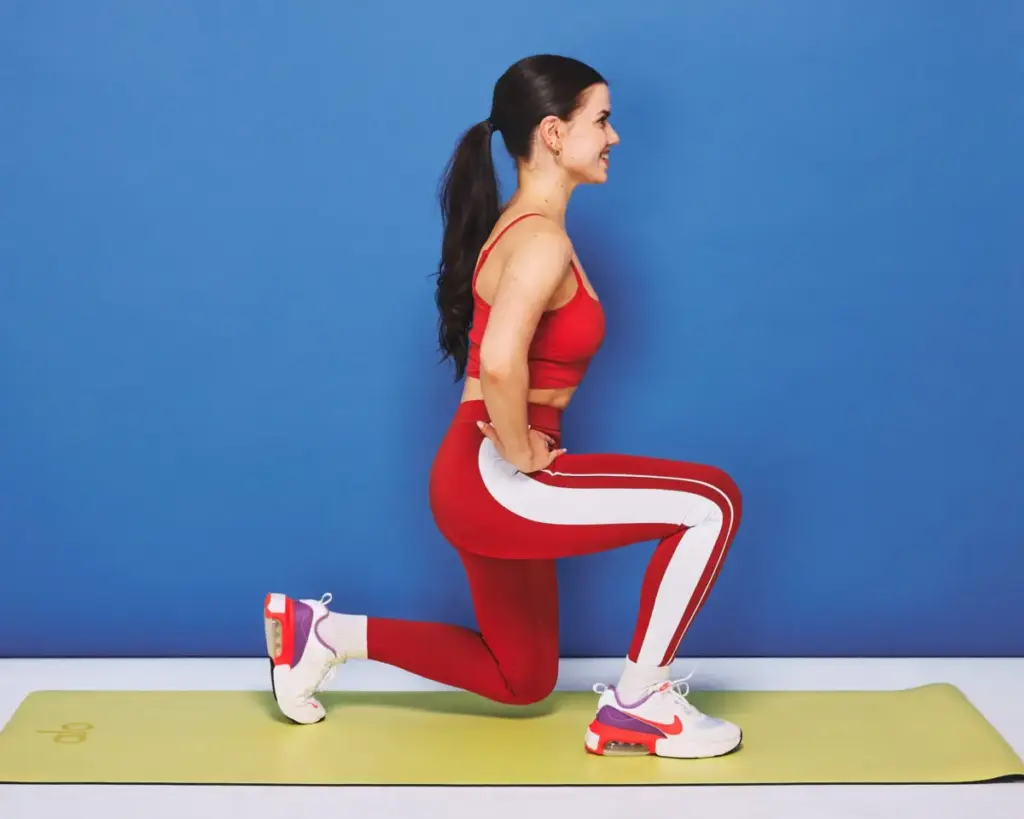
2. The Forward Lunge
Why it works: Lunges introduce an element of deceleration, making them slightly more complex than step-ups. As you step forward, your quadriceps and hamstrings must rapidly brake your body’s forward momentum while your hips stabilize the knee against wobbling.
Progression & Variation: If you find your knee wobbling excessively side to side, regress temporarily to a standard bodyweight squat to build baseline strength. Once you master the lunge, experiment with two distinct variations:
Vertical Torso: Emphasizes quad recruitment.
Slight Hip Hinge: Shifts greater load onto the glutes and posterior chain.
You can alternate these styles across different training days or combine them within a single session.
3. The Lateral Lunge
Why it works: Widely considered the most demanding of the trio, the lateral lunge requires your knee to flex and extend while your center of mass travels sideways across the frontal plane. This demands immense coordination and multi-planar stability.
Execution & Scaling: Maintain an upright posture, ensuring your tracking knee does not cave inward, your trunk does not sway, and your hip does not pop out laterally at the bottom of the movement. If dynamic lateral lunges prove too difficult initially, regress to static lateral lunges by keeping your trailing foot planted outward without lifting it off the floor.
Programming and Progression Guidelines
Starter Circuit Protocol: If these movements are new to your routine, integrate them into a mini circuit-style workout. Perform each exercise sequentially for 30 seconds, followed by 30 seconds of rest. Complete a total of three to four rounds.
Loading and Adaptation: Once you have mastered pristine form and the bodyweight versions feel comfortable, introduce external resistance using dumbbells or kettlebells. Switch your rep-scheme programming to three sets of 15 to 20 repetitions per exercise.
The Long-Term Continuum: Over time, as your connective tissue and musculature adapt, progressively increase the external weight while gradually decreasing the repetition range. This systematic application of progressive overload ensures your stabilizing muscles are continually challenged, cementing a lifetime of durable, pain-free mobility.