Executive Overview
The modern pharmaceutical landscape has been radically reshaped by the advent of GLP-1 receptor agonists, such as Mounjaro and Wegovy. These revolutionary medications have provided unprecedented efficacy for individuals struggling with chronic obesity, helping millions drop substantial amounts of body weight with relative metabolic ease. However, as the waistlines shrink, a hidden physiological cost is emerging from the shadows of rapid transformation: significant muscle wasting.
When the body enters a rapid caloric deficit—whether induced by dieting, bariatric surgery, or advanced pharmacotherapy—it does not selectively burn adipose tissue. It consumes both fat and lean muscle mass indiscriminately. For patients, particularly those navigating their forties and beyond, this unintended muscle loss can precipitate a cascade of negative health outcomes, including metabolic slowdown, decreased bone mineral density, chronic joint pain, and physical frailty.
To counter this, fitness and medical professionals are increasingly viewing resistance training not as a secondary option, but as a mandatory companion to GLP-1 therapies. This report examines the intersection of pharmaceutical weight loss and strength training, drawing on real-world transformations, physiological science, and a specialized, full-body kettlebell protocol designed specifically to protect muscle tissue, fortify bone health, and build functional longevity during and after GLP-1 treatment.
Detailed Chronology: A Case Study in Transformation
Last year, a striking illustration of this physiological challenge walked into a local fitness circuit class. The client, a woman who had never engaged in structured exercise or resistance training in her life, was grappling with the aftereffects of rapid weight loss. Having successfully dropped 59.5 pounds (27 kilograms) utilizing the GLP-1 medication Mounjaro, she sought out professional guidance to begin strength training.
Her initial complaints are emblematic of what thousands of patients experience after pharmaceutical weight loss. She reported that her body felt "very soft" despite the dramatic reduction in scale weight. Everyday physical interactions had changed; even sitting down on a chair felt noticeably less comfortable because the natural padding of subcutaneous fat had vanished. Beneath that missing fat, she sensed a profound lack of physical architecture—she knew she had lost muscle tissue along with the weight.
The Initial Hesitation and Breakthrough
Stepping into an hour-long, high-intensity exercise circuit for the first time is daunting for anyone; for someone completely untrained and recovering from rapid mass loss, it felt nearly impossible. She openly worried that she wouldn’t make it to the end of the session.
Yet, pacing herself through the movements, she completed the entire hour. More importantly, she returned twice more that same week.
That initial leap took place nine months ago. Since then, her consistency has been unwavering, maintaining a disciplined schedule of three classes per week. The resulting transformation—bridging the physical and the psychological—has defied simple metrics.
The Nine-Month Evolution
From a physical standpoint, her body composition has fundamentally shifted. The "softness" has been replaced by noticeable muscle definition and structural firmness. Clinically and functionally, she reports that chronic back pain has significantly receded, replaced by an innate bodily confidence. Simple daily tasks—carrying groceries, climbing stairs, and maintaining posture—are executed with effortless grace. Her journey underscores a vital medical truth: while Mounjaro and similar drugs can alter the scale, only targeted mechanical tension and physical work can rebuild the body.
Supporting Context & Metrics: The Science of Muscle Preservation on GLP-1s
To understand why this client’s experience is so critical, one must examine the physiological mechanics of weight loss. When individuals reduce their caloric intake dramatically—often an involuntary side effect of GLP-1 medications, which suppress appetite by slowing gastric emptying and signaling satiety to the brain—the body requires energy. It draws this energy from stored reserves.
The Muscle-Fat Dilemma
Clinical observations suggest that roughly 20% to 30% of total weight lost through caloric restriction and GLP-1 therapy can come from lean body mass (muscle and bone) rather than fat. This phenomenon poses severe long-term risks:
- Metabolic Slowdown: Muscle tissue is metabolically active; it burns calories even at rest. Losing muscle lowers the basal metabolic rate (BMR), making weight maintenance harder once the medication is stopped.
- The Aging Factor: For individuals in their 40s, 50s, and beyond, natural sarcopenia (the age-related loss of muscle mass) and osteopenia (the decline in bone mineral density) are already underway. Adding rapid, unmanaged weight loss to this biological timeline accelerates structural decline.
- Functional Frailty: Reduced muscle mass leads directly to a loss of functional strength, increasing the risk of falls, joint instability, and mobility loss in later life.
The Role of Mechanical Tension and Protein
Preventing this downward spiral requires a two-pronged biochemical and mechanical strategy:
- Nutritional Support: A protein-rich diet is essential, providing the necessary amino acids to synthesize new muscle protein and repair micro-tears caused by exercise.
- Mechanical Tension: Resistance training sends a biological signal to the nervous system and skeletal structure that muscle tissue is actively required for survival and load-bearing. This signal triggers protein synthesis, protecting lean tissue even in a caloric deficit.
Official Statements & Expert Methodology: The Kettlebell Solution
Recognizing the unique vulnerabilities of patients undergoing pharmaceutical weight loss, fitness experts have developed specialized routines that maximize efficiency, safety, and muscle recruitment. Among the most effective tools for this demographic is the kettlebell.
Unlike traditional dumbbells or barbells, the center of mass on a kettlebell projects outward, away from the user’s hand. This offset design introduces an inherent instability, forcing the stabilizer muscles, core, and grip to work exponentially harder to control the trajectory of the weight. Consequently, kettlebell training recruits a vast array of auxiliary and stabilizing muscles simultaneously, making it an optimal instrument for functional strength and total-body conditioning during GLP-1 therapy.
Designing the Protocol
To safeguard muscle mass without overwhelming novices, fitness specialists recommend a structured, full-body kettlebell circuit.
- Equipment Needed: A medium-heavy kettlebell for lower-body and pulling movements, and a slightly lighter kettlebell for overhead pressing.
- Timing Structure: Perform each exercise continuously for 40 seconds, followed by 20 seconds of rest.
- Volume: Complete 3 to 5 full rounds of the circuit per session, aiming for 2 to 3 sessions per week.
Exercise Guides: The 5-Move GLP-1 Muscle-Preservation Circuit
1. Goblet Squat
- Duration: 40 seconds work | 20 seconds rest
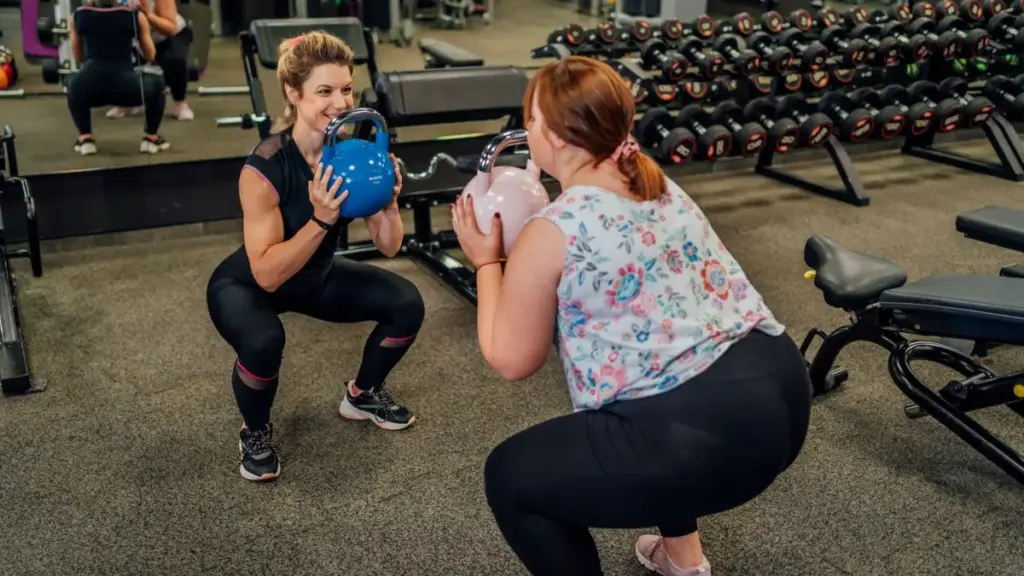
- Execution: Hold the kettlebell vertically by the horns close to your chest. Keeping your chest proud and core braced, push your hips back and down into a deep squat, ensuring your knees track over your toes. Drive back up to the starting position by pushing through your mid-foot and heels.
- Why it matters: Squats target the body’s largest lower-body muscle groups—the quadriceps, glutes, and hamstrings. Maintaining these muscles is vital for metabolic health and ensures that everyday movements like rising from a chair or climbing stairs remain effortless as your body weight shifts.
2. Romanian Deadlift (RDL)
- Duration: 40 seconds work | 20 seconds rest
- Execution: Hold the kettlebell with both hands in front of your thighs. Keeping a slight bend in your knees and a neutral spine, hinge backward at the hips, sending your glutes toward the wall behind you. Lower the bell until you feel a deep stretch in your hamstrings, then squeeze your glutes to drive your hips forward and return to standing.
- Why it matters: The RDL engages the posterior chain—the glutes, hamstrings, and erector spinae. These massive muscle groups are primary drivers of athletic posture and structural integrity. Strengthening the posterior chain signals the body to preserve lean tissue during rapid weight loss while stabilizing the lower back.
3. Single-Arm Row
- Duration: 40 seconds per side | 20 seconds rest
- Execution: Place one hand and the same-side knee on a stable bench or elevated surface. With your opposite hand, grab the kettlebell hanging toward the floor. Pull your elbow upward and back toward your hip, squeezing your lat and shoulder blade at the top, then lower with control.
- Why it matters: Dieters frequently neglect the upper back, shoulders, and arms. The single-arm row introduces heavy mechanical tension via a pulling pattern, signaling the upper body that its musculature is essential. This preserves upper-body strength and counters the "hollowed-out" look sometimes associated with rapid weight loss.
4. Goblet Reverse Lunge
- Duration: 40 seconds work | 20 seconds rest
- Execution: Hold the kettlebell in the goblet position at your chest. Take a controlled step backward with one foot, dropping your back knee toward the floor while keeping your front shin relatively vertical. Push off your back foot to return to the starting position, alternating legs each repetition.
- Why it matters: Unilateral (single-leg) movements like the reverse lunge challenge balance and core stability while targeting the glutes and quads. They correct muscular imbalances, protect knee joint health, and ensure symmetrical muscle development.
5. Single-Arm Overhead Press
- Duration: 40 seconds per side | 20 seconds rest
- Execution: Hold the lighter kettlebell in the "rack" position at shoulder height, elbow tucked in close to your ribs. Brace your core tightly and press the kettlebell straight overhead until your arm is fully extended. Lower the bell smoothly back to the rack position.
- Why it matters: Pressing overhead requires complete synchronization between the shoulders, triceps, and core stabilizers. It builds upper-body pressing power and scapular stability, reinforcing bone density in the arms and shoulders which is particularly vulnerable during pharmacological weight reduction.
Future Outlook
As GLP-1 medications become an entrenched pillar of modern medicine and weight management, the healthcare narrative is rapidly maturing. The medical community is shifting away from viewing weight loss purely in terms of scale-induced metrics, recognizing that losing weight without preserving lean muscle is a pyrrhic victory.
The future of obesity treatment will no longer rely on pharmacology alone. Instead, it will feature an integrated, multidisciplinary approach where endocrinologists, general practitioners, and physical trainers work in tandem. Patients prescribed Mounjaro, Wegovy, and future generations of metabolic drugs will routinely receive concurrent prescriptions for structured resistance training and nutritional optimization.
As demonstrated by the remarkable turnaround of patients committing to kettlebell circuits and strength protocols, reclaiming one’s health is not merely about subtracting fat—it is about deliberately building strength, resilience, and vitality for the decades to come.