
Executive Overview
Age is far more than just a number when it comes to the biomechanics of physical training, but it is certainly not a harbinger of gym doom. While conventional wisdom once dictated that the half-century mark meant trading free weights for gentle aquatic aerobics and speed-walking in the park, modern fitness science tells a completely different story. Today’s veterans of the iron game are rewriting the rules of human physiology. Look no further than cultural icons well past their fifth and sixth decades—such as a remarkably shredded Lenny Kravitz, Hugh Jackman still deadlifting with the ferocious intensity of Wolverine, and an ageless Jason Statham—proving that the human body retains an extraordinary capacity to adapt, grow, and thrive.

However, sustaining this level of physical prowess requires a paradigm shift. Training in your forties, fifties, and beyond cannot mirror the brute-force, ego-driven approach of your twenties. Connective tissues lose elasticity, joint recovery slows down, and work capacity fluctuates. To maintain eternal power, fitness enthusiasts must adopt a smarter methodology: one rooted in strategic mindset shifts, combating age-related muscle loss, prioritizing micro-movements for joint longevity, and intelligently modifying high-risk exercises. This is your comprehensive guide to defying physiological decline and unlocking peak physical performance for life.
Detailed Chronology & Evolution: From Brute Force to Intelligent Longevity
The journey of a lifelong lifter typically follows a distinct evolutionary arc, moving from chaotic youth to calculated mastery. Understanding this chronology is essential for anyone hoping to avoid the debilitating injuries that sideline aging athletes.

Phase 1: The Invincible Decades (Ages 20 to 30)
In youth, the body operates with a high margin of error. Hormonal profiles are optimized for rapid hypertrophy and recovery, connective tissues are resilient, and structural misalignments or poor lifting forms rarely result in immediate consequences. Workouts during this era are frequently defined by maximal loads, ego-lifting, high-volume "hypertrophy hell," and an "always more is better" philosophy.
Phase 2: The Transition and Friction (Ages 35 to 45)
As men enter their late thirties and forties, the first signs of physiological friction emerge. Sarcopenia—the age-related loss of skeletal muscle mass—begins quietly eroding muscle tissue at a rate of 3 to 8 percent per decade. Simultaneously, systemic recovery slows down. Joint stiffness transitions from a morning annoyance to a persistent training obstacle. Lifters who fail to adapt during this window often find themselves trapped in a frustrating cycle of chronic injuries, nagging tendonitis, and diminishing returns.

Phase 3: The Era of Intelligent Mastery (Age 50 and Beyond)
Those who successfully navigate the transition into their fifties and sixties enter an era defined not by what they cannot do, but by how efficiently they train. As prominent fitness experts and elite trainers note, this stage requires a transition away from heavy barbell lifting that locks limbs into fixed, unnatural paths. Instead, maturity brings an appreciation for precision, movement quality, and longevity-focused programming. The goal shifts from simply moving heavy iron to optimizing stimulus while minimizing joint wear and tear.
Supporting Context & Metrics: Fighting Sarcopenia and Reclaiming Power
To successfully build muscle later in life, one must first understand the biological adversary. Sarcopenia is not merely a cosmetic issue involving shrinking biceps; it is a systemic decline in muscle fiber architecture, heavily impacting Type II (fast-twitch) muscle fibers, which are responsible for explosive power and overall functional independence.

The Science of Sarcopenia
Research spearheaded by veteran muscle physiologists, such as Dr. Brad Schoenfeld, emphasizes that traditional bodybuilding routines designed solely for strength are insufficient to combat the full scope of aging. Lifters must deliberately cultivate power—the ability to apply force rapidly.
While standard strength measures how much weight you can move, power measures how fast you can move that weight. To counteract the degradation of fast-twitch fibers, experts recommend incorporating dedicated power-focused training sessions twice weekly:

- Load Selection: Utilize lighter weights (approximately 50 to 60 percent of your one-rep max).
- Tempo Prescription: Perform 3 sets of 6 repetitions. Take a controlled 2 seconds to lower the weight (eccentric phase), followed by an explosive, maximal-velocity acceleration upward taking no more than 1 second (concentric phase).
Nutritional Architecture: Feeding the Muscle
Training merely provides the destructive stimulus; recovery and nutrition supply the construction materials. Without adequate dietary intervention, the micro-tears induced by resistance training fail to repair, accelerating muscle degradation.
Dr. Schoenfeld emphasizes that daily protein intake must be optimized, recommending a baseline of 35 to 40 grams of high-quality protein per meal distributed evenly throughout the day. For context, this equates to roughly 4 to 6 ounces of lean meat, poultry, fish, or a robust whey protein isolate shake.
Expert Insights & Official Methodologies
Several top-tier strength coaches and fitness authorities have dedicated their careers to defining what fitness looks like post-40 and beyond. Their insights form the bedrock of sustainable, lifelong training.
Bryan Krahn, C.S.C.S. (Author of Muscle After 40)
Krahn advocates for a pragmatic approach to aging in the gym. "You don’t have to change everything you’re doing," Krahn notes. "Just work smart." According to Krahn, the primary limiter for older trainees is declining work capacity and recuperative ability. To combat this, he advises imposing strict caps on training sessions—such as limiting workouts to a hard 45-minute window or capping sessions at precisely 12 working sets.

Bobby Maximus (Trainer and Author of Maximus Body)
Maximus champions the philosophy of working hard and recovering harder. As the human body accumulates training mileage, lifestyle factors outside the gym dictate performance inside it. "I pay attention to little things," Maximus explains. "If I dial in sleep, stress, and nutrition, I can continue to train at a high level." Maximus advocates for a balanced allocation of time: for every 30 minutes spent lifting heavy iron, athletes should invest a full hour into tissue maintenance, foam rolling, and mobility work.
Kirk Charles (NASM Trainer and Longevity Columnist)
Specializing in functional resilience for men over 50, Charles emphasizes the importance of mastering subtle, foundational movements. "Subtle exercises make a world of difference for injury prevention, superior conditioning, and max performance," Charles says. He highlights the necessity of shifting focus toward resistance training as one ages, particularly for those who relied heavily on endurance cardio in their youth.

Future Outlook: The Golden Rules of Lifelong Training
To future-proof your physique, your training framework must evolve across four distinct pillars: mindset, targeted movement modifications, structural support via minor exercises, and the intelligent swapping of high-risk lifts.
Step 1: Psychological and Structural Adjustments
- Embrace Dumbbells Over Barbells: While heavy barbells remain a staple of youthful lifting, they restrict the natural arc of your joints. Switching to dumbbells allows your limbs to move through anatomically favorable paths, reducing sheer stress on aging elbows, wrists, and shoulders.
- Integrate Bodybuilding Isolation Moves: Total-body movements like cleans and heavy squats are fantastic, but isolation exercises—such as bicep curls and tricep pushdowns—place minimal systemic stress on the central nervous system, allowing for rapid recovery and increased training frequency.
- Cap Your Workouts: Never sacrifice tomorrow’s workout for an extra minute of high-intensity conditioning today. Set rigid time or set limits to prevent overtraining.
Step 2: Master the Unsung "Small" Exercises
Injury prevention rarely looks glamorous. Incorporating these three foundational movements will safeguard your joints:

- Elevated Hip Bridge Hold: Lie on your back with your heels resting on a chair, toes pointed upward. Drive your heels down, engage your core, and lift your hips until they align with your knees and shoulders. Hold for 20 to 30 seconds, squeezing the hamstrings. Perform 5 repetitions to bulletproof your posterior chain.
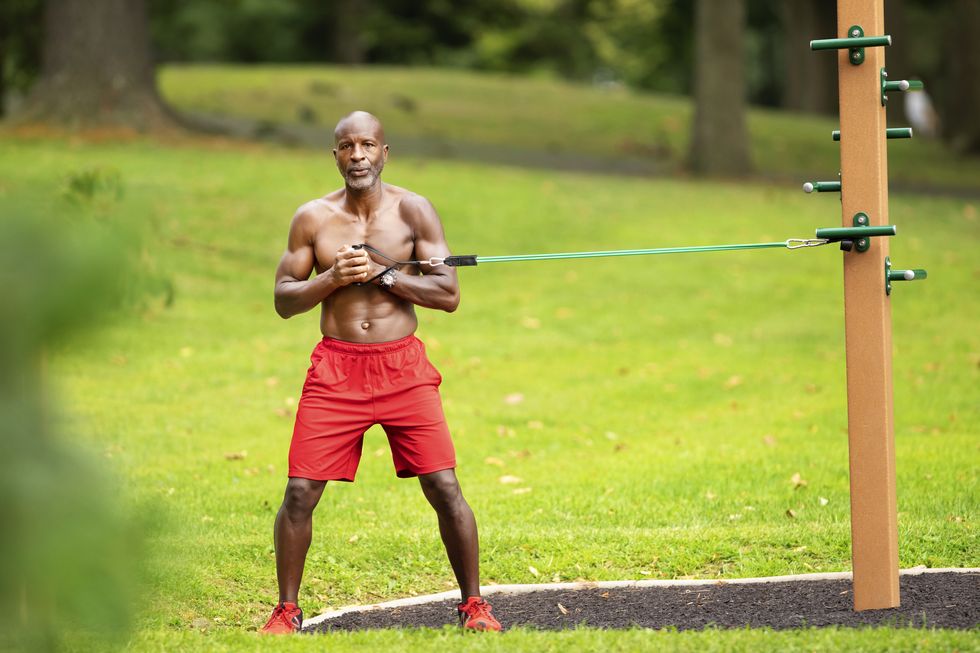
- Pallof Press: Anchor a resistance band at shoulder height. Step away to create tension, hold the band at your chest with a braced core, and press your arms straight out. Hold for 2 seconds before returning to the start. Complete 3 sets of 12 to 15 reps per side to eliminate lower-back vulnerability.
- Resistance Band Pull-Apart: Stand with a light band held in both hands, palms facing each other. Keeping your arms parallel to the floor, pull the band apart while squeezing your shoulder blades. Complete 3 sets of 15 reps to protect your rotator cuffs and midback.
Step 3: Smart Swaps for Classic Lifts
You do not need to abandon compound movements entirely; you simply need to execute smarter variations:
- Instead of Ground Deadlifts: Transition to Romanian Deadlifts (RDLs) to bypass limitations in hip mobility while keeping the focus squarely on the hamstrings and glutes.
- Instead of Bench Presses: Utilize the Floor Press. By stopping the descent when your triceps hit the floor, you protect your shoulder joints from excessive hyperextension while maintaining chest hypertrophy.
- Instead of Wide-Grip Pullups: Opt for Neutral-Grip Pullups with hands positioned just outside shoulder width to preserve shoulder health.
- Instead of Overhead Barbell Presses: Switch to Landmine Presses, which allow your arms to press upward and slightly forward in a natural, pain-free vector aligned with your torso.
Conclusion
The narrative that physical decline is an inevitable, rapid descent into weakness is outdated and scientifically inaccurate. By adjusting your mindset, respecting your body’s changing recovery windows, fueling with adequate protein, prioritizing power over sheer ego, and executing intelligent exercise modifications, you can remain strong, agile, and muscular across the decades. Age may be an immutable fact of time, but how gracefully—and powerfully—you carry it remains entirely within your control.