As the global advertising industry enters the peak of its autumn 2026 event cycle, a familiar echo reverberates through conference centers from New York to Western Europe and beyond. The letters “A” and “I” remain permanently fused on lips, slides, and banner headlines. Yet, the tenor of the conversation has fundamentally shifted.
In the pioneering days of the generative artificial intelligence era, keynote stages hummed with unbridled optimism. Pitches were laser-focused on innovation, speed, and efficiency gains. Today, however, that honeymoon phase has slammed into a wall of reality. Rapid efficiency has given way to mounting structural job losses across the marketing ecosystem, a measurable erosion of creative standards, and a deep, systemic weariness among the professionals tasked with steering major brands through the storm.
Amid these turbulent dynamics, marketers, agency heads, and enterprise leaders are urgently seeking to establish new guardrails. They are forced to confront an uncomfortable truth: as automation scales, quality plummets, and the very soul of brand equity hangs in the balance.
Executive Overview
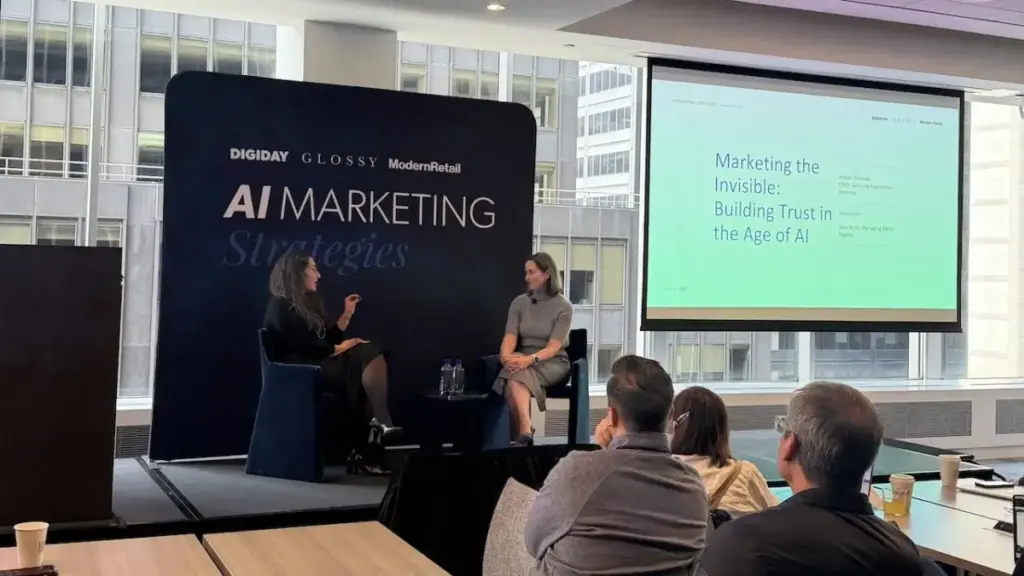
The inaugural AI Marketing Strategies event—co-hosted on September 24 by Digiday, Glossy, and Modern Retail—offered a stark reflection of this maturation crisis. Beneath the polished veneer of conference panels, brand-side leaders, agency executives, and digital strategists gathered behind closed doors to grapple with the collision of cost-cutting algorithms and brand integrity.
Conversations revealed a fractured landscape. On one side, corporate boards and financial stakeholders are pushing for maximum automation to offset shrinking margins and workforce overhead. On the other, creative directors, brand managers, and digital strategists are sounding the alarm over a growing industry acceptance of the "good enough" ethos.
From botched logos on automated creative assets to disjointed consumer experiences in a "zero-click" internet dominated by autonomous agents, the advertising world is learning that speed without oversight is a liability. This comprehensive report explores the discussions, tensions, and strategic pivots shaping adland as it attempts to build a talent base and operational standard fit for the AI era.
Detailed Chronology: Inside the Closed-Door Discussions
The day’s most revealing insights emerged from town hall sessions held under the Chatham House Rule, allowing brand-side marketers to speak with unvarnished candor regarding their operational realities.
The Morning Session: The Digital Supply Chain and Brand Degradation
The morning kicked off with a deep dive into "change management," a recurring theme that quickly pivoted into a frank critique of digital supply chain integrity. As companies grapple with AI-driven layoffs—which have transformed from a cyclical shock into a permanent feature of modern agency life—they are increasingly defaulting to automated workflows.
However, participants warned that hyper-automated content generation often sacrifices nuanced storytelling for brute-force volume. For premium brands, this trade-off is proving catastrophic.
"The quality control is so bad," confessed a senior marketing leader representing a global beauty brand. "Establishing brand standards into AI-driven ad platforms is challenging all of us."
The participant elaborated on their daily workflow, introducing what they described as a modified 10/80/10 formula for managing generative outputs:
- 10% Upfront Effort: Spending initial time meticulously prompting and guiding the algorithm.
- 80% Autonomous Processing: Allowing the system to generate the bulk of the asset.
- 10% Remedial Oversight: Expending crucial human labor at the tail end just to salvage the work and ensure it meets basic brand thresholds.
Rather than saving net hours, many brand managers find themselves acting as glorified quality-assurance editors for runaway algorithms that lack fundamental context, aesthetic judgment, and cultural intelligence.
The Afternoon Session: Agency Friction and the "Good Enough" Culture
As the day progressed, the friction between brands and their agency partners took center stage. Several brand-side marketers voiced growing frustration, noting that external agency partners appear far less motivated to safeguard rigorous brand standards than internal teams.
With many agencies restructuring their own workforces and relying heavily on junior employees to oversee complex AI platforms, the margin for error has widened dramatically. For premium sectors—particularly luxury, fashion, and beauty, where perception is everything—substandard AI-generated assets threaten to permanently alienate discerning consumers.
“It’s like there’s a growing acceptance of ‘good enough — go,’” remarked another brand-side executive. “I’ve seen lots of creative executions from our agencies, and our logo isn’t right.”
The executive confirmed that their company had been forced to institute strict mandates, legally or operationally requiring dedicated human oversight before any automated campaign execution is cleared to run live.
Supporting Context & Metrics: Navigating the "Zero-Click" World
Beyond creative execution, structural shifts in how audiences consume media are forcing a total reinvention of digital strategy.
From Human-First to Agent-First Traffic
During a prominent keynote session, Isabel Perry, Global EVP of Strategy at DEPT, addressed the monumental transition from the traditional "digital-first" era to an ecosystem where bot- and agent-driven internet traffic is rapidly outpacing human consumption.
Perry challenged the industry’s historical obsession with vanity metrics, arguing that marketers are currently drowning in a sea of superficial data.
"We are drowning in measurement… instead of just measuring numbers, we need to measure gaps," Perry stated. "If you’re measuring the gap, you can start actually allocating budgets to the pieces that really matter, instead of just chasing semi-generic industry metrics, which are useful but not actually strategic."
Perry advocated for dynamic budget reallocation based on a clear-eyed assessment of the consumer journey: separating touchpoints that genuinely require human emotional resonance from those that can be efficiently handled by artificial intelligence agents.
The Internet of Two Audiences
Complementing Perry’s insights, Rajiv Ragu, VP of Digital at Thorne, tackled the mechanics of product discovery in what he termed a "zero-click world." As search engines morph into answer engines and consumer queries are intercepted by AI intermediaries, brands are forced to cater to an "internet of two distinct audiences": human consumers and autonomous software agents.
Ragu emphasized that legacy content libraries cannot simply be left to rot in digital archives. Surviving the transition requires continuous, active curation.
“You need to see what content is still being picked up,” Ragu explained to the audience. He acknowledged that maintaining content libraries—updating metadata, refreshing authorship credentials, and validating historical claims—requires dedicated financial investment. However, he warned that neglecting legacy assets opens the door to severe brand damage when AI agents ingest and regurgitate outdated or inaccurate corporate information.
Official Statements and Industry Perspectives
The dichotomy between technological acceleration and human displacement generated intense debate among agency leaders and tech vendors throughout the conference.
Reflecting on the psychological toll of automation, a chief executive of a specialized boutique agency drew historical parallels to the tumultuous digital transitions of the 2000s and early 2010s.
"With AI, you can get to where you need to [in terms of campaign implementation] within weeks… but with AI, you can get there within hours," the agency boss noted. "So, you have to ask yourself what value do your employees have on top of that? People are going to feel very threatened. But we can help them work out how we fit in that world."
This sentiment underscores the core mandate facing leadership across adland: change management cannot be treated as an afterthought or a technical upgrade. It is an existential human challenge. When automation compresses a three-week creative sprint into a three-minute prompt cycle, leadership must redefine what constitutes human value, creative ownership, and job security within agency walls.
Future Outlook: Rebuilding the Foundation of Adland
As the advertising industry looks past the hype cycles of 2026, the path forward is clear, albeit arduous. The initial wave of AI adoption was defined by uncritical enthusiasm and a rush to slash headcount in the name of operational efficiency. The next phase—already underway—will be defined by rigorous accountability, structural remediation, and the rediscovery of human craftsmanship.
To survive and thrive in this new landscape, marketing organizations must address three critical imperatives over the coming years:
- Reinventing Quality Control Frameworks: Brands can no longer delegate the oversight of AI platforms entirely to stretched junior agency staff. Rigorous, multi-tiered human verification processes must be embedded into every automated workflow to protect brand equity and visual integrity.
- Bridging the Talent and Training Gap: As automation absorbs routine execution, agencies must upskill their surviving workforces to focus on high-value strategy, emotional intelligence, and creative direction. Employees cannot feel like collateral damage if companies expect them to champion innovative tools.
- Optimizing for the Dual Audience: Digital strategies must evolve to serve both human consumers and autonomous agentic scrapers. Content libraries, product data feeds, and search strategies must be actively maintained and audited to prevent systemic misinformation and brand degradation.
The echoes of "AI" will continue to ring through conference centers for years to come. But the conversation has grown up. Adland is no longer asking what artificial intelligence can do; it is finally asking what it is costing them—and whether the industry is willing to pay the price.