Executive Overview
In the hyper-connected theater of modern social media, few metrics carry as much sting as being "ratioed"—where a reply dramatically outperforms the original post in engagement, usually to mock or undermine the author. On a brisk winter day, tech billionaire and owner of X (formerly Twitter) Elon Musk experienced a masterclass in this phenomenon. The official social media account for Ubisoft’s flagship franchise, Assassin’s Creed, publicly eviscerated Musk on his own platform, garnering upwards of 400,000 likes overnight and sending shockwaves through the online gaming community.
The public roasting was not an isolated incident of corporate sass; rather, it was the explosive intersection of culture-war politics, high-profile internet feuds, and a lingering controversy regarding Musk’s own integrity as a video game player. By inserting himself into a debate regarding corporate sponsorships and leftist streamers, Musk inadvertently cracked the door open to callbacks regarding his widely publicized Path of Exile 2 "account boosting" scandal.
This deep dive examines the anatomy of the viral interaction, tracing the timeline from initial grievances over promotional partnerships to a full-blown internet spectacle. We will analyze the historical context of Musk’s gaming controversies, the mechanics of the digital feud involving political commentator Hasan Piker and video game critic "Grummz," and the broader implications of a multibillionaire social media titan getting routinely "cooked" by corporate brands on the very infrastructure he acquired for $44 billion.
Detailed Chronology of Events
The Catalyst: The Grummz and Hasan Piker Controversy
The digital dust-up began when notorious video game critic and internet commentator "Grummz" took aim at Ubisoft. Grummz criticized the game development giant for sponsoring prominent leftist Twitch streamer Hasan Piker (known online as HasanAbi) to play and promote their upcoming, highly anticipated title, Assassin’s Creed: Shadows.
Grummz’s critique struck a chord within certain anti-establishment and conservative gaming circles, which frequently scrutinize AAA game studios for aligning with progressive internet personalities. As discussions swirled around the ethics and marketing strategies of modern game publishers, Elon Musk—known for his frequent, unfiltered commentary on internet culture and political discourse—decided to weigh in.
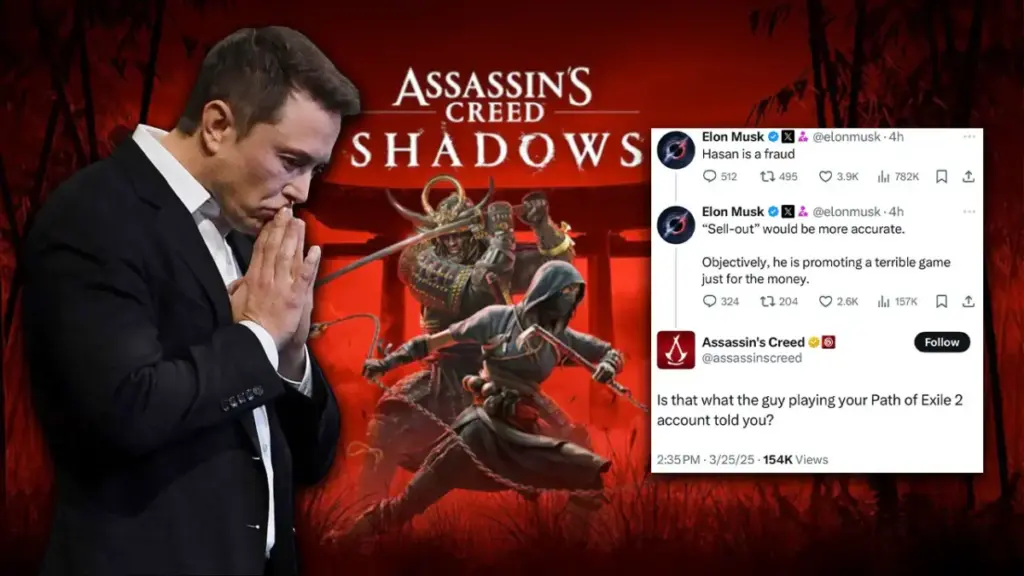
Quoting or responding within the thread, Musk levied heavy accusations against Piker. He branded the streamer a "fraud" and a "sell out," claiming that Piker was promoting a "terrible game just for the money."
The Influx of Piker and the Elden Ring Challenge
The feud quickly escalated from a corporate marketing critique into a direct internet brawl. Hasan Piker, unfazed by Musk’s accusations, exchanged barbs with the tech mogul through a series of screenshots and direct replies, mediated in part by Grummz’s ongoing commentary.
The back-and-forth grew increasingly juvenile yet thoroughly entertaining for onlookers. Piker publicly challenged Musk to a digital "duel" in FromSoftware’s critically acclaimed action-RPG, Elden Ring, putting the billionaire’s purported gaming prowess to the test. In response, Musk fired back, calling Piker "chickens—" for allegedly blocking him on X. As the two high-profile figures bickered over game lobbies and block buttons, the internet pulled up lawn chairs to watch the spectacle unfold.
The Assassin’s Creed Drop: The Ultimate Ratio
While the verbal sparring between Musk and Piker captured significant attention, it was the official @AssassinsCreed X account that ultimately delivered the fatal blow.
Recognizing an opportunity to defend their marketing strategy and mock a notoriously thin-skinned platform owner, the social media manager behind the Assassin’s Creed account crafted a surgically precise response. Referencing Musk’s recent, highly embarrassing gaming scandals, the account replied to Musk:
"Is that what the guy playing your Path of Exile 2 account told you?"
The response was an instantaneous viral phenomenon. Within hours, the tweet amassed over 400,000 likes, completely overshadowing Musk’s original post and achieving one of the most devastating corporate ratios in the history of social media. The internet erupted in celebratory memes, GIFs, and expressions of sheer disbelief that a major corporate entity had so brazenly humiliated the platform’s owner.
Supporting Context & Metrics: The Path of Exile 2 "Fraud Gamer" Scandal
To fully understand why the Assassin’s Creed jab cut so deeply, one must revisit the events of earlier that year, when Elon Musk’s credibility as a legitimate video game enthusiast was irrevocably shattered in the eyes of hardcore gamers.
Faking It Until You Make It
Musk had been proudly livestreaming his playthrough of Grinding Gear Games’ complex, hardcore action-role-playing game, Path of Exile 2 (PoE 2). Sporting an overpowered, high-rank character, Musk attempted to present himself to his followers as a dedicated, elite-tier gamer who had ground his way to the top through sheer skill and time investment.

However, veterans of Path of Exile 2—a notoriously difficult franchise known for its punishing mechanics and steep learning curve—immediately spotted glaring discrepancies. Watching Musk navigate the game was akin to watching someone handle a high-performance sports car for the very first time. He blundered awkwardly across maps, made basic tactical errors, and displayed a fundamental misunderstanding of the character builds and mechanics he purportedly mastered.
The Smoking Gun: Geolocation and Account Boosting
As the internet is wont to do, a collective digital forensics team descended upon Musk’s streams and publicly available game data. Keen-eyed players discovered something damning: the telemetry and data associated with Musk’s character indicated that he was either physically playing from Asia or utilizing a Virtual Private Network (VPN) to route his connection through Asian servers—an illogical configuration for a billionaire playing from North America unless specific conditions were met.
The gaming community quickly reached a consensus: Musk had purchased an account-boosting service, paying skilled players in Asia to grind out an elite character so he could step in, play on stream, and pretend to be an elite gamer without putting in the necessary work.
Faced with mounting evidence and relentless mockery from the gaming community, Musk eventually copped to the reality of the situation. In a defensive post on X, he effectively admitted to account boosting, writing: "It’s impossible to beat the players in Asia if you don’t, as they do!"
This admission sealed his fate within the gaming community, cementing the narrative that Musk was a "fraud gamer" who relied on superficial displays of wealth and outsourced labor rather than authentic skill. Thus, when Musk called Hasan Piker a fraud, the irony was too palpable for the internet—and Ubisoft’s social media team—to ignore.
Official Statements and Community Reaction
The fallout from the Assassin’s Creed ratio demonstrated a fascinating shift in how corporate entities interact with internet subcultures and platform owners.
The Death of Corporate Professionalism
Historically, official brand accounts maintained a sterile, overly polite veneer, tiptoeing around controversy to avoid alienating potential consumers. In recent years, however, social media managers have embraced a chaotic, conversational, and often ruthless persona—frequently referred to as "brand sass."
Ubisoft’s decision to let their Assassin’s Creed account publicly mock the owner of the platform represented a watershed moment. It signaled that major corporations no longer felt compelled to genuflect before platform oligarchs, even when operating within ecosystems those oligarchs control.
The Public Verdict: "I Was Unfamiliar with Your Game"
The public response to the ratio was overwhelmingly favorable toward the brand, with internet users rallying behind the corporate account in a display of anti-billionaire schadenfreude.
- The Apology Meme: Countless users replied with variations of the popular meme, "I was unfamiliar with your game," ironically applying gaming terminology to the corporate social media team’s tactical execution.
- Direct Sales Impact: Some users noted that the sheer audacity of the roast inspired them to open their wallets. X user
@soundaholismfamously quoted the Assassin’s Creed reply, vowing to purchase Assassin’s Creed: Shadows at full price rather than waiting for a discount, solely as a reward for the team’s stellar roasting capabilities. - The $44 Billion Punchline: The most persistent theme among the commentary revolved around the irony of Musk’s massive financial investment. Users endlessly joked that Musk spent $44 billion to acquire Twitter/X just to routinely get "cooked," ratioed, and humiliated on his own digital turf by video game characters and corporate PR interns.
Future Outlook: The Intersection of Tech Oligarchs and Gaming Culture
As we look toward the future of digital discourse, the clash between Elon Musk and the gaming community offers a revealing lens through which to view modern internet culture.
The Fragility of Digital Persona
For public figures who curate online personas around being "relatable," "tech-savvy," or "hardcore gamers," authenticity is everything. Unlike political debates where spin can obscure facts, video games operate on objective metrics, mechanical competence, and transparent data. When a high-profile figure attempts to fake expertise in a community as fiercely protective and analytical as hardcore gamers, the exposure is swift and brutal.
Musk’s ongoing friction with gaming culture suggests that these culture-war battlegrounds will remain volatile. Whether it is criticizing streamer sponsorships, inserting opinions into studio development cycles, or attempting to flex high-level gameplay, tech billionaires are learning that the internet’s memory is long, and its tools for humiliation are exceptionally sharp.
What’s Next for Assassin’s Creed: Shadows and Ubisoft?
From a marketing perspective, Ubisoft’s unorthodox social media engagement succeeded wildly. While Assassin’s Creed: Shadows has faced various scrutiny and culture-war debates prior to its release, the viral moment shifted the narrative temporarily away from manufactured outrage and toward pure internet entertainment. By leaning into the chaos and engaging in platform banter, Ubisoft successfully captured millions of impressions that traditional advertising dollars could never reliably buy.
Ultimately, the day Elon Musk got ratioed by a hooded assassin will go down in digital folklore. It serves as a permanent reminder that no matter how many billions of dollars you spend to own the platform, you cannot buy immunity from a well-timed, highly accurate burn grounded in the collective memory of the internet.