In the modern fitness landscape, where time is often at a premium and home-gym footprints are increasingly minimal, the quest for a truly efficient workout can feel elusive. Enter the single kettlebell: a deceptively simple, highly versatile piece of cast-iron equipment that bridges the gap between resistance training and cardiovascular conditioning.
Designed by Lacee Lazoff, a prominent trainer at New York City’s acclaimed Fhitting Room, a newly developed 20-minute interval routine demonstrates that you do not need an arsenal of heavy machinery or a fully equipped commercial gym to spark profound physical changes. By leveraging functional movement patterns—the fundamental pushes, pulls, hinges, and rotations that mirror everyday life—this routine targets every major muscle group, elevates the heart rate, and supports long-term skeletal health, including bone density.
Unlike traditional dumbbells, whose weight is evenly distributed around the grip, the kettlebell features an offset center of gravity. This unique structural design—a weighted ball attached to a handle—creates an inherent instability. When pressed overhead, racked at the chest, or swung dynamically, the bell constantly attempts to pull the body off-balance. This forces deep core stabilization, enhances grip strength, and engages smaller, hard-to-reach stabilizing muscles.
Structured around time-based intervals rather than traditional repetition counts, this workout prioritizes movement quality over sheer volume. Integrated bodyweight recovery movements are strategically woven into the sequence to give the forearms, grip, and central nervous system brief reprieves, allowing for sustained exertion across four distinct circuits. Whether you are an experienced lifter looking for a streamlined conditioning tool or a beginner aiming to simplify your home fitness routine, this comprehensive guide breaks down the science, the structure, and the execution of Lazoff’s transformative 20-minute kettlebell workout.
Detailed Chronology: Anatomy of a 20-Minute Kettlebell Session
To maximize the physiological adaptations of a short-duration, high-intensity workout, precise sequencing is essential. Lazoff’s 20-minute protocol is meticulously divided into a targeted mobility warmup, followed by four distinct kettlebell-focused circuits. Each circuit is designed to transition smoothly from weighted exertion to unweighted recovery, ensuring a balance of upper- and lower-body engagement.
Phase 1: The Mobility Warmup (0–5 Minutes)
Before lifting a single ounce of external weight, preparing the nervous system, lubricating the joints, and elevating the core internal temperature are paramount. The warmup utilizes four bodyweight movements designed to open the hips, mobilize the thoracic spine, and awaken dormant stabilizer muscles:
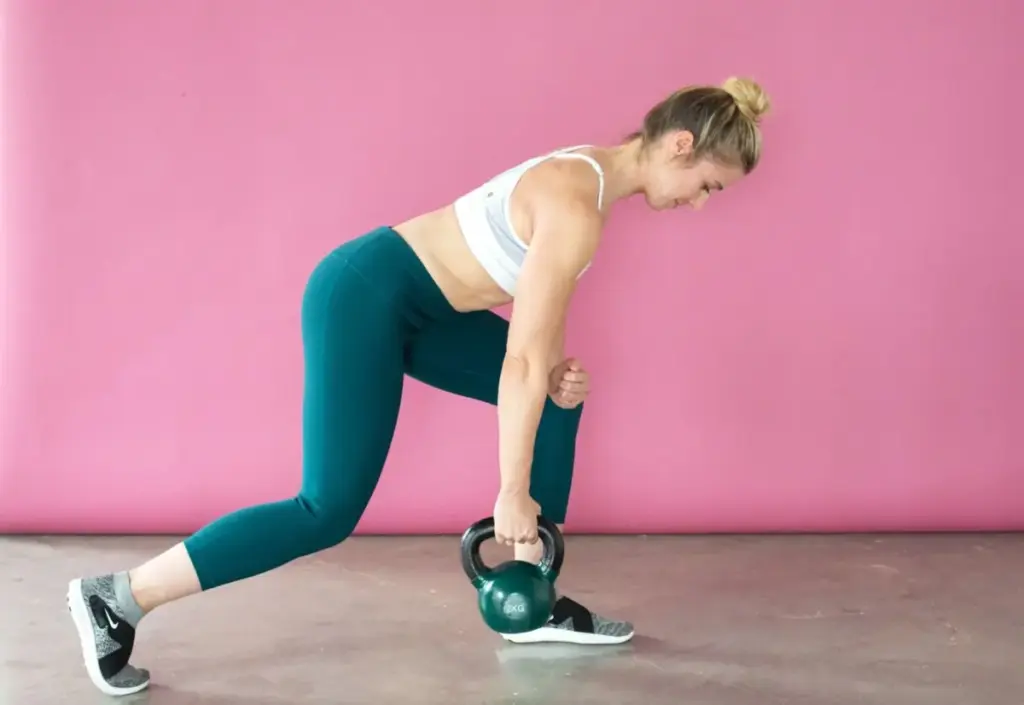
The World’s Greatest Stretch: A comprehensive, multi-planar movement that simultaneously stretches the hip flexors, hamstrings, and thoracic spine. Stepping into a deep lunge and rotating the torso toward the front knee opens up areas frequently locked tight by prolonged sitting.
Alternating Lateral Lunge: Targets the frontal plane, working the adductors (inner thighs), glutes, and quadriceps while dynamically stretching the groin.
Cat-Cow: Promotes spinal articulation, relieving tension in the lumbar and thoracic regions while encouraging diaphragmatic breathing.
Hip Switches: Enhances internal and external hip rotation, priming the pelvis for the rotational and lateral demands of functional exercise.
Phase 2: The Working Circuits (5–18 Minutes)
The heart of the routine consists of four circuits. Each circuit pairs a compound, demanding kettlebell exercise with strategic intervals designed to keep the heart rate elevated while managing local muscular fatigue.
Circuit 1 (Foundation & Core Engagement): Focuses on establishing a solid baseline, utilizing heavy foundational holds and hinges to engage the posterior chain and core stabilizers.
Circuit 3 & 2 (Dynamic Flow & Unilateral Strength): Introduces shifting loads, pressing patterns, and asymmetrical loading to challenge unilateral balance and upper-body endurance.
Circuit 4 (Finisher & Conditioning): Combines explosive, full-body movements with active recovery, ensuring maximum caloric expenditure and cardiovascular strain before the session concludes.
Phase 3: Cooldown and Rest (18–20 Minutes)
Transitioning the autonomic nervous system from sympathetic (fight-or-flight) back to parasympathetic (rest-and-digest) dominance. Practitioners are advised to take anywhere from 30 seconds to 2 minutes of complete rest between circuits, depending on their current fitness level and cardiovascular recovery rate.
Supporting Context & Metrics: The Science of Kettlebell Training
The efficacy of a 20-minute kettlebell routine is backed by an increasing body of exercise science and biomechanical research. Understanding why this tool yields such profound results helps practitioners execute movements with greater intentionality and focus.
1. Functional Movement and Everyday Biomechanics
Traditional bodybuilding routines often isolate muscles in single planes of motion (such as the seated bicep curl or leg extension). While effective for local hypertrophy, these exercises rarely translate to the unpredictable physical demands of daily life. Kettlebell training, by contrast, is rooted in functional multi-planar movements. Exercises like hinges, lunges, and rotational presses recruit kinetic chains—interconnected systems of muscles, tendons, and joints that work in unison to produce and absorb force.
2. Bone Density and Mechanical Loading
As individuals age, maintaining bone mineral density becomes a critical public health priority to prevent osteopenia and osteoporosis. Bone is a dynamic, living tissue that remodels in response to mechanical stress. The compressive and tensile forces generated by lifting moderate-to-heavy loads—such as holding a challenging kettlebell at the chest or stabilizing a bell overhead—signal osteoblasts (bone-forming cells) to lay down new mineral matrix, reinforcing skeletal integrity over time.
3. The Offset Center of Gravity
The physical architecture of a kettlebell separates it entirely from dumbbells or barbell plates. Because the bulk of the mass hangs below the handle, the implement creates a constant rotational moment arm. When performing movements where the bell is held "bottoms-up" or racked against the forearm, the body cannot rely on passive skeletal alignment alone. Deep abdominal muscles (including the transverse abdominis and obliques), rotator cuff stabilizers, and forearm flexors must constantly micro-adjust to prevent the weight from tilting. This results in superior neuromuscular coordination compared to traditional free-weight training.
4. Cardiovascular Conditioning Meets Strength
High-intensity interval training (HIIT) performed with resistance implements offers a dual benefit: it stimulates muscle protein synthesis (building and preserving lean mass) while simultaneously challenging the cardiorespiratory system. Because continuous kettlebell movements require high oxygen consumption to fuel large muscle groups under load, practitioners often experience elevated post-exercise oxygen consumption (EPOC)—commonly known as the afterburn effect—where the body continues to expend calories at an elevated rate long after the workout concludes.
Official Expert Insights
To understand the philosophy behind interval-based kettlebell training, we turn to Lacee Lazoff, a senior trainer at the renowned Fhitting Room in New York City. Lazoff’s programming philosophy centers on efficiency, accessibility, and functional longevity.
"Kettlebells are versatile, portable, and taxing on the entire body during most movements and movement patterns," Lazoff explains to SELF. "Just holding a heavy bell at the chest is an effective way to strengthen the core, back, arms, and shoulders."
This quote underscores a fundamental truth of kettlebell training: isometric tension. Even when a kettlebell is not actively being swung or pressed, holding it in a rack position requires relentless muscular engagement across the entire upper torso and core corset.
Furthermore, Lazoff emphasizes the strategic design of interval training over endless repetitions:
"This workout is focused on total-body movements in functional patterns—a.k.a. ways we move in everyday life. I created short intervals with various movements in sequences to keep the body moving, increase heart rate, and balance upper- and lower-body work."
By avoiding rigid rep counts and instead moving continuously for timed intervals, practitioners bypass the temptation to rush through sets with poor form. Instead, the clock dictates the pacing, encouraging individuals to listen to their bodies, maintain pristine biomechanics, and scale their intensity relative to their daily energy levels.
Future Outlook: The Evolution of Minimalist Home Fitness
As the fitness industry continues to evolve, the pendulum has swung away from cumbersome, single-use exercise machines and toward minimalist, highly efficient training modalities. The single-kettlebell protocol represents the vanguard of this movement.
1. The Democratization of Strength Training
Access to high-level fitness has historically been gated by expensive gym memberships, sprawling equipment collections, and specialized coaching. A single, high-quality cast-iron or vinyl-coated kettlebell represents a one-time investment that can last a lifetime. Because a single bell can be used for hundreds of distinct exercises—ranging from ballistic swings and snatches to grinding presses and squats—it serves as a complete, scalable gym floor in the palm of your hand.
2. Longevity and Injury Prevention
In an aging demographic, physical autonomy—the ability to carry groceries, climb stairs, lift children, and rise off the floor without assistance—is the ultimate metric of health. Workouts that prioritize functional patterns, grip strength, core stability, and bone density are uniquely positioned to support healthy aging. As more fitness enthusiasts embrace injury-prevention and structural longevity over aesthetic-only goals, tools like the kettlebell will undoubtedly remain central to modern exercise science.
3. Scalability for All Fitness Levels
One of the most promising aspects of Lazoff’s 20-minute routine is its infinite scalability. For the absolute beginner, starting with a light bell (or even mastering the movement patterns unweighted) builds foundational motor control. For the advanced athlete, scaling up to a heavy, competition-style kettlebell transforms the exact same sequence into a brutal test of maximal strength and anaerobic endurance.
Ultimately, this routine proves that an effective workout is not defined by how many hours you spend in the gym, but by the intentionality, focus, and intelligent design you bring to every minute of movement. Grab your bell, honor your form, and discover how much physical transformation can be packed into just 20 minutes.



.gif)