Executive Overview
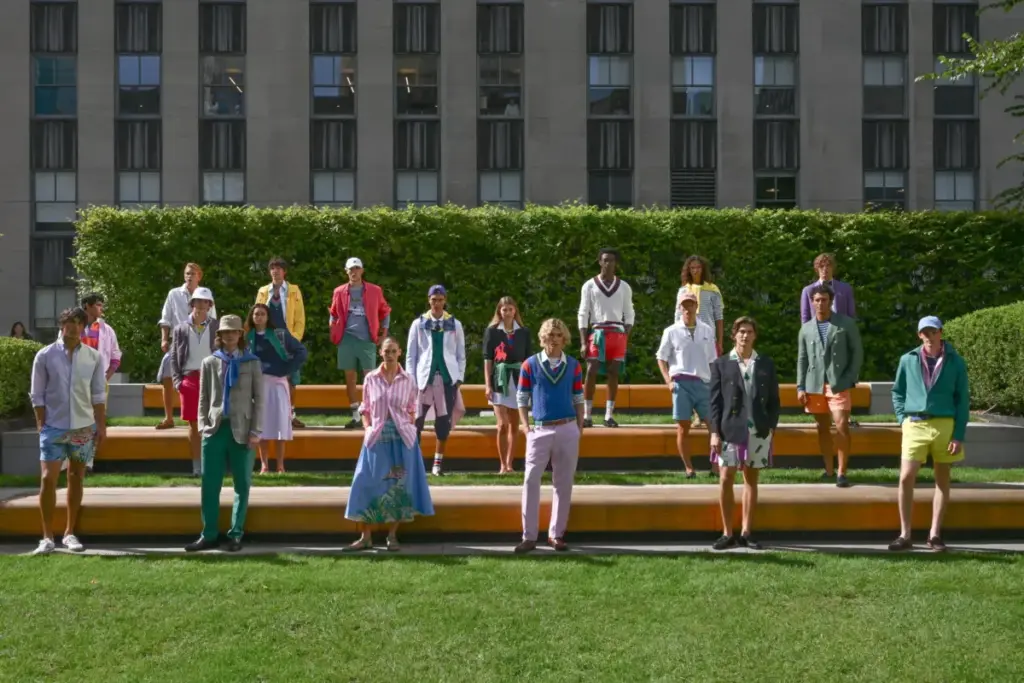
The American menswear landscape is undergoing a profound renaissance, anchored by a radical reinterpretation of classic preppy heritage. In the searing heat atop Manhattan’s Radio City Music Hall last week, models for Brooks Brothers—cooled by emergency ice packs between turns on the runway—marked a critical inflection point for the 200-year-old institution. This was Brooks Brothers’ first New York Fashion Week (NYFW) show in years, signaling far more than a seasonal aesthetic update. It represents the aggressive, high-stakes final lap of a brand turnaround led by Creative Director Michael Bastian and CEO Ken Ohashi.
Since emerging from bankruptcy in 2020 under the stewardship of Authentic Brands Group, Brooks Brothers has quietly orchestrated one of the most compelling retail comebacks of the decade. Once plagued by a catastrophic 70% drop in sales during the initial transition period, the brand is now brushing shoulders with the coveted $1 billion annual revenue mark. Through a calculated blend of top-of-funnel marketing investments, streetwear collaborations, uniform contracts, and strategic department store partnerships, management is purposefully carving a path toward sustainable, billion-dollar status.
Simultaneously, fellow American sportswear titan Tommy Hilfiger is celebrating four decades of global dominance. Marking his own triumphant return to the NYFW schedule at the historic Plaza Hotel, Hilfiger reflected on an empire that has expanded from a domestic menswear label into a global lifestyle powerhouse. Together, these two industry pillars illustrate a broader retail truth: heritage brands can no longer rely solely on archives. To survive the modern consumer landscape, they must actively court Gen Z, integrate sports culture, and balance prestige with smart, high-margin diversification.
Detailed Chronology: From Bankruptcy to the Runway
To understand where Brooks Brothers is today, one must examine the perilous depths from which it climbed. Founded in 1818, the tailors of American presidents and financial titans spent two centuries building an unassailable reputation for Ivy League tailoring. However, shifting workplace dress codes, corporate missteps, and the catastrophic blow of the COVID-19 pandemic forced the company into Chapter 11 bankruptcy in July 2020.
The 2020 Rescue and Early Stabilization
The acquisition by Authentic Brands Group and SPARC Group in late 2020 injected capital and operational clarity into the flagging brand. When CEO Ken Ohashi assumed the helm alongside Creative Director Michael Bastian, the immediate reality was grim: first-week sales were down a staggering 70%.
Ohashi and Bastian bypassed purely nostalgic appeals, implementing a two-pronged strategy focused on financial stabilization and cultural relevance. On the operational front, they diversified revenue streams. Two years ago, Brooks Brothers launched a high-volume corporate uniform business. Today, it proudly outfits more than 66,000 employees for United Airlines—a massive, stable B2B revenue stream that insulates the company from retail volatility.
The Strategic Macy’s Partnership
To balance accessibility with historical prestige, Ohashi engineered a selective wholesale partnership with Macy’s. Rather than oversaturating the market and diluting the brand’s luxury equity, the rollout was executed with surgical precision. Brooks Brothers suiting was introduced into approximately 40 Macy’s doors nationwide. This measured approach allowed the company to capture a broader, more price-conscious consumer base without alienating its traditional, affluent clientele.
The NYFW Milestone
The apex of this multi-year turnaround crystallized on the rooftop of Radio Park. Despite brutal summer heatwaves that forced backstage production teams to scramble with cooling interventions, the runway show delivered the cultural shockwave leadership desired. Marking the brand’s return to the NYFW calendar, the show was consciously designed as an expensive, top-of-funnel marketing investment. According to Bastian, standard lookbooks and traditional catalogs no longer move the needle with younger demographics. The runway provided the theatricality and digital shareability required to pierce through the noise of modern media consumption.
Supporting Context & Metrics: Chasing the Billion-Dollar Threshold
The financial metrics underpinning Brooks Brothers’ current trajectory point toward undeniable momentum. While executive leadership declined to disclose exact, audited revenue ledgers, Bastian confirmed that the enterprise has already brushed against the $1 billion threshold in annual sales. More importantly, the company is on a steady trajectory to hit and sustain that watermark consistently in the near future.
This milestone is backed by six consecutive quarters and years of positive comparable store growth. Crucially, this revenue expansion has occurred without sacrificing the brand’s core demographic. High-net-worth, full-price traditional buyers have remained loyal, proving that brand elevation does not require alienating legacy consumers.
The Under-40 Awareness Gap
Market research conducted by the leadership team revealed a glaring vulnerability: an awareness gap among consumers under the age of 40. While the brand enjoys near-universal recognition among older generations, Gen Z and younger millennials often view Brooks Brothers as historical rather than contemporary.
To bridge this gap, marketing initiatives have shifted toward unexpected cultural adjacencies. Recent campaigns have cast younger, culturally resonant talent, including comedian Alex Edelman and influencer TyLynn Nguyen. Furthermore, capsule collections partnered with boundary-pushing streetwear labels like Needles and New Era have injected street cred into the brand’s heritage framework, signaling to younger shoppers that traditional prep is open for reinterpretation.
Official Statements and Industry Insights
Michael Bastian on Reclaiming the Archive
On the design front, Bastian expressed surprise upon taking over that some of the most iconic silhouettes invented by Brooks Brothers—most notably the Oxford cloth button-down shirt—were paradoxically underrepresented in the core assortment.
"The ball is already rolling," Bastian remarked regarding the brand’s multi-year streak of positive revenue growth. "We just have to get the word out. And the show is a big part of that. It’s an investment, but the reward can be so big. We want to bring the iconic pieces back to the center of the collection while making them feel alive today."
The latest runway presentation synthesized classic prep staples—such as Harrington jackets, cable-knit sweaters, and oxford shirts—with eclectic stylistic flourishes inspired by the sun-drenched coast of Monaco and the earthy tones of the American Southwest.
Ken Ohashi on Retail Expansion
Physical retail remains an indispensable pillar of the brand’s long-term master plan. With a global footprint hovering around 140 stores, Brooks Brothers is aggressively expanding its experiential retail footprint.
"We opened our New York flagship in May of last year, and we’re opening 10 stores over the whole year," Ohashi noted. "We just did Fashion Week, and we’re investing a lot more in top-of-funnel marketing… We’ve seen a lot of healthy growth so far. Six consecutive years of comp growth and no deterioration in the full-price wealthy customer."
Parallel Evolution: Tommy Hilfiger at 40
While Brooks Brothers writes its comeback story, American sportswear pioneer Tommy Hilfiger is celebrating four decades at the apex of global fashion. Ahead of his own blowout NYFW show at Manhattan’s Plaza Hotel—where the designer once lived for over a decade—Hilfiger reflected on the evolution of his eponymous label in an exclusive conversation.
+-------------------------------------------------------------------------+
|                  TOMMY HILFIGER: 40-YEAR EVOLUTION                      |
+--------------------------+----------------------------------------------+
| Foundation               | Domestic menswear, department store focus    |
| Expansion                | Women's, children's, fragrance, footwear     |
| Global Reach             | European market embrace -> Global Lifestyle  |
| Cultural Integration     | F1 (30 yrs), Liverpool FC, NBA (Josh Hart)   |
| Future Horizons          | Home furnishings, hospitality, restaurants   |
+--------------------------+----------------------------------------------+
The Intersection of Fashion and Sport
Hilfiger has long understood the symbiotic relationship between athletics and apparel. Beyond his historic, three-decade partnership with Formula 1 racing, the brand has doubled down on athletic integrations. Recent high-profile collaborations include outfitting Premier League powerhouse Liverpool FC for tunnel walks and global advertising campaigns, alongside partnerships with NBA player Josh Hart and NFL star Travis Kelce.
"Liverpool is fairly new, and we are very excited about that," Hilfiger explained. "The whole team will wear our clothes in the tunnel walks and will appear in our advertisements. Having that connection with the team is really cool. A lot of value there… We think fashion and sport is very important. They go together very well."
Navigating Generational Demographics
When questioned about the modern Tommy Hilfiger consumer, Hilfiger emphasized a multi-generational balancing act. While the brand actively courts Gen Z through contemporary styling and high-visibility runway integrations—such as opening the show with supermodel Gigi Hadid—it fiercely protects its core demographic. Millennial and Baby Boomer consumers, who began purchasing the label 30 or 40 years ago, rely on the brand’s unwavering quality and price consistency.
Furthermore, Hilfiger’s retail strategy has embraced real-time consumer gratification. Rather than traditional lag-time models, the brand leverages a see-now, buy-now framework where frontline celebrities and influencers wear pieces from the active runway collection, making them immediately available to consumers worldwide. Looking ahead, Hilfiger harbors ambitions beyond apparel, eyeing potential expansions into home furnishings, tabletop decor, boutique hotels, and branded restaurants.
Future Outlook: The Road Ahead for Heritage American Sportswear
The parallel trajectories of Brooks Brothers and Tommy Hilfiger offer a masterclass in modern fashion repositioning. For Brooks Brothers, crossing the $1 billion revenue threshold is no longer a distant pipe dream; it is an operational probability backed by consecutive years of disciplined growth, calculated wholesale diversification through Macy’s, stable B2B contracts, and high-impact experiential marketing.
As the retail landscape continues to grapple with the disruptions of digital customer acquisition, artificial intelligence, and shifting consumer demographics, these legacy brands prove that physical retail and bold cultural investments remain vital. By honoring their historical archives while fearlessly courting younger audiences through streetwear collaborations, athletic partnerships, and theatrical runway productions, American heritage brands are not just surviving—they are dictating the future of global style.