Executive Overview
For elite athletes, transitioning from the singular, intensely isolated pressure of competitive sports to the high-visibility, collaborative environment of mainstream entertainment is rarely straightforward. Yet, few transitions have captured the public imagination quite like that of Olympic gold medalist Amber Glenn. Juggling a grueling daily routine that bridges the ice rink and the television studio, Glenn has quickly emerged as a formidable contender on the latest season of ABC’s Dancing with the Stars.
Paired with professional dancer Pasha Pashkov, Glenn’s journey on the reality dance competition is far more than a secondary extracurricular venture; it is a profound extension of her artistic and personal evolution. Bringing the discipline of an elite figure skater into the world of Latin and ballroom dance, she has proven to be an immediate standout. However, her impact transcends the leaderboard. By openly addressing her neurodivergence, her mental health journey, her identity as an openly queer athlete, and the non-linear trajectory of her career, Glenn is using the DWTS platform to redefine what it means to find success outside of conventional timelines. This comprehensive review examines Glenn’s transition to the ballroom, the therapeutic and physical challenges of the competition, the deep bonds forming behind the scenes, and the powerful thematic storytelling driving her performances week after week.
Detailed Chronology
The Whirlwind Routine: Balancing the Rink and the Soundstage
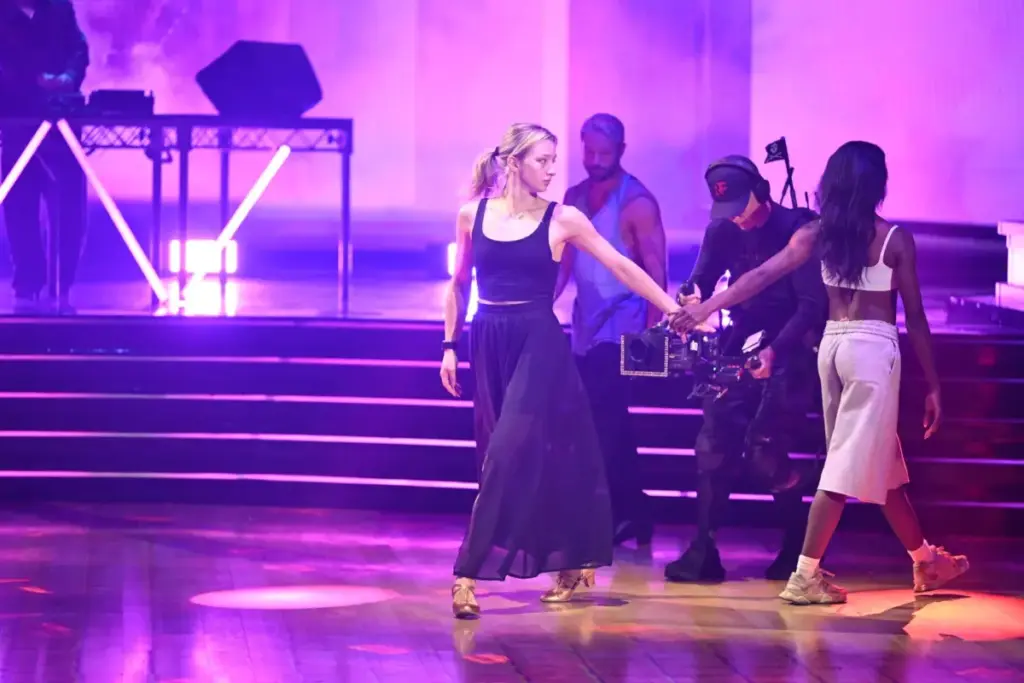
A typical day in the life of Amber Glenn during her tenure on Dancing with the Stars is a masterclass in time management and physical endurance. Speaking to reporters while driving between training facilities, Glenn maps out an itinerary that would exhaust even the most seasoned performers. Her morning begins on the ice, maintaining the rigorous physical conditioning required of an Olympic figure skater. From the rink, she transitions directly to the DWTS set for wardrobe and costume fittings ahead of her live Tuesday night performances, followed immediately by a mandatory three-hour rehearsal block alongside Pashkov.
Despite the punishing schedule, Glenn’s enthusiasm is palpable. While swapping ice skates for Latin heels might seem like a natural progression for a competitive skater, Glenn insists the learning curve is surprisingly steep. Although certain foundational elements—such as spatial awareness, musicality, and the ability to rapidly memorize complex choreography—are deeply familiar, the mechanics of ballroom movement require an entirely different physical vocabulary.
.JPG)
"There are certain things that are familiar, like knowing how to learn and apply choreography, which honestly hasn’t always been my strong suit," Glenn shares candidly. Navigating her diagnosis of Attention Deficit Hyperactivity Disorder (ADHD) adds another layer of complexity to the rehearsal process. "It’s also been a bit hard for me with my ADHD; I tend to have trouble focusing as well, as I will somehow do the opposite of what I’m told while truly trying my best and just inverting it."
While elements like extending the lines of the body and maintaining innate musicality feel second nature, mastering specific stylistic nuances has demanded intense concentration. Reflecting on her chaotic first-week cha-cha, she notes the frustration of retraining her body: "It took me a while to get ‘sharp arms.’ And just the way we move our bodies in dance for that style is not what I do on the day-to-day."
Week Two: The "Viral Songs" Tango and Cinematic Storytelling
Glenn’s breakthrough moment arrived during Week Two’s "Viral Songs" theme, where she and Pashkov delivered a mesmerizing tango that landed them in a three-way tie at the top of the judges’ leaderboard. Rather than opting for a standard pop arrangement, Glenn curated a performance that paid direct homage to the emotional complexity of the series Heated Rivalry while weaving in her personal narrative as an openly queer athlete.
The routine served as a physical interpretation of an intense nightclub scene from the acclaimed HBO series, echoing a cinematic piece Glenn had performed earlier in the year. The choreography explored themes of repression, longing, and public visibility.
.JPG)
"It was a way of really showing that moment in the club scene where Shane is trying his best to be what everyone wants him to be, in a straight relationship, and he sees this person he’s been longing for, and they’re both seeing what they can’t have because they’re in a public place," Glenn explains. "Being able to take this work that many people are a fan of, that has this really strong, underlying message behind all of the fanfare, there’s a strong message that I really connected with and I wanted to pay tribute to."
Working closely with Pashkov ensured that the technical demands of the tango—its sharp frames, dramatic pauses, and precise footwork—never overshadowed the narrative core of the piece. Pashkov’s dedication to honoring Glenn’s authentic voice proved instrumental in forging a partnership built on mutual respect and artistic vulnerability.
Week Three: Yacht Rock, Resilience, and Breaking Timelines
As the competition advanced into Week Three, themed around the laid-back sounds of yacht rock, Glenn faced a foxtrot to Toto’s classic anthem "Hold the Line." For Glenn, the song’s lyrical theme resonated deeply with the overarching trajectory of her life and career.
For years, Glenn felt the crushing weight of societal expectations regarding athletic longevity. In a sport where peak performance is frequently associated with early-twenties youth, reaching the absolute pinnacle of success later in life felt to her like arriving late to a predetermined finish line.
.JPG)
"It’s about holding on and how things aren’t always on an exact timeline," Glenn reflects. "For so long I thought, ‘Oh, I’m too late. I didn’t find success by this age, and now I’m never going to.’ And that was so far from the truth. I’ve had so many people come to me and say that me peaking and finding success past this made-up expiration date has been very inspiring or very comforting to them."
Supporting Context & Metrics
Anatomy of an Unlikely Partnership
Entering the competition, Glenn experienced significant apprehension regarding the interpersonal dynamics of ballroom dance. Unlike figure skating, where an athlete maintains ultimate autonomy over their solo routines—even when working within pairs or ice dance, the solitary nature of singles skating dominates—ballroom requires an unprecedented level of physical and emotional intimacy with a partner.
"I was like, ‘Oh, I don’t know how comfortable I’m going to be having someone there, especially like a guy,’" Glenn admits. Trust does not come easily to the Olympic champion, making her rapid rapport with Pashkov all the more notable. "But we got really comfortable really quickly and he earned my trust… That’s not an easy thing to do with me. So the fact that I am able to feel this comfortable dancing with him is a testament to who he is, not just as a partner and a teacher, but as a person."
Behind-the-Scenes Camaraderie and Mental Health Advocacy
Beyond the grueling hours on the ballroom floor, the ecosystem of Dancing with the Stars has provided Glenn with an unexpected support system. She describes her core circle—consisting of Pashkov, his wife and fellow pro Daniella Karagach, and Karagach’s celebrity partner, Paralympian Ezra Frech—as a "little family."

Further expanding her network of confidants, Glenn has formed close bonds with professional dancer Mark Ballas and his partner, reality television star Maura Higgins. Describing Ballas and Higgins as "angels" during her maiden voyage in entertainment television, Glenn highlights the depth of their off-camera interactions.
"Mark is an incredible human being. I’ve been talking to him about our own mental health journeys, and he’s been very fascinated about skating," Glenn notes. "Maura is a sweetheart."
True to her roots as an ice athlete, Glenn has also embraced a mentor-like role among the celebrity cast, frequently dispensing practical advice on how to survive the brutal physical toll of dance footwear. "I’ve shared some advice with my fellow contestants about how to handle blisters because, as a figure skater, been there."
Official Statements & Personal Philosophy
Throughout her press engagements, Glenn has been remarkably transparent about the purpose driving her participation in Dancing with the Stars. While public scores and viewer retention percentages dictate the weekly eliminations, Glenn’s primary metrics of success are internal and community-focused.
.JPG)
+--------------------------------------------------------------------------+
|                     AMBER GLENN'S CORE PILLARS ON DWTS                   |
+--------------------------+-----------------------------------------------+
| Athletic Identity        | Translating Olympic discipline to ballroom    |
+--------------------------+-----------------------------------------------+
| Neurodivergence          | Navigating ADHD and spatial choreography      |
+--------------------------+-----------------------------------------------+
| Queer Representation     | Bringing authentic queer storytelling to primetime|
+--------------------------+-----------------------------------------------+
| Mental Health Advocacy   | Deconstructing linear timelines of success   |
+--------------------------+-----------------------------------------------+
"Regardless of how far I go in the competition—and we hope it’s far!" Glenn emphasizes, "I want [viewers] to know that I love what I’m doing. I love performing. I love the platform that Dancing with the Stars gives me to tell my story about my mental health journey, my identity as part of the queer community, as someone who hasn’t had the most linear journey in my life."
This explicit mission statement positions Glenn not merely as a celebrity contestant seeking a temporary career pivot, but as a cultural voice utilizing mainstream media to advocate for acceptance, patience, and self-compassion.
Future Outlook
As Dancing with the Stars progresses deeper into its season, Amber Glenn stands at a fascinating intersection of athletic prestige and entertainment stardom. The unique blend of judges’ technical evaluations and the volatile nature of audience voting means her longevity in the competition remains contingent on sustained viewer support. However, her early high-scoring performances—cemented by her Week Two tango triumph and her disciplined execution of the Week Three foxtrot—demonstrate that she possesses the raw technical capacity and artistic depth to contend for the mirrorball trophy.
Looking beyond the immediate horizon of weekly eliminations, Glenn’s presence on primetime television marks a significant milestone in sports media and entertainment crossover. By openly challenging outdated narratives around athletic age limits, destigmatizing neurodivergence in high-performance environments, and unapologetically centering queer narratives in traditional ballroom genres, Glenn is securing a lasting legacy that extends far beyond the boundaries of the ice rink or the dance floor. Whether she lifts the trophy or simply leaves an indelible mark on the ballroom’s history, Amber Glenn has firmly established that her light burns brightest when she refuses to conform to anyone’s timeline but her own.