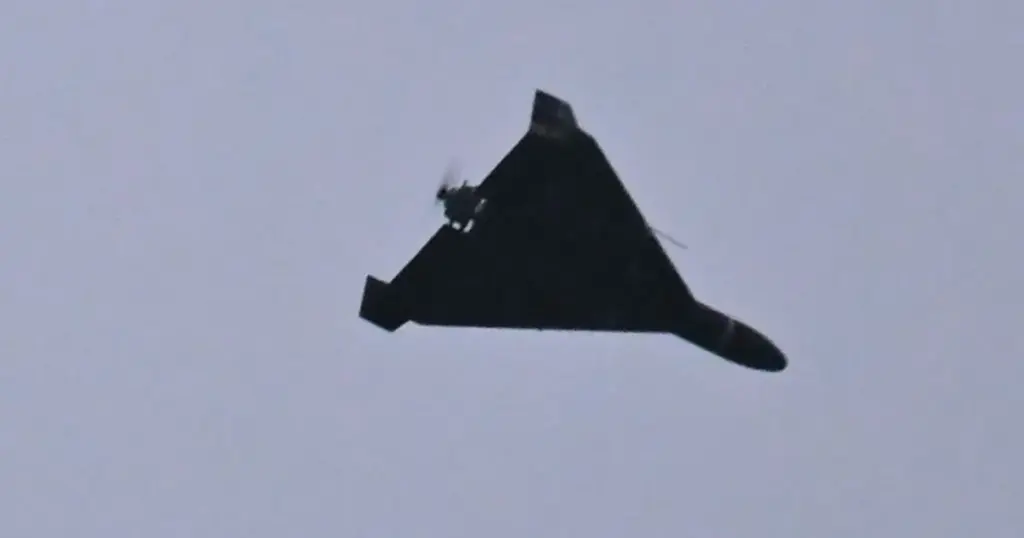
As the devastating conflict in Ukraine grinds relentlessly into its fifth year, the technological arms race defining the war has taken a dangerous leap forward. Russian forces are reportedly upgrading their arsenal of low-cost, long-range loitering munitions—commonly referred to as kamikaze drones—by integrating jet propulsion systems into both iconic platforms like the Iranian-designed Shahed series and newer, mid-range strike unmanned aerial vehicles (UAVs) such as the BM-35.
According to military analysts, defense reports, and warnings issued by top Ukrainian officials, these rapid hardware modifications are engineered to bypass Kyiv’s increasingly sophisticated network of aerial interceptors. With claims that the newly configured, jet-powered BM-35 can achieve velocities exceeding 217 mph (350 km/h) over a combat radius of more than 124 miles, the tactical calculus of air defense over the frontlines and major urban centers is shifting dramatically.
This technological evolution occurs against a backdrop of unrelenting aerial bombardments. In a single overnight barrage documented mid-August 2026, Moscow unleashed a massive wave of 152 drones across Ukrainian territory, resulting in civilian casualties—including a tragic infant fatality in Marhanets—while Ukraine concurrently executed sweeping long-range drone retaliation strikes targeting strategic industrial and energy infrastructure deep inside Russian territory, spanning 19 regions. As President Volodymyr Zelensky continues to lobby Western partners for vital anti-ballistic missile systems like the Patriot, the race between drone speed, interception capabilities, and air defense saturation has reached a critical juncture.
Detailed Chronology of Recent Escalations
The mid-August 2026 surge in unmanned aerial warfare highlights a meticulously orchestrated escalation by both belligerents, transitioning from sporadic engagements to industrial-scale aerial attrition.
The Weekend Barrage and Immediate Aftermath
The latest wave of escalation intensified overnight into Saturday, August 15, 2026. Russian military command launched a coordinated, multi-vector assault utilizing 152 low-cost UAVs. Ukrainian air defense units, operating under severe resource constraints and relying heavily on a mix of mobile fire groups, electronic warfare (EW) jamming, and newly developed interceptor drones, managed to neutralize 124 of the incoming projectiles.
Despite a high interception rate of roughly 81 percent, the sheer volume of incoming ordinance guaranteed catastrophic structural impacts and tragic human loss. In the southeastern Ukrainian town of Marhanets, a direct drone strike struck a multi-story residential apartment block. The blast claimed the life of a three-month-old infant and left 11 other civilians seriously wounded, underscoring the lethal toll exacted by indiscriminate loitering munitions on civilian population centers.
The Shift to Jet Propulsion
Concurrently, intelligence gathered from open-source military reports and validated by Ukrainian defense officials revealed that Moscow’s defense sector is pivoting away from standard internal combustion engines toward turbojet and pulsejet propulsion.
Serhii “Flash” Beskrestnov, a prominent military-technical adviser to President Volodymyr Zelensky specializing in electronic warfare and UAV technology, took to Telegram to sound the alarm. Beskrestnov shared Russian state and defense channel reports detailing the technical specifications of the upgraded BM-35 attack drone.
"The enemy is fitting jet engines not only to Shahed-type drones, but also to budget mid-range strike UAVs," Beskrestnov warned his followers, emphasizing that the primary driver behind this costly retrofit is the necessity to outrun Ukraine’s growing fleet of specialized anti-drone interceptors.
According to data cited by Ukrainian investigative outlet Ukrainska Pravda, the jet-powered iteration of the BM-35 is engineered to cross skies at speeds topping 217 mph, carrying a destructive payload across ranges exceeding 124 miles.
Reciprocal Strikes Deep Inside Russian Territory
While Ukraine absorbed the brunt of the drone blitz, Moscow faced an equally unprecedented aerial assault originating from Ukrainian soil. Russian defense ministries and regional governors reported a massive, synchronized counter-offensive involving hundreds of long-range Ukrainian UAVs targeting critical national infrastructure.
The Russian Ministry of Defense claimed its air defense networks intercepted and destroyed 598 Ukrainian drones overnight. These operations spanned 19 distinct administrative regions within the Russian Federation, as well as airspace over the Black Sea, the Sea of Azov, and the illegally annexed Crimean peninsula. Primary targets included vital industrial manufacturing hubs and energy complexes, notably within the south-western Samara region. Kyiv’s strategy aims to systematically degrade Moscow’s war-funding economic engine while bringing the stark realities of the full-scale invasion directly to the Russian domestic population.
Supporting Context & Technical Metrics
To fully understand the strategic significance of Russia’s pivot toward jet-powered kamikaze drones, one must examine the baseline performance metrics of older models and the mechanics of the ongoing technological duel.
The Evolution of the Shahed and the BM-35
For years, the backbone of Russia’s deep-strike loitering munition campaign has been the Iranian-designed Shahed-136 (locally designated in Russia as the Geran-2). Powered by a noisy, propeller-driven MD-550 piston engine, the standard Shahed is notoriously sluggish, cruising at modest speeds of roughly 115 to 130 mph (185–210 km/h). While cost-effective to manufacture—costing tens of thousands of dollars per unit compared to million-dollar cruise missiles—their low speed made them vulnerable to acoustic tracking and interception by mobile machine-gun teams and slower propeller-driven light aircraft.
The introduction of the jet-powered BM-35 and modified Shahed variants radically alters this vulnerability matrix:
Metric / Feature
Standard Propeller Shahed (Geran-2)
Upgraded Jet-Powered BM-35 / Shahed Variant
Propulsion Type
Piston / Internal Combustion
Micro-Turbojet / Pulsejet
Cruising / Max Speed
~115 – 130 mph (185–210 km/h)
>217 mph (350+ km/h)
Operational Range
600+ miles (1,000+ km)
124+ miles (200+ km) [Mid-range focus]
Tactical Role
Strategic saturation, deep infrastructure strikes
Tactical evasion of air interceptors, precision speed-strikes
Acoustic Signature
Distinctive "moped" buzzing sound
High-pitched turbine screech / roar
By nearly doubling the flight velocity, Russian engineers hope to compress the operational reaction time of Ukrainian air defense crews. At 217+ mph, visual tracking, acoustic triangulation, and manual targeting become exponentially more difficult, forcing Ukraine to rely entirely on automated radar systems, surface-to-air missiles, and high-speed kinetic interceptor drones.
The Economic and Strategic Calculus
The deployment of cheap jet engines introduces a complex economic dilemma for both sides. Turbojet engines are inherently more expensive and mechanically complex than two-stroke piston engines, potentially driving up the unit cost of drones like the BM-35. However, if these jet-powered munitions succeed in penetrating dense air defense umbrellas that would otherwise shoot down slower models, their cost-effectiveness per successful strike remains high from Moscow’s perspective.
Conversely, Ukraine’s strategic response—evidenced by the massive drone saturation attacks across 19 Russian regions—demonstrates an asymmetric capability to target the supply chains, assembly plants, and fuel depots that make Russian UAV and missile production possible.
Official Statements and Diplomatic Fronts
As military lines harden and aerial engagements scale up, political leaders on both sides are framing the technological escalation through distinct strategic narratives.
Kyiv’s Urgent Appeals to the West
The Ukrainian government has consistently emphasized that Russia’s adaptation of its drone arsenal is a direct consequence of delayed or constrained Western military assistance. President Volodymyr Zelensky has intensified diplomatic pressure on Washington and European capitals, demanding the immediate delivery of additional anti-ballistic missile batteries, specifically the U.S.-made Patriot systems.
Military analysts note that while mobile defense groups and interceptor drones are effective against slow-moving piston UAVs, fast-moving jet-propelled munitions and ballistic missiles require high-tier, radar-guided air defense systems to ensure interception before impact.
In public briefings, Ukrainian officials have cautioned that Moscow is actively testing the limits of Western resolve, attempting to exploit temporary gaps in Kyiv’s layered air defense network.
Moscow’s Defense Narrative
On the opposing side, Russian state media and defense channels have hailed the development of high-speed loitering munitions as a triumph of domestic engineering and adaptation. State-backed reports frame the integration of jet engines into platforms like the BM-35 as a necessary counter-measure to modern electronic warfare and interception tactics deployed by NATO-trained Ukrainian units.
By emphasizing the sheer volume of intercepted Ukrainian drones—such as the 598 UAVs claimed downed over Russian territory—Moscow seeks to project an image of impregnable defensive resilience, reassuring its domestic audience that state infrastructure is actively absorbing and neutralizing the threat posed by Kyiv’s long-range campaign.
Future Outlook: The Next Phase of Aerial Warfare
Looking ahead, the conflict in Ukraine is poised to serve as the definitive proving ground for autonomous and semi-autonomous aerial combat systems well into the late 2020s.
Several critical trends are expected to dominate the operational landscape in the coming months:
The Interceptor Drone Race: With conventional air defense missiles remaining scarce and economically unsustainable for targeting low-cost drones, both nations will heavily invest in AI-enabled, high-speed interceptor drones designed specifically to run down and ram or detonate near fast-moving jet UAVs.
Expansion of Autonomous Guidance: As electronic jamming by both Ukrainian and Russian forces becomes increasingly sophisticated—nullifying standard GPS and GLONASS guidance—future iterations of weapons like the BM-35 will likely incorporate advanced optical terminal guidance and terrain-matching AI to operate entirely independent of external signals.
Escalation of Long-Range Retaliation: Ukraine’s willingness to strike deep into Russian regions like Samara signals that the geographical scope of the war will remain uncontained. Energy facilities, logistics hubs, and defense manufacturing plants across Western and Central Russia will remain primary targets for asymmetric drone raids.
Ultimately, the advent of the jet-powered kamikaze drone marks the closure of the "slow-drone" era. As velocities increase and electronic warfare intensifies, the skies over Ukraine will demand even higher levels of technological innovation, turning the airspace into a relentless, high-speed laboratory of modern military attrition.