Executive Overview
A major emergency response has been deployed to the Burscough area of West Lancashire following a severe railway incident involving a passenger train and a motor vehicle. The collision, which occurred on the afternoon of Friday, August 29, 2026, has brought a vital regional transport corridor to a complete standstill, blocking all rail traffic between Wigan Wallgate and Southport.
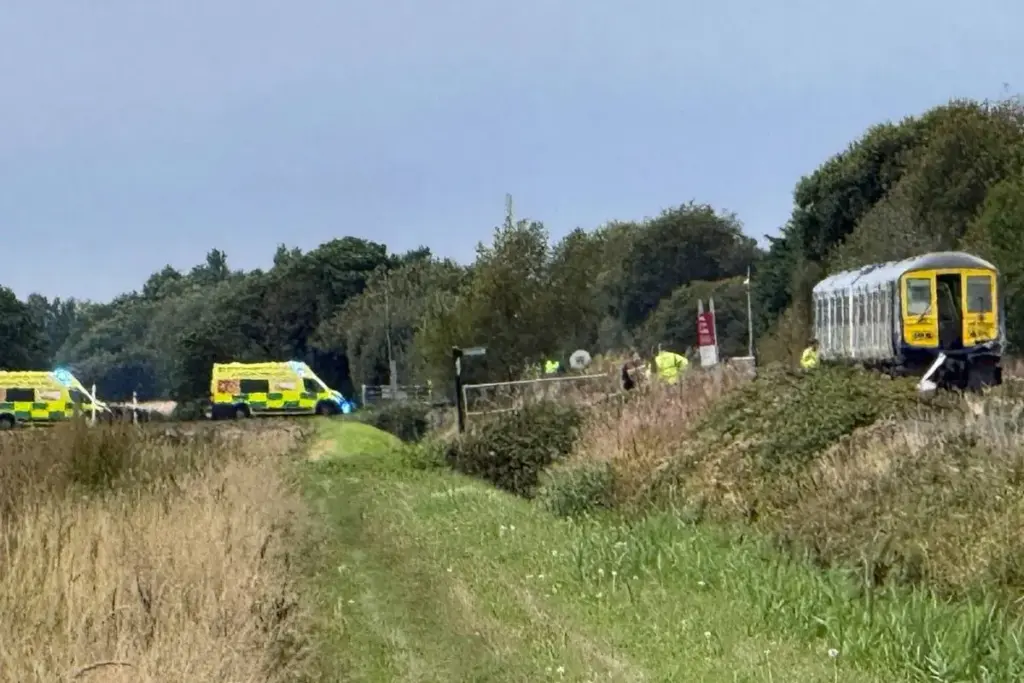
Emergency services, including multiple ambulance crews, fire and rescue appliances, and specialized transport police units, rushed to the scene near Martin Lane, close to its junction with Whitehouse Lane. Initial visual evidence from the site depicts a halted Northern rail service standing starkly against rural green fields, flanked by emergency personnel in high-visibility uniforms. Debris, identified as parts of a heavily damaged motor vehicle, lies scattered in the immediate vicinity of the impacted train.
While the coordinated multi-agency response is fully underway, official confirmation regarding injuries or casualties remains pending as first responders prioritize site safety, passenger evacuation, and medical triage. Rail operator Northern has issued sweeping travel warnings, suspending ticket restrictions across affected routes to mitigate passenger strandedness while investigators work to determine the exact sequence of events that led to the collision.
Detailed Chronology of Events
1. The Immediate Aftermath and First Reports
At approximately 17:45 BST, local authorities and emergency dispatchers received urgent calls reporting a catastrophic collision on the railway line running through Burscough, West Lancashire. Initial reports indicated that a Northern rail service operating on the regional route had struck a vehicle that had somehow made its way onto the tracks.
Eyewitnesses in the vicinity reported hearing a sudden, jarring impact followed by the screeching of emergency brakes as the multi-carriage train ground to an abrupt halt amidst open countryside. Within minutes of the initial distress calls, the scale of the emergency prompted local dispatchers to escalate the event to a "major incident," activating pre-planned multi-agency emergency protocols designed to handle large-scale accidents with potential mass casualties or extensive infrastructural damage.
2. Emergency Services Deployment
The response was swift and substantial. Fire engines from Lancashire Fire and Rescue Service, multiple hazardous area response teams (HART), standard ambulance crews from the North West Ambulance Service (NWAS), and officers from the British Transport Police (BTP) converged on the location near Martin Lane and Whitehouse Lane.
Responders faced the immediate task of securing the perimeter to prevent secondary accidents on the live line—though power to the tracks had been immediately isolated—and gaining access to the stricken carriages. Photographs captured at the scene show emergency workers establishing a command post close to the tracks, while paramedics boarded the stationary train to assess passengers for shock, minor injuries, or worse. Concurrently, technical rescue teams began inspecting the structural integrity of the front carriage and examining the wreckage of the vehicle embedded near or beneath the front wheels of the train.
3. Transport Network Disruption and Operator Response
By 17:49 BST, rail authorities confirmed that the physical obstruction had paralyzed the entire route between Wigan Wallgate and Southport in both directions. Northern, the primary train operating company managing the route, took to social media and digital passenger information networks to broadcast urgent warnings.

In an official statement published via X (formerly Twitter), the operator announced: "Due to the emergency services dealing with an incident Wigan Wallgate – Southport all lines are blocked. Please note that other train operators may also be affected by disruption – please check your whole journey before travelling."
Recognizing the severe impact on commuter and leisure travel during the late afternoon peak, Northern enacted contingency measures. Advance and Peak ticket restrictions were immediately lifted across the affected network, allowing stranded passengers to use alternative routes, buses, or delayed services without financial penalty once lines eventually reopen.
Supporting Context & Metrics
The Geography of the Incident
The collision occurred in a semi-rural stretch of West Lancashire well-known for its network of level crossings, agricultural access points, and busy commuter corridors. Specifically pinpointed near Martin Lane in Burscough—near the intersection with Whitehouse Lane—the location presents unique operational challenges for emergency responders due to its limited road access points across fields and drainage ditches characteristic of the Lancashire mosslands.
Burscough serves as a critical junction point in the regional rail network, connecting passengers from Southport through to Wigan, Manchester, and beyond. Incidents along this stretch invariably cause systemic knock-on effects across the North West’s rail grid, forcing operators to implement complex bus replacement strategies at short notice.
The Route: Wigan Wallgate to Southport
The Wigan Wallgate to Southport line is a heavily relied-upon regional artery managed primarily by Northern. It serves residential communities, commuters traveling toward major employment hubs, and tourists heading to the coast.
- Key Characteristics of the Line:
- Signalling and Infrastructure: A mix of modern and legacy signalling systems, featuring various types of level crossings ranging from automated barriers to user-worked occupation crossings.
- Rolling Stock: Frequently utilizes diesel multiple units (DMUs), which, while robust, are vulnerable to significant structural damage when colliding with heavy road vehicles.
- Passenger Volume: Handles thousands of daily journeys, making any unplanned closure during peak hours a major logistical challenge for transport planners.
Level Crossing and Track Safety in the UK
While a definitive cause for the Burscough incident has not yet been officially established by investigators, vehicle-train collisions on the British rail network typically trigger rigorous reviews under the auspices of the Rail Accident Investigation Branch (RAIB) and the Office of Rail and Road (ORR).
Statistically, level crossings and unauthorized trespass or vehicle incursions remain among the most significant safety hazards managed by Network Rail. Modern safety interventions focus heavily on:
- Upgrading passive crossings to active, barrier-controlled systems.
- Improving signage and visibility for motorists approaching rural rail interfaces.
- Implementing advanced technological deterrents to prevent vehicles from straying onto the permanent way.
Official Statements and Industry Response
Northern Rail
In subsequent updates following the initial emergency declaration, Northern management emphasized that passenger safety and cooperation with emergency services remain their absolute priority. A spokesperson reiterated that all available resources are being coordinated to assist those affected:

"Our thoughts are with everyone involved in this afternoon’s serious incident in Burscough. We are working closely with the emergency services, Network Rail, and industry regulators to understand how this event unfolded. We urge passengers to check their journeys before setting out, as disruption is expected to persist for the remainder of the day. Ticket restrictions remain lifted to ease travel difficulties."
Network Rail and Emergency Services
Network Rail engineers were dispatched alongside British Transport Police forensic teams to inspect the track infrastructure. Initial concerns centered on potential damage to the rails, sleepers, signalling cables, and nearby level crossing mechanisms.
A Network Rail representative noted that once emergency services conclude their on-site forensic examinations and remove the damaged vehicle and train, infrastructure teams will need to conduct rigorous safety checks before certifying the line safe for the resumption of commercial traffic.
Future Outlook and Ongoing Investigations
Immediate Operational Recovery
As daylight fades over West Lancashire, the immediate focus shifts from rescue and triage to structural recovery. Heavy lifting equipment will likely be required to safely separate the damaged vehicle from the Northern train and re-rail or tow the affected carriages back to a maintenance depot for detailed engineering analysis.
Commuters planning to travel along the Wigan Wallgate to Southport corridor are strongly advised to monitor real-time travel updates via National Rail Enquiries or Northern’s official website. Replacement bus services are being organized, though journey times are expected to be significantly extended well into the evening.
Long-Term Investigations
The Rail Accident Investigation Branch (RAIB) is expected to deploy inspectors to Burscough to conduct a thorough, independent probe into the circumstances surrounding the collision. Investigators will examine:
- How and why the vehicle entered the railway envelope: Determining whether the vehicle breached a level crossing, bypassed security gates, or gained access via an adjacent private or agricultural track.
- Train speed and driver actions: Downloading data recorders from the Northern train to analyze braking distances, driver reaction times, and compliance with signals.
- Infrastructure integrity: Reviewing whether any technical faults with crossing barriers, warning lights, or communication systems contributed to the accident.
As this remains a developing news story, further updates regarding casualties, structural damage, and the anticipated timeline for reopening the railway will be provided by local authorities and transport operators as they become available.