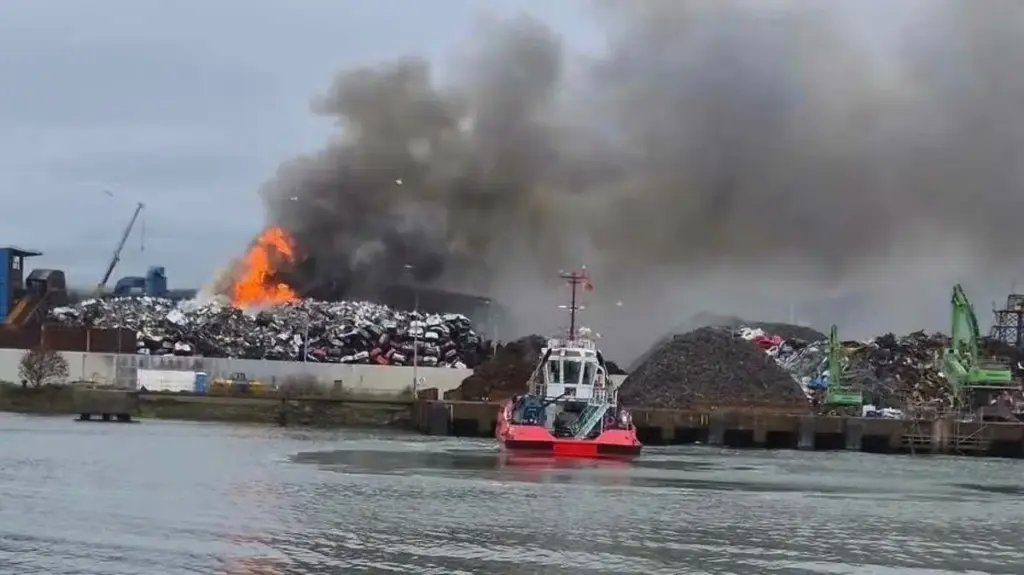
BELFAST — More than 50 firefighters spent a grueling night battling a massive, highly complex blaze at a scrap metal recycling facility in Belfast Harbour. The inferno, which ignited shortly after midday on Wednesday, September 2, 2026, consumed approximately 4,500 tonnes of scrap cars at the Clearway Disposals site on East Twin Road.
Sending towering plumes of thick, toxic black smoke billowing across the Northern Irish capital, the incident triggered an emergency multi-agency response, road closures, and air-quality warnings for residents living across east Belfast. The blaze marks the second major fire at the same facility in less than four months, renewing public scrutiny regarding safety protocols and regulatory oversight at industrial recycling plants situated within critical port zones.
Executive Overview
The emergency began at 12:14 PM BST on Wednesday when the Northern Ireland Fire and Rescue Service (NIFRS) received initial reports of a fire breaking out within the industrial heartland of Belfast Harbour. Within minutes, thick plumes of smoke darkened the skies over the shipyard district, becoming visible for miles and drifting directly over densely populated areas, including inner east Belfast and Victoria Park.
By Thursday morning, NIFRS confirmed that crews were still locked in a persistent battle against a "well-developed fire" involving an immense volume of compacted scrap vehicles. The scale of the material—roughly 4,500 tonnes of metal, residual plastics, fluids, and synthetic components—created severe logistical challenges for emergency responders.
Due to the waterfront location of the Clearway Disposals facility, the operation required unconventional firefighting tactics. Alongside traditional land-based fire appliances, marine assets, including harbour tugboats, were deployed to pump seawater directly from the Belfast Lough to starve the deep-seated fire of oxygen and heat.
While no casualties or serious injuries have been reported, the incident has severely disrupted industrial operations in the port area and amplified environmental and safety concerns among local politicians and residents.
Detailed Chronology of Events
Wednesday, September 2, 2026
- 12:14 PM – Initial Alarm Raised: The NIFRS command center receives the first emergency call regarding a fire breaking out among a quantity of vehicles on East Twin Road within the Belfast Harbour Estate.
- 12:23 PM – Major Incident Declared: Early responders confirm a major blaze is underway at the Clearway Disposals scrap metal recycling facility. Initial social media reports and eyewitness accounts from local journalists highlight rapidly escalating columns of dense, dark smoke.
- 12:26 PM – NIFRS Deploys Heavy Resources: The Fire and Rescue Service issues an official statement detailing a massive initial response. Appliances from Central, Knock, Cadogan, Westland, and Carrickfergus fire stations are dispatched. They are reinforced by a high-volume pump from Whitla, an aerial appliance from Springfield, and a command support unit from Kilrea.
- 12:30 PM – Political and Public Warnings: Democratic Unionist Party (DUP) leader Gavin Robinson takes to social media to warn residents across inner east Belfast—particularly those near Victoria Park—of the heavy smoke hazard. Belfast Harbour Police, alongside the Police Service of Northern Ireland (PSNI), urge the public to avoid the harbour zone entirely and advise locals to keep windows and doors tightly sealed.
- 1:13 PM – Marine Intervention: As land crews struggle to access the heart of the densely stacked scrap metal piles, emergency response tactics shift to include maritime support. Harbour tugboats and marine vessels are deployed to supply continuous water streams from the lough.
- 1:59 PM – Official Identification: Authorities formally confirm that the blaze is centered precisely at the Clearway Disposals recycling site. Belfast Harbour Police announce a joint containment strategy operating hand-in-hand with NIFRS and site management.
- 3:09 PM – Echoes of Past Incidents: Media reports highlight the troubling historical context of the location: a remarkably similar large-scale fire occurred at the exact same Clearway Disposals site just four months prior, in May 2026.
Thursday, September 3, 2026
- Overnight Operations: More than 50 firefighters rotate through arduous shifts throughout the night, utilizing foam blankets and continuous cooling streams to prevent reignition within the massive metallic mounds.
- 10:00 AM – Continuing Suppression: NIFRS confirms that while the fire’s progression has been successfully halted, crews remain on-site dealing with isolated pockets of heat deep within the 4,500 tonnes of charred vehicles.
- 5:54 PM – Stand-Down Phase: Authorities begin scaling back the emergency footprint, though monitoring equipment and cooling operations remain active to secure the perimeter completely.
Supporting Context & Metrics
To fully understand the magnitude of Wednesday’s incident, one must examine the critical economic, logistical, and environmental footprint of the location itself.
The Strategic Importance of Belfast Harbour
Belfast Harbour is not merely an industrial zone; it is the commercial gateway of Northern Ireland. According to official port metrics:
- The harbor handles more than 70% of all seaborne imports and exports for Northern Ireland.
- It accounts for approximately 25% of the total sea trade across the entire island of Ireland.
- Spanning thousands of acres, the estate integrates heavy manufacturing, shipping terminals, logistics hubs, and recycling facilities in close proximity to urban residential neighborhoods like sydenham and inner east Belfast.
The Scale of the Hazard
Managing 4,500 tonnes of scrap cars presents unique industrial fire risks. Modern automobiles are packed with hazardous materials that complicate firefighting efforts:
- Synthetic Polymers and Plastics: Dashboards, bumpers, and interior linings produce thick, acrid, hydrocarbon-heavy smoke when burned.
- Residual Fluids: Even drained vehicles often retain traces of fuel, engine oil, transmission fluid, brake fluid, and windshield washer solvent, which act as accelerants.
- Lithium-Ion Batteries: With the exponential rise of hybrid and electric vehicles (EVs) entering the waste stream, scrap yards increasingly face the danger of thermal runaway—a chemical reaction that is notoriously difficult to extinguish using conventional water methods.
Official Statements
The emergency response generated significant commentary from civic leaders, emergency services, and port authorities, reflecting the gravity of the situation.
Northern Ireland Fire and Rescue Service (NIFRS) Statement:

"We are currently in attendance at an incident on East Twin Road, Shipyard, Belfast, where a quantity of cars are on fire. The initial call was received at 12.14pm today… We would ask for the public to avoid the area whilst we deal with the fire."
Belfast Harbour Police Official Release:
"We are working closely with Northern Ireland Fire and Rescue Service, and staff of Clearway Disposals, following the outbreak of a fire at its scrap metal recycling facility in the Harbour Estate. We would advise local residents and surrounding businesses to keep windows and doors closed, as a precautionary measure and for people to avoid the area."
DUP Leader Gavin Robinson’s Public Address:
"A scrap metal recycling facility is currently on fire in the Harbour Estate. Belfast Harbour Police are currently assisting NIFRS and PSNI. A large plume of smoke is affecting parts of Inner East Belfast, including Victoria Park… Residents in the surrounding area should keep windows and doors closed as a precaution if affected by smoke. Please avoid the immediate area and allow the emergency services to carry out their work safely."
Future Outlook and Environmental Questions
As the smoke clears over Belfast Lough and structural dampening operations conclude, attention will inevitably shift from emergency response to rigorous investigation and accountability.
1. Environmental Impact Assessments
Environmental agencies, including the Northern Ireland Environment Agency (NIEA), face mounting pressure to evaluate the air and water quality repercussions of the blaze. Runoff water contaminated with automotive fluids and fire-suppressing chemicals must be contained to prevent pollution of Belfast Harbour and the marine ecosystem of the lough. Furthermore, residents subjected to hours of noxious smoke are demanding transparency regarding particulate matter exposure and long-term health risks.
2. Regulatory Scrutiny on Recycling Facilities
Perhaps the most urgent question surrounding the incident is structural repetition. Coming just months after a major fire at the exact same Clearway Disposals yard in May 2026—and building upon historical incidents noted by local politicians like DUP Assembly Member David Brooks regarding safety concerns stretching back years—community leaders are questioning whether current industrial safety regulations for scrap metal storage are robust enough.
Industry experts suggest that stricter mandates regarding the spacing of compacted metal piles, the rapid processing and turnaround times for combustible end-of-life vehicles, and mandatory advanced thermal-monitoring technology may need to be legally enforced across all major UK recycling hubs.
3. Economic and Operational Review
Belfast Harbour Commissioners will likely conduct a comprehensive review of how industrial accidents within tenant facilities impact overall port throughput. While shipping lanes and primary cargo terminals largely avoided direct structural damage, the temporary closure of surrounding access roads caused localized freight delays and logistical bottlenecks.
Ultimately, Wednesday’s fire serves as a stark reminder of the volatile nature of modern waste management and the vital importance of preparedness, coordination, and modernization in industrial safety protocols across Northern Ireland.