Executive Overview
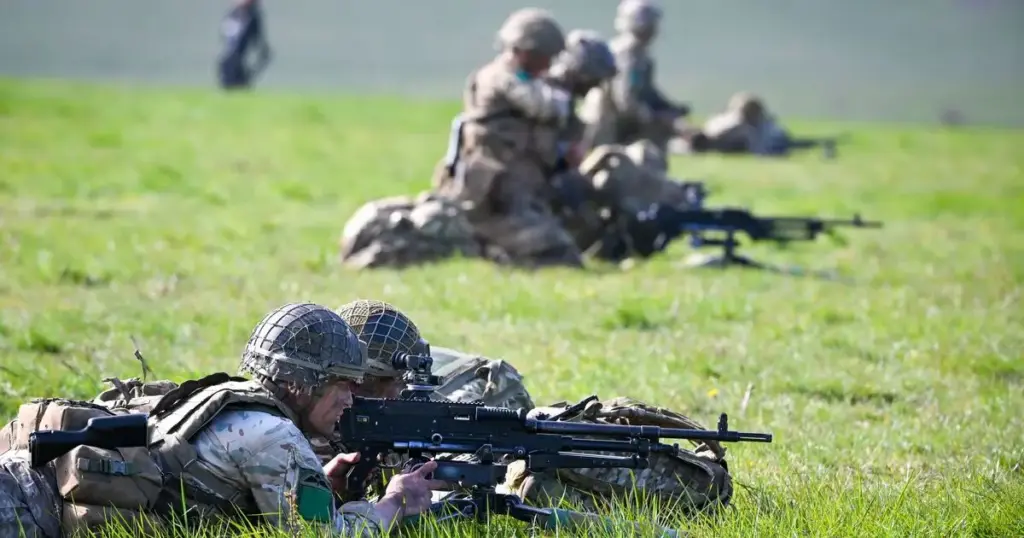
In a decision that has sent shockwaves through the defense establishment, the British Army has been ordered to immediately suspend a raft of major training exercises in an urgent bid to claw back £30 million. Commanding officers across the country have received strict instructions to halt large-scale "collective training" unless units are actively preparing for imminent deployment, standing by on active readiness, or fulfilling a specialized quick-reaction role.
This drastic financial triage—driven by a severe shortfall in in-year running costs rather than capital equipment budgets—has resulted in the abrupt cancellation of high-profile combat drills, including a six-week live-fire exercise for the Royal Tank Regiment scheduled in Wales. Alongside these cancellations, reserve force training budgets have been slashed by 10 percent.
While defense chiefs maintain that the savings are being channeled into a broader, necessary modernization strategy informed by the realities of modern warfare in Ukraine—such as the proliferation of drones and electronic warfare—critics have slammed the move. High-ranking military insiders and defense historians have labeled the freeze "devastating" and an "unprecedented national dereliction of duty" that risks crippling the UK’s military readiness at a time of escalating geopolitical volatility.
Detailed Chronology of the Crisis
The unfolding crisis surrounding the Ministry of Defence’s sudden budgetary shortfall reached a boiling point in early September 2026. The sequence of events leading to the freeze underscores the precarious financial tightrope currently being walked by the British Armed Forces.
- Late August 2026: Informal warnings circulate among senior commanding officers regarding a critical in-year budget deficit within the British Army’s operational running costs. Unlike long-term procurement lines—which ring-fence funding for major capital acquisitions like warships and fighter jets—day-to-day training, fuel, ammunition, and maintenance budgets face immediate shortfalls.
- September 3, 2026: Direct orders are transmitted down the chain of command instructing units to halt all large-scale collective training exercises. The mandate explicitly targets heavy armor formations and attack helicopter drills unless units fall under active deployment orders.
- Days Before Execution: The Royal Tank Regiment is forced to scrap a meticulously planned six-week live-fire combat exercise in Wales just days before troops are set to deploy. Associated training exercises for attached military reservists are similarly struck from the calendar.
- Immediate Aftermath: Senior military insiders voice profound frustration to national media, highlighting that units comprising hundreds of soldiers are suddenly left without primary training objectives. Defense officials scramble to manage operational communications, privately instructing officers to handle the news with extreme discretion to avoid signaling strategic weakness to potential adversaries.
Supporting Context & Metrics: The Anatomy of the Budget Crunch
To understand the gravity of the £30 million training freeze, one must examine the broader financial and strategic ecosystem of the contemporary British military. The cuts do not affect the multi-billion-pound long-term equipment pipeline, but rather the bleeding edge of operational readiness: the fuel burned by Challenger tanks, the live rounds expended by infantry, and the collective hours spent by brigades learning to maneuver as cohesive fighting units.
The Financial Breakdown
- £30 Million: The immediate in-year savings target driving the cancellation of major collective training exercises across the British Army.
- 10 Percent: The specific budget reduction slapped on reserve force training pipelines as part of the wider cost-containment measures.
- £2 Billion: The figure cited by Army leadership as a newly announced 15-year transformation fund designed to overhaul training models—though critics argue this future investment offers little comfort for units experiencing operational blackouts today.
The Strategic Shift: Tanks vs. Drones
The Ministry of Defence has insisted that the cancellations are not merely a knee-jerk reaction to a balance sheet error, but part of a calculated pivot away from legacy warfare. The war in Ukraine has fundamentally rewritten military doctrine. Heavy armor formations and mechanized infantry operating in dense, predictable groupings have proven highly vulnerable to cheap, First-Person View (FPV) drones, loitering munitions, and ubiquitous artillery spotting.
Consequently, defense planners are attempting to accelerate a transition toward agile, highly dispersed, and tech-integrated warfare. This includes a planned operational shift in Estonia, where British Challenger 2 tanks are scheduled to be withdrawn next April. The deployment is set to transition into a 1,200-strong mobile anti-armour force heavily reliant on advanced drone technology and asymmetric tactics.
However, military analysts point out a glaring contradiction: while the theoretical pivot toward drone warfare and tactical mobility is sound, cutting live-fire collective training before new capabilities are fully operational leaves a dangerous capability vacuum.
Official Statements and Divergent Perspectives
The friction between political leadership, defense bureaucrats, and front-line military commanders has exposed deep divisions over the state of the nation’s defenses.
A senior military source painted a bleak picture of life inside the barracks following the directive, telling investigators:

"Armies train, that is what they do. Now nothing is going to happen. Everything is cancelled and commanding officers have 600 blokes with nothing to do."
The psychological and operational impact on personnel has been profound. Justin Maciejewski, director of the National Army Museum and a retired senior officer, unleashed a blistering critique of the decision, condemning it in the strongest possible terms:
"It is unprecedented in the history of the Army since World War II and given the seriousness of the threats we are facing it shows a national dereliction of duty."
In an effort to mitigate strategic vulnerabilities, internal communications leaked from defense headquarters revealed that commanders were explicitly told to manage the situation with extreme care. One military insider noted that officers were ordered to "keep this a very close hold and communicate it very carefully," driven by acute anxiety that adversaries like Russia would perceive the training blackout as a sign of institutional decay or a lack of political will to prepare for large-scale conflict.
Political opposition figures have seized upon the crisis to pressure the government over national security priorities. Conservative leader Kemi Badenoch launched a sharp attack on the Prime Minister, accusing Downing Street of failing to prioritize defense. Badenoch warned that Britain’s adversaries will not pause their own military expansions while Whitehall scrambles to plug budgetary holes in its running costs.
Conversely, Army representatives have defended the decision by framing it as a nuanced, case-by-case reprioritization rather than a blanket paralysis. Basic soldiering skills—such as core driving proficiencies, camouflage and concealment drills, and gunnery simulations—remain active. Officials maintain that the overarching goal is to ruthlessly weed out obsolete training methods and concentrate remaining funds where they directly enhance immediate operational deployability.
Future Outlook: Can the British Army Adapt Fast Enough?
As the British Armed Forces navigate this painful fiscal bottleneck, the path forward remains fraught with peril. The tension between funding legacy heavy-force structures and financing the agile, drone-heavy armies of tomorrow has exposed structural underfunding that goes far beyond a £30 million in-year shortfall.
The coming months will test whether the Ministry of Defence can successfully execute its 15-year transformation strategy without hollowing out the current generation of fighting forces. If elite regiments like the Royal Tank Regiment are routinely forced to sideline live-fire exercises, the institutional muscle memory required to wage high-intensity conventional warfare risks atrophy.
Ultimately, the £30 million saved on Salisbury Plain and the Welsh ranges may come at an exorbitant long-term cost to Britain’s geopolitical deterrence, leaving defense analysts and military leaders waiting anxiously to see if political will—and funding—will rise to meet an increasingly dangerous global landscape.