PUBLISHED: Saturday, August 29, 2026 – 17:54 BST
UPDATED: Saturday, August 29, 2026 – 17:54 BST
LOCATION: Burscough, West Lancashire, United Kingdom
Executive Overview
A catastrophic transport incident unfolded in West Lancashire on Saturday afternoon, triggering a massive, multi-agency emergency response after a passenger train collided with a road vehicle near the village of Burscough. The incident, which occurred late this afternoon, brought a Northern rail service grinding to a halt near Martin Lane, disrupting vital transit links across the North West of England.
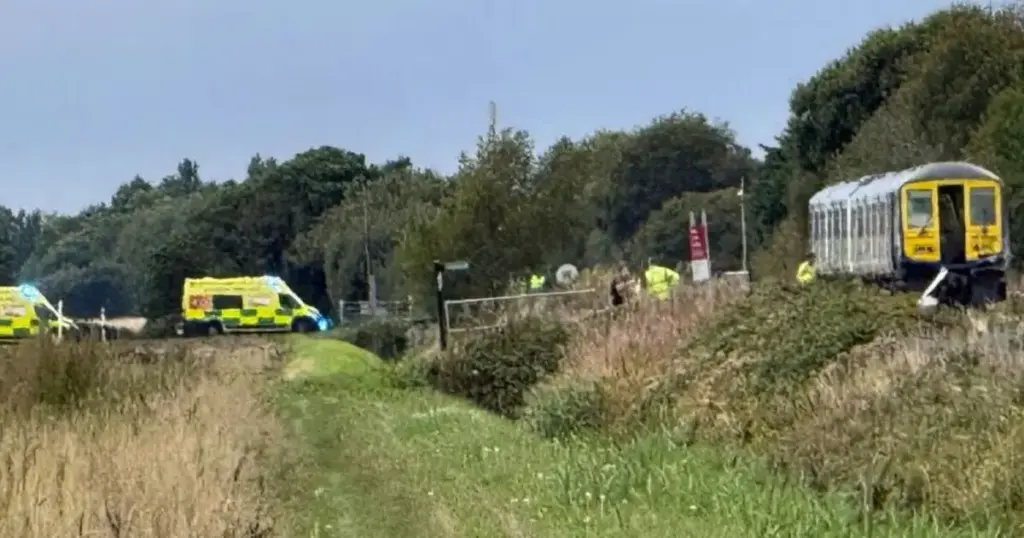
Initial reports from the scene indicate that multiple emergency units—including specialist fire and rescue teams, hazardous area response ambulances, and regional police forces—rushed to the location as the scale of the collision became apparent. Visual documentation from the area reveals a heavy concentration of emergency vehicles surrounding the railway tracks, where a severely damaged vehicle rests perilously close to the impacted Northern train.
While frantic efforts to secure the perimeter and evaluate the structural integrity of both the train and the wreckage are currently underway, rail operator Northern has confirmed that all services running between Wigan Wallgate and Southport have been brought to an immediate standstill. As hundreds of rail passengers wait patiently inside the carriages for coordinated evacuation procedures, transport authorities, safety regulators, and emergency service commanders are working around the clock to ascertain the exact cause of the collision, assess structural damages, and clear the blocked corridor.
Detailed Chronology of Events
1. The Incident Unfolds
At approximately late Saturday afternoon on August 29, 2026, routine rail operations along the Wigan Wallgate to Southport line were abruptly shattered. According to preliminary incident logs, a Northern passenger train operating through West Lancashire collided with a vehicle that had somehow breached or become obstructed on the tracks near Martin Lane in Burscough.
The exact velocity of the train at the time of impact remains under active investigation by rail accident investigators, but the physical evidence visible at the site points to a high-impact collision. Witnesses and passengers onboard reported feeling a sudden, violent jolt as the emergency brakes were applied, followed by the screech of grinding metal as the train ground to an eventual standstill.
2. The Emergency Services Mobilize
Within minutes of the initial collision, automated alarm systems and frantic 999 calls triggered a rapid-response protocol. Lancashire Constabulary, Lancashire Fire and Rescue Service, and the North West Ambulance Service (NWAS) dispatched high-priority units to the rural crossing point near Martin Lane.
By late afternoon, the scene transformed into a sprawling command hub. Images transmitted from the location captured a line of emergency response vehicles, including command vans, engine appliances equipped for heavy extrication, and multiple ambulance crews. Paramedics and firefighters immediately established a sterile triage zone, preparing to manage potential mass-casualty scenarios while ensuring the surrounding infrastructure was safe for human intervention.
3. Passenger Containment and Evacuation Procedures
As darkness and logistical challenges began to close in, the immediate priority for commanders on the ground shifted to passenger safety and reassurance. The Northern train, stalled on the embankment near Burscough, held dozens of commuters and travelers.
Passengers reported being instructed to remain seated inside their carriages while structural engineers and emergency personnel assessed the stability of the railcars and verified that overhead electrical equipment (if applicable) or secondary hazards were neutralized.
Early accounts from individuals trapped inside the train offered a glimmer of reassurance amidst the chaos. One passenger communicated that, despite the shocking nature of the impact, individuals onboard appeared largely uninjured and were maintaining their composure while waiting for organized extraction teams to deploy temporary boarding ramps. Emergency services began methodical, carriage-by-carriage evacuations shortly after securing the zone, guiding passengers away from the wreckage toward nearby assembly points where temporary shelter and medical evaluations were provided.
Supporting Context & Metrics
Rail Network Disruptions
The collision has inflicted immediate and severe paralysis on the regional rail network operated by Northern. The arterial route connecting Wigan Wallgate and Southport—a critical commuter and leisure corridor traversing Lancashire and Greater Manchester—has been severed entirely.

- Blocked Route: Wigan Wallgate to Southport (both directions)
- Impacted Operator: Northern Rail
- Alternative Transport: Rail replacement bus services and ticket acceptance agreements with neighboring operators are currently being organized, though widespread delays and cancellations are expected to persist well into the evening and potentially affect Sunday timetables.
Infrastructure and Crossing Safety
The geography of Burscough and the wider West Lancashire district features numerous rural and semi-urban level crossings, making safety compliance an ongoing focus for Network Rail and the Office of Rail and Road (ORR). While the precise classification of the crossing near Martin Lane has not yet been formally categorized in preliminary briefings, collisions between trains and road vehicles invariably ignite intense scrutiny regarding:
- Visibility parameters for motorists and train drivers.
- The operational status of warning lights, barriers, or telephone-controlled systems.
- The frequency of vehicular misjudgments or unauthorized crossings in rural transit corridors.
According to historical data compiled by safety regulators, level crossing incidents represent one of the most statistically dangerous categories of railway accidents, prompting multi-million-pound modernization programs across the UK network over the past decade. Investigators will undoubtedly pull telemetry data, signaling logs, and dashcam or CCTV footage from the surrounding area to reconstruct the moments leading up to the collision.
Official Statements and Institutional Responses
Northern Rail
In the immediate aftermath of the incident, Northern released an urgent service update via its operational channels and social media platforms to inform the traveling public of the disruption. A spokesperson for the train operator stated:
"Emergency services are currently dealing with an incident between Wigan Wallgate and Southport, following reports that a train has collided with a vehicle near Burscough. All lines between these stations are currently blocked. We are working closely with our emergency service partners on the ground to manage this situation safely. Customers are advised not to travel on this route until further notice, and ticket restrictions have been lifted for alternative pathways where applicable."
Emergency Services Briefing
Lancashire Constabulary and the North West Ambulance Service issued a joint operational statement urging members of the public to avoid the Burscough area to allow unimpeded access for critical response vehicles.
Emergency planners confirmed that a multi-agency control cell was established immediately to coordinate tactical responses, manage traffic diversions along local rural roads, and oversee the complex logistics of passenger evacuation. Officials emphasized that public safety remains paramount, noting that specialized teams are conducting meticulous sweeps of the trackbed and surrounding ditches to ensure no secondary victims or debris are overlooked.
Future Outlook and Ongoing Investigations
As the sun sets over West Lancashire, the immediate operational phase—characterized by rescue, triage, and evacuation—is transitioning into a complex forensic and engineering recovery phase.
1. The Rail Accident Investigation Branch (RAIB)
Given the severity of the collision, the Rail Accident Investigation Branch (RAIB) is expected to deploy inspectors to the Burscough site. The RAIB operates independently to investigate railway accidents and incidents with the objective of improving railway safety, rather than apportioning blame or liability. Investigators will examine:
- The black box (event recorder) data from the Northern train.
- The mechanical condition of the train’s braking systems.
- The positioning and status of the vehicle involved, including how and why it came to be on the tracks.
- Witness testimonies from both the train crew and motorists in the vicinity.
2. Infrastructure Recovery and Track Reopening
Once forensic teams complete their initial documentation of the crime and accident scene, heavy lifting equipment will be required to hoist the damaged vehicle clear of the embankment and remove any compromised rail components. Network Rail engineers will subsequently conduct exhaustive ultrasonic and structural tests on the rails, sleepers, signaling cables, and ballast to ensure the track is structurally sound before permitting passenger services to resume.
Travelers planning to use the Wigan Wallgate to Southport line over the coming days are strongly urged to check live travel trackers, consult Northern’s official website, and allow significantly extended journey times as the network undergoes a painstaking recovery process.
Updates to this developing story will continue to be provided as official briefings are released by Lancashire Constabulary, Northern Rail, and Network Rail.