Executive Overview
Ten years after its initial premiere at FrightFest in August 2016, Yeon Sang-ho’s Train to Busan (Busanhaeng) remains an undisputed touchstone of modern horror cinema. Arriving at a cultural juncture when the zombie subgenre was suffocating under the weight of repetitive tropes, oversaturated television markets, and high-budget misfires, the South Korean thriller breathed vital, terrifying life into the undead.
Far from being a mere creature feature, Train to Busan married the kinetic, adrenaline-fueled terror of fast-moving zombies with a deeply affecting, emotionally devastating human core. Its recent screening at the 2026 Tubi FrightFest—alongside Yeon’s animated prequel Seoul Station, the 2020 sequel Peninsula, and his post-COVID-inspired release Colony—serves as a timely reminder of the film’s enduring impact. A decade on, Train to Busan stands not only as Yeon’s finest cinematic achievement but also as the absolute pinnacle of zombie horror over the past twenty years.
Detailed Chronology: From Stagnant Subgenre to Global Phenomenon
The Crisis of the Undead (Early 2000s – 2016)
To understand the monumental cultural weight of Train to Busan, one must contextualize the state of the horror landscape in the mid-2010s. The early 2000s had witnessed a major renaissance for the subgenre, catalyzed by Danny Boyle’s adrenaline-soaked 28 Days Later (2002), Edgar Wright’s pitch-perfect horror-comedy Shaun of the Dead (2004), and Zack Snyder’s stylish remake of Dawn of the Dead (2004). This momentum was subsequently hijacked and amplified globally by AMC’s The Walking Dead, based on Robert Kirkman’s long-running comic book series.

However, overexposure quickly bred creative fatigue. Studios rushed out high-profile, big-budget entries such as Land of the Dead (2005), 28 Weeks Later (2007), and the Brad Pitt-led blockbuster World War Z (2013). While financially successful, these projects frequently traded intimate dread for CGI spectacles, diluting the genre’s visceral edge. Even The Walking Dead began to hemorrhage its cultural capital; by the time the scenery-chewing, ultra-brutal villain Negan (played by Jeffrey Dean Morgan) entered the narrative, the series had hit a creative inflection point from which it struggled to recover.
The FrightFest Breakthrough and Global Domination
It was against this backdrop of fatigue that Train to Busan burst onto the international scene. Premiering at the UK’s FrightFest in August 2016, the film instantly shattered expectations, securing its legacy as one of the most successful and electrifying screenings in the festival’s history.
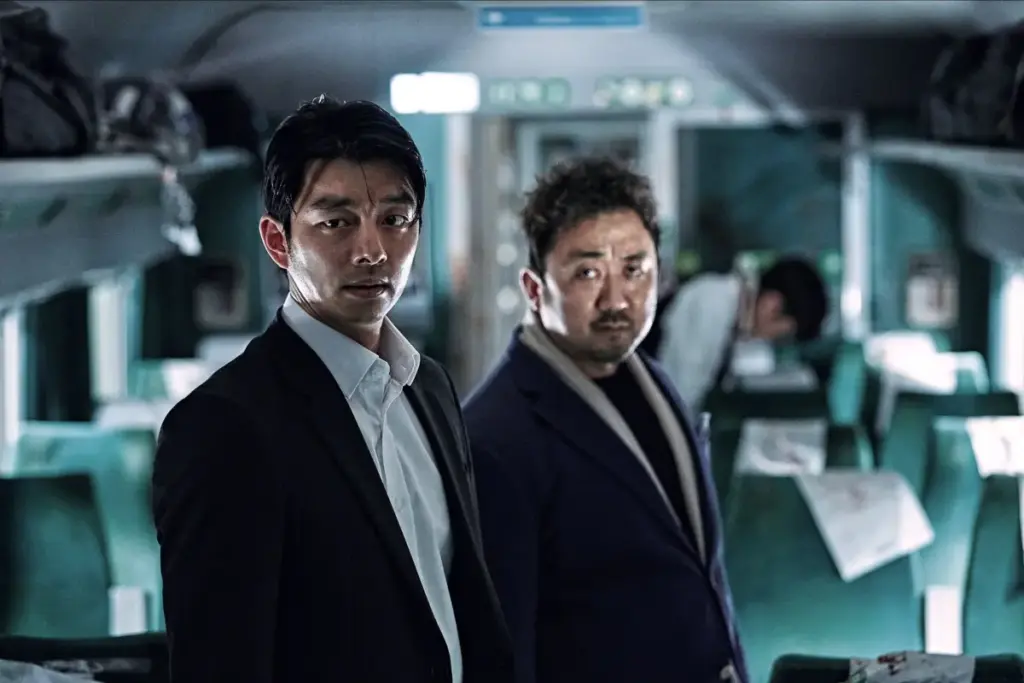
Audiences accustomed to Western zombie tropes were met with a masterclass in spatial tension. Set almost entirely aboard a high-speed KTX train bound from Seoul to Busan as a catastrophic viral outbreak sweeps the nation, the film trapped its characters—and its viewers—in an inescapable, claustrophobic crucible. The film’s runaway success at the global box office shattered records across Asia and transformed its principal cast, including Gong Yoo and Ma Dong-seok, into international stars.

Supporting Context & Metrics: The Anatomy of a Modern Classic
Key Production and Release Metrics
- Director: Yeon Sang-ho
- Writers: Park Joo-suk, Yeon Sang-ho
- Principal Cast: Gong Yoo, Jung Yu-mi, Ma Dong-seok, Kim Su-an, Kim Eui-sung, Sohee
- Runtime: 1 hour and 58 minutes
- Rating: 15 (BBFC) / Not Rated (MPAA)
- Original Theatrical Release Date: October 28, 2016 (UK)
- Anniversary Screening Date: August 28, 2026 (Tubi FrightFest)
The Emotional Engine Beneath the Horror
What truly separates Train to Busan from its cinematic peers is its refusal to treat its characters as mere fodder for the infected hordes. Much of its enduring power stems from its robust, character-driven melodrama—functioning as deftly as a high-stakes Korean soap opera as it does an action thriller.
At the center of the chaos is Seok-woo (Gong Yoo, later recognized globally for his role as the enigmatic recruiter in Netflix’s Squid Game), a detached, workaholic fund manager. Traveling with his neglected young daughter, Soo-an (Kim Su-an), to visit her estranged mother in Busan, Seok-woo embodies the classic Spielbergian archetype of the absent father forced to re-evaluate his moral compass in the face of apocalypse.
As the infection spreads among passengers, the train becomes a micro-society under extreme duress. The narrative brilliantly contrasts acts of profound selflessness with ugliest human impulses. Ma Dong-seok (Eternals, The Roundup) delivers a star-making, physically imposing performance as Sang-hwa, a devoted husband protecting his pregnant wife (Jung Yu-mi). Conversely, the film’s true horror is frequently catalyzed not by the sprinting, contorting zombies, but by human malice—exemplified by Kim Eui-sung’s chillingly self-serving corporate executive, Yon-suk, whose desperate self-preservation proves just as lethal as the virus itself.

Official Statements and Critical Reception
Critics and festival organizers have consistently highlighted Train to Busan as a masterclass in pacing, tension, and emotional manipulation. Upon its 2016 release, Alan Jones, FrightFest co-director, noted the unprecedented visceral reaction from festival-goers:
"Train to Busan proved that the zombie film still possessed uncharted territories. It combined state-of-the-art kinetic horror with a tear-jerking father-daughter dynamic that left audiences completely drained, in the best possible way."
Reflecting on the film’s 10-year legacy during its commemorative screening at the 2026 FrightFest, retrospective reviews echoed the sentiment. Film critics noted that while director Yeon Sang-ho has continued to explore the genre—through his animated prequel Seoul Station, the dystopian live-action sequel Peninsula, and his 2026 high-rise quarantine thriller Colony—none have matched the taut structural perfection of the 2016 original.

While Colony offers an ambitious, post-COVID re-imagining of societal collapse within a quarantined skyscraper, its comparison only serves to underscore the lightning-in-a-bottle perfection of Train to Busan.
Future Outlook: The Enduring Blueprint for the Undead
As the horror genre continues to adapt to post-pandemic anxieties and shifting cinematic landscapes, Train to Busan remains the gold standard for how to reinvent a exhausted subgenre. It proved that special effects and high budgets are secondary to strong characters, high-concept spatial constraints, and genuine emotional stakes.
For audiences revisiting the film a decade later—whether on digital rental platforms like Amazon Prime, Apple Video, and Sky Store, or through special theatrical retrospectives—the journey remains as devastating as ever. The final act stands tall as one of the most emotionally ruinous, heartbreaking sequences in modern cinema.

As Yeon Sang-ho continues to push the boundaries of speculative fiction and horror, Train to Busan secures its place in film history not merely as a thrilling ride, but as a timeless exploration of human empathy in the face of absolute annihilation. For anyone stepping aboard the KTX to Busan anew: pack your tissues; you will need them.