Executive Overview
The modern creator economy is standing at a volatile intersection of corporate commerce and authentic self-expression. For years, digital marketing strategies have relied heavily on the parasocial bonds forged between internet personalities and their devoted followings. Brands have funneled billions of dollars into influencer marketing, viewing digital creators as the ultimate human billboards—capable of slipping seamless endorsements into everyday routines.
However, a profound friction is boiling beneath the surface. Recent insights gathered from a roundtable of college-age creators within the Glossy Campus community expose a critical, widening chasm between the aspirations of beauty marketers and the daily realities of the influencers they hire.
At the heart of this tension lies the "scripted brief." While brands frequently purchase access to a creator’s audience, they routinely undermine the very asset they are paying for: the creator’s authentic voice. Bound by rigid talking points, mandatory product claims, and heavy-handed editorial guidelines, many young influencers find themselves delivering sponsored content that sounds nothing like them. For full-time creators navigating the economic pressures of early adulthood, this dynamic often forces an uncomfortable compromise between financial survival and personal integrity.
This deep dive examines the cost of hyper-prescriptive beauty advertising. It explores how restrictive campaign guidelines alienate audiences, push creators away from lucrative beauty categories toward lifestyle content, and ultimately prompt forward-thinking brands to experiment with radical creative freedom—yielding surprising commercial results.
Detailed Chronology: The Evolution of the Creator-Brand Clash
To understand the current crisis in beauty marketing, it is necessary to trace how the dynamic between brands and digital talent has evolved over the past decade.
Phase One: The Wild West of Early Influencer Marketing
In the nascent stages of the creator economy, brand partnerships were defined by loose agreements and high degrees of autonomy. Brands would send products to creators with simple requests: try it out, and if you like it, share your thoughts. Audiences welcomed these recommendations because they felt organic, resembling word-of-mouth advice from a trusted friend.
Phase Two: Corporate Professionalization and the Rise of the Script
As influencer marketing matured into a multi-billion-dollar industry, corporate marketing teams stepped in. Armed with key performance indicators (KPIs), legal compliance requirements, and rigid brand guidelines, companies sought to professionalize the medium.
Content briefs transformed from casual creative prompts into exhaustive legal documents. Creators were handed exact scripts detailing what phrases to use, how to hold the product, what facial expressions to avoid, and which specific regulatory claims must be spoken verbatim. While this protected brands from legal liability and ensured message consistency, it stripped away the idiosyncratic charm that made creators appealing in the first place.
Phase Three: The Breaking Point and Audience Backlash
Today, audiences have grown sophisticated. Armed with heightened bullshit detectors, Gen Z consumers instantly spot when a creator is reciting corporate copy rather than sharing a genuine review.
This disconnect was starkly illustrated by Emma Ambrose, a 21-year-old full-time content creator and graduate of the College of Charleston. Speaking candidly during the Glossy roundtable, Ambrose recounted the public reaction to one of her early beauty ad spots.
“They were like, ‘Emma, what is this?’” Ambrose recalled, speaking of her friends’ immediate confusion when the ad dropped. Her internal calculus reflected the precarious financial reality of many emerging creators: “And I was like, ‘You know what? Money’s money right now.’”
Ambrose’s story highlights a systemic flaw in modern influencer marketing. A creator agreeing to a brief does not mean they believe in the product, nor does it guarantee that the content will resonate. For Ambrose, the frustration of reading unnatural scripts has actively contributed to her decision to pivot away from beauty partnerships altogether, shifting her focus toward lifestyle content where creative freedom remains intact.
Phase Four: The Economic Compromise
Ambrose is far from alone. Sloane Wetzell, a 22-year-old University of Colorado Boulder graduate, echoed similar sentiments. While saving money for an international move to Australia, Wetzell accepted a scripted skin-care partnership out of financial necessity.
The campaign featured an advertiser offering to put paid media behind a promotional video—a standard practice designed to maximize reach. However, Wetzell felt the resulting video was fundamentally inauthentic and ill-equipped to generate the organic engagement the brand desired. The pressure to monetize forced her to compromise her standards, illustrating how economic vulnerability traps creators in uninspired partnerships.
Conversely, other creators have chosen to walk away entirely. Addison Campbell, a 20-year-old student at the University of North Florida, turned down a lucrative partnership with a beauty brand she genuinely admired. The reason? The mandatory script clashed violently with her personal style and tone.
“My audience is gonna know that I do not want to do this,” Campbell explained.
Her refusal demonstrates a mature understanding of long-term audience retention: a single paycheck is rarely worth the permanent erosion of trust with a community built over years.
Supporting Context & Metrics: The Cost of Control
The friction between creators and beauty brands is not merely a matter of bruised artistic egos; it carries measurable consequences for campaign efficacy and brand equity.
The Power of Spontaneity: The Alix Earle Effect
Industry examples repeatedly prove that letting go of control yields superior performance. Last November, top-tier creator Alix Earle spoke at the Vogue Business Gen Z summit, sharing a defining case study in brand collaboration.
Microsoft approached Earle for a campaign promoting its AI tool, Copilot. Instead of using a polished, highly produced promotional post that Earle had previously submitted and received approval for, Microsoft chose a video she had filmed entirely on a whim. In the impromptu clip, Earle used Copilot to answer a troll’s malicious comment asking whether she looked 40 years old.
The organic, unscripted video exploded, reaching 10 million views and securing its place as Microsoft’s most-viewed TikTok advertisement at the time. The lesson was clear: audiences engage with human reactions, not corporate talking points.
The Refy Experiment: A Masterclass in Letting Go
Recognizing the homogenization of digital ads, some forward-thinking beauty brands have begun dismantling traditional brief structures.
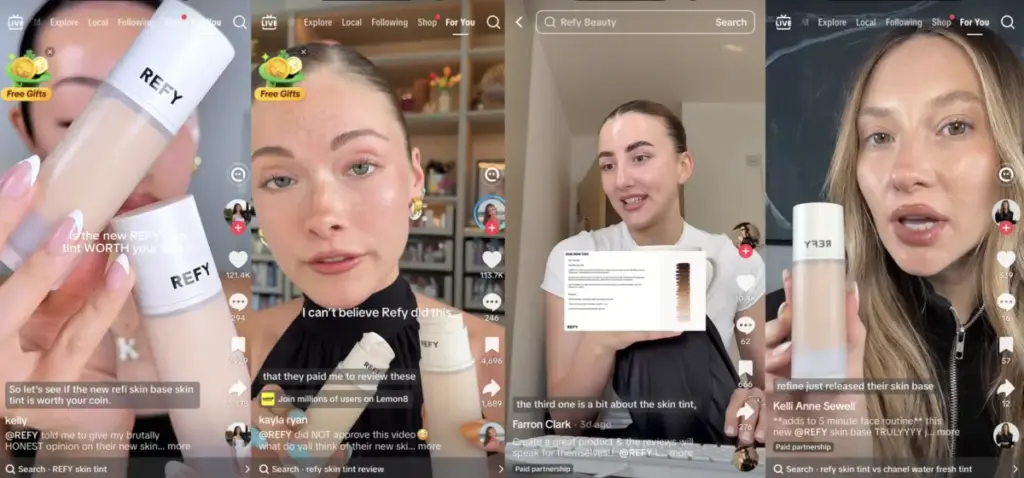
For the launch of its Skin Base Skin Tint earlier this year, indie beauty brand Refy implemented an unprecedented strategy: they paid 12 creators to post content about the new product without requiring any prior approval. Creators were given complete creative license.
Creator Kayla Ryan, who had previously built a reputation for offering unfiltered, sometimes critical reviews of Refy’s older product catalog, expressed profound shock at the brand’s hands-off approach.
Charlotte Geoghegan, Refy’s head of brand, explained the philosophy behind the gamble to Glossy:
“Creator marketing has all become very similar.”
The commercial results were staggering. Early sales for the Skin Base Skin Tint exceeded company forecasts by an astounding 200%. While brand executives acknowledge that this spike cannot be exclusively isolated to the creator brief structure, the launch stands as a powerful commercial validation that brands can thrive by relinquishing final editorial control.
However, the experiment was not entirely without friction. While creators received essential product information, use cases, ingredient breakdowns, and brand claims to ensure safety and accuracy, Geoghegan admitted she wished more participants had explicitly mentioned the unusual, approval-free arrangement in their videos. This minor grievance underscores the core anxiety for marketing departments: letting go of control means accepting creative choices that internal teams would never have made themselves.
The Fragrance Sector Adapts: Snif’s Consumer-First Approach
The beauty and personal care sectors are gradually waking up to consumer fatigue. Fragrance brand Snif adopted a remarkably similar ethos ahead of its Notewrks launch at Ulta Beauty.
Bryan Edwards, co-founder and CEO of Snif, revealed that the brand actively instructed creators not to promote the new fragrances unless they genuinely enjoyed wearing them. Snif’s internal market research revealed a telling consumer trend: young fragrance shoppers are deeply skeptical of influencer recommendations that appear overly scripted, uniformly positive, or financially coerced. By encouraging radical honesty—even if it meant some creators would decline participation—Snif protected its brand authenticity.
Official Statements & Industry Perspectives
The structural divide between beauty marketing and other consumer categories becomes glaringly apparent when creators compare notes across industries.
Chrishawn Williams, a 19-year-old student at the University of South Florida, offered a direct comparison during the roundtable discussions. When contrasting his experiences in the beauty vertical with a partnership he executed for Busch Gardens, the disparity in creative freedom was striking.
Theme park and lifestyle brands invited Williams to experience a fun day out with friends, capturing his genuine enjoyment before seamlessly integrating mandatory talking points into his natural storytelling style.
“I love when a brand can give me full creativity to create my own script,” Williams noted.
While Williams fully acknowledges the commercial necessity of getting specific product language, clinical claims, and regulatory details correct, he found beauty briefs to be disproportionately rigid, corporate, and prescriptive compared to lifestyle, hospitality, and entertainment brands.
This sentiment points to an identity crisis within beauty marketing. Beauty brands pride themselves on championing self-expression, individuality, and empowerment. Yet, behind closed doors, their marketing contracts often demand strict uniformity, reducing diverse creators to interchangeable reading machines.
Future Outlook: Where Does Influencer Marketing Go From Here?
While roundtable discussions and qualitative interviews do not definitively establish that scripted advertisements consistently underperform in direct sales—nor did participants name specific beauty brands behind their worst experiences—they illuminate a profound hidden cost.
Advertisers rarely see the human toll of restrictive contracts in their standard campaign analytics reports. They see conversion rates, click-through rates, and cost-per-acquisition metrics. What they do not see is the quiet erosion of trust between creators and their audiences, nor do they witness talented digital artists quietly crossing the beauty category off their roster of potential partners.
As the creator economy matures, the balance of power is slowly shifting. Creators with established, highly loyal audiences are realizing their leverage. They no longer need to compromise their personal brand integrity to survive financially, especially as alternative verticals—such as lifestyle, gaming, tech, and travel—offer more collaborative, creatively fulfilling partnerships.
For beauty brands looking to survive and thrive in the coming years, the roadmap is clear:
- Ditch the Scripts: Replace mandatory word-for-word scripts with clear, concise creative frameworks and essential product guardrails.
- Trust the Talent: Recognize that creators understand their audiences better than any corporate marketing director ever could. Authenticity cannot be manufactured in a boardroom.
- Embrace Transparency: Follow the lead of innovators like Refy and Snif by encouraging genuine reactions, even if it means risking mixed reviews or relinquishing final approval workflows.
Ultimately, the future of beauty marketing belongs to brands that treat creators as true creative partners rather than disposable advertising channels. Those that fail to adapt will find themselves speaking to empty rooms—or worse, talking only to themselves.