Executive Overview
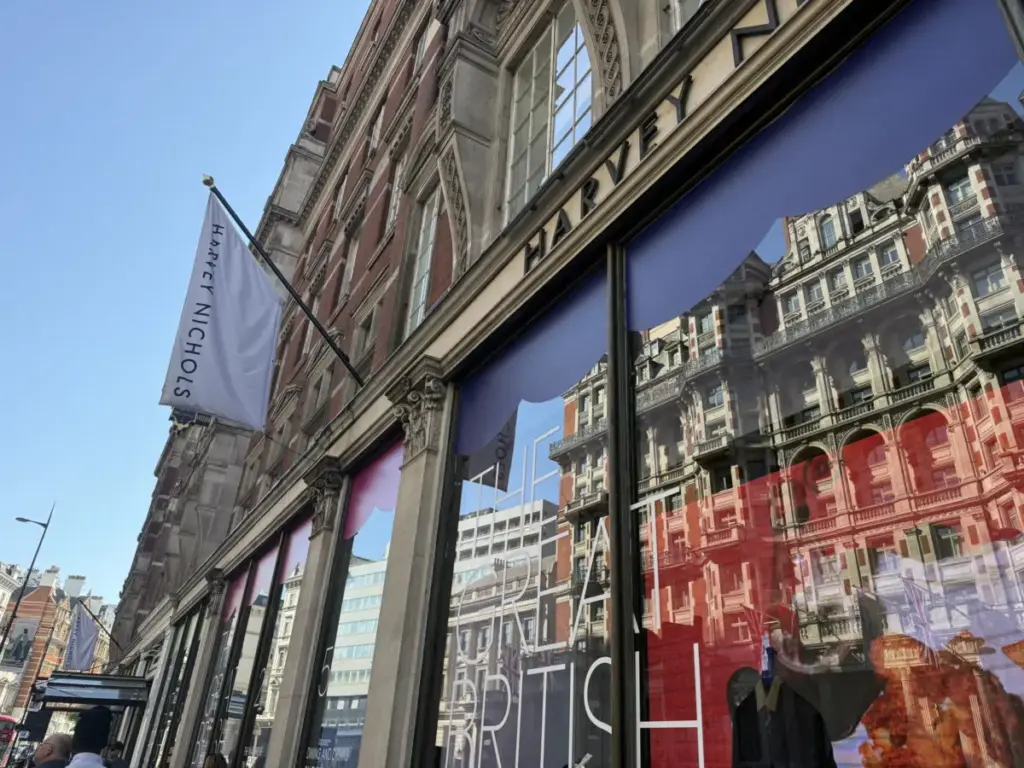
The retail landscape of the United Kingdom has long been a theater of high-stakes corporate maneuvering, but few moves match the sheer audacity of Frasers Group’s latest play. Controlled by retail billionaire Mike Ashley, Frasers has officially secured Harvey Nichols—one of Britain’s most storied and prestigious luxury department stores—in a pre-pack administration deal valued at approximately $54 million (£40 million).
While the acquisition price has been widely characterized as a bargain, industry analysts and retail insiders agree that the purchase cost will prove to be the least challenging hurdle for Ashley and Frasers CEO Michael Murray. Breathing new life into a heritage brand squeezed by titanic competitors, strained supplier relations, and shifting consumer habits will require a root-and-branch operational overhaul. Estimates from retail consultants suggest that revitalizing the brand could require upwards of $270 million (£200 million) over the medium term.
This transaction represents far more than a simple rescue operation. It is a calculated chess move in Frasers Group’s broader, aggressive march into the upper echelons of the global luxury market. Having evolved from its mass-market sporting goods roots—exemplified by Sports Direct—Frasers is aggressively pivoting upward to insulate itself from ultra-cheap e-commerce giants like Shein and Temu. By stitching together a high-end portfolio that includes Flannels, The Webster, and significant stakes in international heavyweights like Hugo Boss and Burberry, Frasers is betting that the luxury sector offers superior long-term resilience.
However, Harvey Nichols carries severe baggage. Plagued by declining customer traffic, heavy debts to unpaid suppliers, and underperforming regional real estate, the retailer’s survival depends on navigating a perilous web of brand relationships, financial restructurings, and difficult restructuring choices.
Detailed Chronology: The Road to Administration and the Frasers Takeover
The unraveling and subsequent rescue of Harvey Nichols did not happen overnight; it is the culmination of years of margin pressures, shifting retail footprints, and tightening liquidity.
The Pre-Pack Administration
The deal was finalized on a Thursday via a pre-pack administration—a controversial legal mechanism where a company negotiates and agrees upon a sale prior to formally entering administration. Handled swiftly to prevent sudden operational collapse, the transaction successfully transferred Harvey Nichols’ crown jewels to Frasers Group. The package includes the retailer’s six physical stores across the United Kingdom, its comprehensive e-commerce infrastructure, existing inventory, international franchise agreements, and the jobs of more than 1,000 employees.
Despite securing the business, Frasers Group leadership has been remarkably transparent about the friction ahead. CEO Michael Murray did not mince words in his initial statements, warning stakeholders that the turnaround will necessitate "tough choices," even if it means running a significantly smaller business footprint in the near term.
The Looming Shadow of Matches
For luxury fashion suppliers, the pre-pack arrangement rings alarm bells. The market’s anxiety is deeply rooted in Frasers Group’s recent track record. In December 2023, Frasers acquired upscale online fashion retailer Matches for $70 million (£52 million). Less than three months later, Mike Ashley placed Matches into administration, leaving more than 500 unsecured creditors—including prominent independent luxury brands and major design houses—collectively owed roughly $49 million (£36 million).
The collapse of Matches shattered supplier confidence across the British luxury ecosystem. Consequently, when Frasers absorbed Harvey Nichols through a similar pre-pack vehicle, current and prospective brand partners reacted with intense caution. Insiders note that luxury suppliers are acutely aware of their leverage. As insolvency and retail experts point out, when a brand is critical to a department store’s merchandising mix, that supplier dictates the terms of engagement—whether demanding cash-on-delivery, withholding fresh inventory, or cutting ties entirely until past debts are resolved.
Supporting Context & Metrics: Financial Realities and Market Dynamics
To understand the monumental scale of the task facing Frasers Group, one must look closely at the cold, hard numbers defining the U.K. luxury department store sector.
The Financial Chasm: Harvey Nichols vs. The Titans
Harvey Nichols does not operate in a vacuum; it sits directly in the shadow of dominant market leaders Harrods and Selfridges. According to recent financial disclosures, the competitive landscape is heavily skewed against Harvey Nichols:
- Harrods: Reported a staggering turnover of $1.48 billion (£1.1 billion) alongside a pre-tax profit of $114 million (£84.9 million) for the fiscal year ended February 1, 2026.
- Selfridges: Recorded $1.04 billion (£774.6 million) in revenue, though it posted a pre-tax loss of $21.5 million (£15.9 million) for the 48-week period ended January 4, 2025.
These figures illustrate a brutal economic model where mid-tier luxury players must "run faster and faster each year just to stand still." Retail analyst Richard Hyman notes that Harvey Nichols’ primary ailment has never been a simple lack of capital injection, but rather a persistent deficiency in customer traffic and sales volume. Squeezed from multiple directions by competitors who execute the luxury department store model with greater scale and operational efficiency, Harvey Nichols has struggled to maintain distinct market share.
Capital Burn and Real Estate Realities
Jonathan De Mello, founder and CEO of retail consultancy JDM Retail, estimates that the frequently discussed initial investment figure of $81 million (£60 million) will likely sustain the business for a mere two years unless radical organic growth materializes instantly. Over a five-year horizon, De Mello projects total required investments closer to $270 million (£200 million). This capital must be deployed across wholesale relationships, designer links, exclusive product arrangements, modern marketing, and digital infrastructure.
Simultaneously, Frasers must address a bloated and underperforming physical store footprint. While the flagship location in London’s Knightsbridge has undergone substantial, praised renovations, the regional portfolio presents significant liabilities.
- The Stronger Asset: The Leeds location remains a stable regional performer.
- The Problem Children: Stores in Birmingham, Bristol, and Edinburgh face severe structural hurdles. Birmingham’s location within the Mailbox development isolates it from the city’s primary retail foot traffic corridors, making it a prime candidate for closure or conversion into alternative Frasers retail formats.
Official Statements and Industry Perspectives
The acquisition has generated intense debate among retail analysts, fashion consultants, and insolvency experts, all of whom offer contrasting views on how Frasers should proceed.
The Need for Product Discovery
Cozette McCreery, a fashion consultant and co-founder of the defunct London Fashion Week label Sibling, argues that Harvey Nichols has long struggled to offer shoppers a genuine sense of discovery. While acknowledging that the Knightsbridge flagship is vastly improved aesthetically, McCreery pointed out a glaring lack of contemporary, cutting-edge, or emerging indie brands during recent visits.
"If the new owners take that path and offer support and a space for new, then I, for one, would return," McCreery told industry media. "Otherwise, frankly, I’ll stick with DSM [Dover Street Market]."
Restoring Harvey Nichols’ discovery credentials is only half the battle; maintaining relationships with the heritage luxury houses that anchor its current inventory—including Gucci, Loewe, Saint Laurent, The Row, Moncler, Brunello Cucinelli, and Valentino—is equally paramount. The retailer requires a dual-engine strategy: established names to drive consistent basket values and financial credibility, paired with avant-garde designers to capture consumer imagination.
The Legal and Supplier Standpoint
Jeremy Goldring, an insolvency expert at Goldring Law, emphasizes the delicate power dynamic between the new corporate ownership and unsecured creditor-suppliers.
"If the continued support of any particular supplier is critical to the business, then irrespective of its legal rights, that supplier should be able to dictate the terms on which it will provide that support," Goldring explains.
This dynamic mirrors the broader global turbulence seen in high-end retail restructuring, such as the Chapter 11 filing of Saks Global in the United States. In both instances, supplier confidence dictates inventory flow, proving that liquidity injections are meaningless if brand partners refuse to ship merchandise.
Future Outlook: Strategic Vision and the Road Ahead
As the dust settles on the acquisition, the broader strategic blueprint of Mike Ashley’s retail empire comes into sharp focus.
The Upward Migration of Frasers Group
Frasers is executing a calculated pivot toward the upper brackets of retail. Facing relentless pressure at the value end of the market from ultra-fast-fashion powerhouses like Shein and Temu, Ashley is betting heavily on the resilience of high-end consumption.
Beyond retail storefronts, Frasers is aggressively seizing control of entire retail real estate ecosystems. By acquiring major regional shopping centers and retail parks—such as Dundee’s Overgate, Braehead in Scotland, and major outlet centers in the East Midlands and York—the group is vertically integrating its operations, controlling everything from the brands and suppliers to the physical malls in which consumers shop.
Leveraging the Regional Footprint
There remains a silver lining for Harvey Nichols’ regional stores. The British Fashion Council recently unveiled Fashion Britain, a nationwide initiative designed to support creative commercial enterprises outside of London. This program features activations across cities including Manchester, Edinburgh, Bristol, and Newcastle.
Industry experts suggest that Harvey Nichols could strategically repurpose its regional footprint to host these emerging designer activations. While such initiatives may not maximize immediate per-square-foot profitability, they could successfully reposition the department store as a champion of British creative talent, driving foot traffic and reclaiming cultural relevance.
Conclusion
The acquisition of Harvey Nichols is a high-stakes gamble for Frasers Group. Turning the historic retailer around will require far more than a financial Band-Aid; it demands rebuilding shattered trust with luxury suppliers, rationalizing a burdensome store network, and rediscovering the curatorial edge that once made the brand a British retail icon. If Michael Murray and Mike Ashley can navigate these treacherous operational waters, Harvey Nichols may finally regain its footing at the pinnacle of luxury retail. If they miscalculate, the venture risks becoming an expensive cautionary tale in the volatile modern retail landscape.