Executive Overview
Pop powerhouse Olivia Rodrigo has officially ushered in a new era of socially conscious live music with the debut of her inaugural Daisy Chain Fields Festival. Hosted at the expansive Great Park in Irvine, California, the event stands out not merely as a high-profile music gathering, but as a monumental synthesis of intergenerational artistry, progressive politics, and direct-action philanthropy.
Curated by Rodrigo herself, the festival’s lineup reads like a masterclass in female-led music history, uniting legendary trailblazers and contemporary icons. Artists taking to the Irvine stages include Stevie Nicks, Karen O, Chappell Roan, Doechii, Mitski, The Breeders, Bikini Kill, Sarah McLachlan, and Garbage. This eclectic, multi-generational roster perfectly encapsulates Rodrigo’s progressive worldview: that popular music can be both fiercely commercial and radically inclusive, bridging historical feminist movements with modern pop sensibilities.
Beyond the sonic landscape, the most staggering achievement of the event is its uncompromising financial commitment to social change. During a pre-festival press presentation, Rodrigo announced a staggering $10 million in total donations directed entirely toward ten nonprofit organizations. Net proceeds from the festival—bolstered by ticket sales, waived artist fees, and corporate sponsorships—will support vital causes encompassing reproductive rights, mental health resources, domestic violence intervention, and maternal healthcare.
True to form, Rodrigo ensured her personal presentation matched the political gravity of the weekend. Stepping onto the stage in a custom-embroidered mini-dress by Palestinian fashion brand Nöl Collective, she married high fashion with pointed political and cultural solidarity. Blending the nostalgic grunge-pop energy that has come to define her aesthetic with homages to 1990s feminist music history—such as Sarah McLachlan’s pioneering Lilith Fair—Rodrigo has firmly established Daisy Chain Fields as a blueprint for the future of socially engaged pop culture.
Detailed Chronology
Friday Press Presentation: Setting the Stage for Philanthropy
Before the gates opened to thousands of eager fans in Irvine, Olivia Rodrigo hosted an intimate, high-impact press conference on Friday afternoon. Surrounded by leaders from the beneficiary organizations—including Jenn Stowe, Christian LoBue, Fatima Goss Graves, and Caren Spruch—Rodrigo formally detailed the philanthropic framework behind Daisy Chain Fields.

Rather than treating philanthropy as a passive afterthought or a peripheral charity partner, Rodrigo placed social infrastructure at the core of the festival’s identity. She revealed that 100 percent of the net proceeds would go directly to ten distinct nonprofits. Among the primary beneficiaries are organizations operating on the frontline of some of the most contentious social battles in the United States today, including the Center for Reproductive Rights, Planned Parenthood, and Baby2Baby.
During her address, Rodrigo took a moment to express profound gratitude to the vast ecosystem that made the $10 million milestone possible. "The organizations we’ve partnered with are doing incredibly important work every single day in the U.S. and globally," Rodrigo stated. "I’m so grateful to every person who bought a ticket, every artist who waived their fee, every sponsor for signing onto a brand-new festival, and every donation that helped get to $10 million dollars to support women and girls."
The Sartorial Statement: Fashion Meets Resistance
True to the modern celebrity tradition of utilizing the red carpet and press appearances as a canvas for socio-political expression, Rodrigo’s outfit for the press presentation was rich with subtext, history, and deliberate craftsmanship.
The singer donned a soft pink embroidered mini-dress custom-designed for her by Nöl Collective, a celebrated Palestinian fashion brand known for supporting local artisans and preserving traditional craft under immense geopolitical pressure. The garment featured a pleated-trim scoop neckline, fluttering cap sleeves, a sharply fitted bodice, and a playful thigh-length silhouette.
Most notably, the dress was adorned with authentic Palestinian Tatreez embroidery—a centuries-old textile art form traditionally passed down through generations from mother to daughter. The intricate embroidery featured hand-stitched birds, universally recognized as symbols of freedom, resilience, and movement, interwoven with delicate daisy chain motifs. By choosing Nöl Collective, Rodrigo integrated international solidarity into a landmark American pop-culture event, elevating Palestinian craftsmanship onto a global media stage.

To round out her look, the you seem pretty sad for a girl so in love singer leaned into her signature aesthetic dichotomy: sweet yet subversive. She styled the dress with vintage burgundy Betty Mary Janes from Gucci, invoking a distinct 1990s grunge nostalgia. Crucially, she accessorized with a Lilith pendant necklace, an explicit nod to Sarah McLachlan’s historic Lilith Fair.
Saturday: The Festival Unfolds
The inaugural day of Daisy Chain Fields at the Great Park in Irvine transformed the Southern California landscape into a haven of alternative culture, community activism, and musical mastery. On-site community-led workshops, grassroots advocacy booths, and interactive panels ran concurrently with the musical performances, ensuring that attendees engaged with the sociopolitical themes of the festival beyond simply watching from the crowd.
The performance schedule offered a breathtaking cross-section of musical innovation. From the riot-grrrl fury of Bikini Kill and the alternative-rock textures of The Breeders to the hypnotic lyricism of Mitski and the genre-bending bravado of Doechii and Chappell Roan, the festival dismantled conventional genre and generational barriers. The inclusion of living legends like Stevie Nicks and Sarah McLachlan created a profound sense of lineage, tying the contemporary feminist pop movement directly to the pioneering women who fought for space in male-dominated rock and pop industries decades prior.
Supporting Context & Metrics
The $10 Million Philanthropic Impact
The allocation of $10 million represents one of the largest single philanthropic efforts launched by a contemporary pop artist under the banner of a proprietary festival. While major music festivals frequently partner with charities for ticket add-on donations or fractional percentage giveaways, Daisy Chain Fields operated on a structural model where net proceeds were entirely funneled back into community infrastructure.
The ten non-profit organizations chosen reflect an intersectional approach to social welfare, prioritizing bodily autonomy, maternal security, and psychological well-being:

- Center for Reproductive Rights: Defending legal protections for reproductive healthcare across the United States.
- Planned Parenthood: Providing essential reproductive healthcare, education, and advocacy.
- Baby2Baby: Supplying diapers, clothing, and basic necessities to children living in poverty.
- Additional mental health, domestic violence, and maternal health organizations: Providing crucial safety nets and systemic support structures for vulnerable populations.
Collaborative Merchandising and Decentralized Support
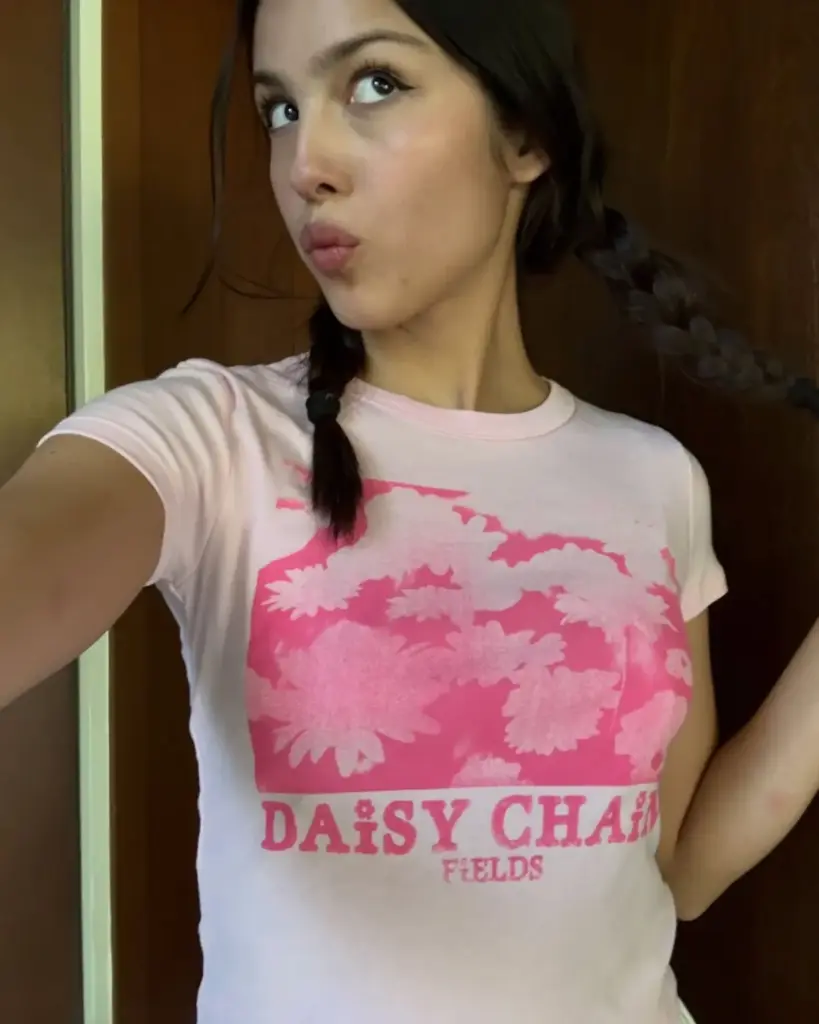
Beyond the massive corporate sponsorships and ticket sales, the festival also fostered grassroots economic empowerment through curated merchandise initiatives. Attendees had access to exclusive festival merchandise, including a high-profile collaborative T-shirt designed alongside legendary fashion designer Anna Sui.
For fans unable to make the trip to Irvine, Rodrigo partnered with Etsy to launch the Daisy Chain Fields Collection by Olivia Rodrigo. This curated, highly localized drop featured handmade pieces sourced directly from ten female-owned Etsy shops, ensuring that the economic benefits of the festival’s digital footprint extended downward to independent female artisans and small business owners.
Official Statements
The collaborative spirit of the festival was heavily emphasized by both its founder and the institutional leaders standing beside her. The press conference featured heavyweights in the advocacy space who underscored the urgency of Rodrigo’s financial contributions.
“Daisy Chain Fields was created to celebrate the power of what can happen when we come together to support one another,” Olivia Rodrigo shared with the press on Friday. “The organizations we’ve partnered with are doing incredibly important work every single day in the U.S. and globally… I can’t wait to see everyone tomorrow.”
Advocacy leaders echoed this sentiment, praising Rodrigo for leveraging her colossal cultural footprint to direct vital resources toward marginalized communities and underfunded legal battles. Fatima Goss Graves, one of the organizational leaders present at the announcement, highlighted how critical youth-led and artist-backed momentum is in mobilizing political and social awareness in contemporary America.

Future Outlook
As the dust settles over the Great Park in Irvine following the inaugural weekend of Daisy Chain Fields, the broader cultural implications of the festival are already becoming clear. Olivia Rodrigo has effectively challenged the prevailing corporate festival model—which often prioritizes bottom-line maximization and ephemeral brand activations—by proving that social justice, ethical fashion sourcing, and uncompromising curatorial integrity can successfully scale into a major live-music enterprise.
Industry analysts are already projecting that Daisy Chain Fields will serve as a permanent fixture on the global festival calendar, with speculation mounting regarding potential international expansions or recurring annual dates. More importantly, the festival sets a formidable new standard for pop stardom in the 2020s. Fans and cultural critics alike have taken note: when young artists refuse to separate their art from their ethics, the resulting cultural moments are not only commercially triumphant, but historically significant.
With flower crowns swaying, independent female artisans supported globally, and ten million dollars deployed directly to the frontlines of social equity, Daisy Chain Fields has rewritten the rulebook for what a pop star’s festival can—and should—achieve.