Executive Overview
It is another scorching summer night in London. The capital is caught in the iron grip of a relentless heatwave sweeping across Europe, and sweat glistens on foreheads, necks, and the backs of legs. “Thank fuck Wembley has air-con,” a young woman mutters to her companion aboard the subterranean depths of the Tube. She doesn’t need to announce her destination; the pink cowboy hat and matching marabou feather boa give her away instantly.
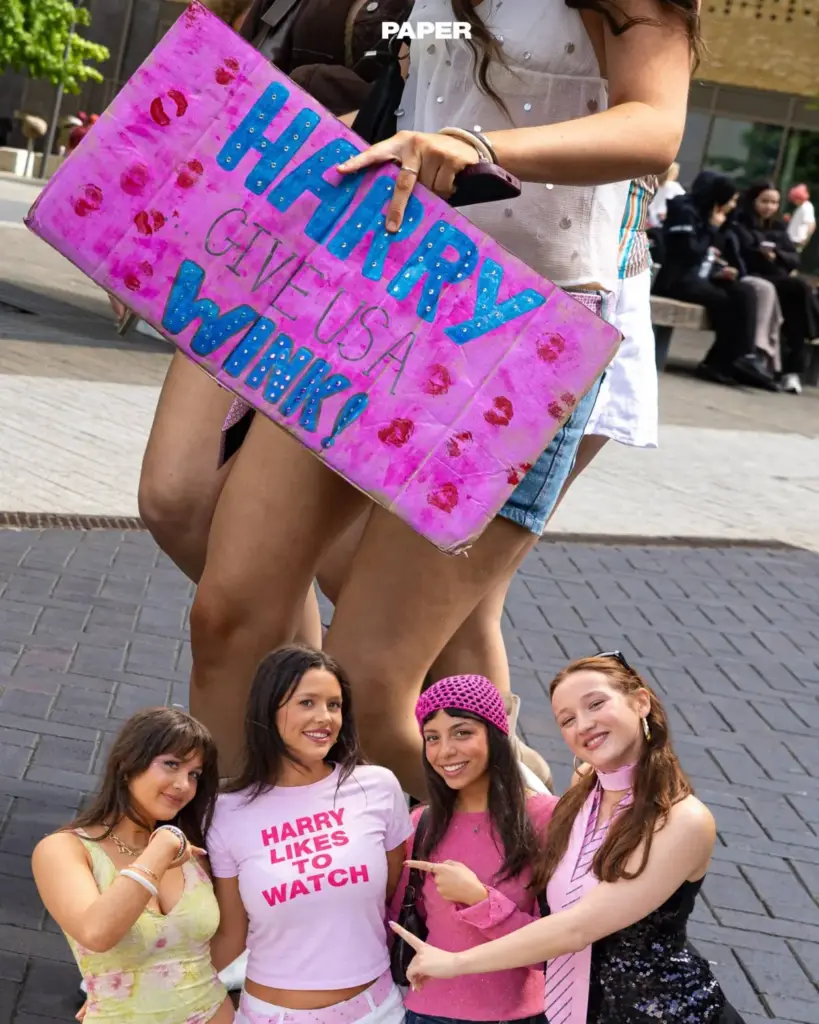
Predictably, this is one of the nights Harry Styles is headlining Wembley Stadium. Nearly the entire carriage—if not the entire transit line—is gussied up in the exact same sartorial uniform. “I think we’re underdressed,” I remark to my friend upon meeting her outside the station gates. Crucially, we do not look like everyone else. We are wearing practical, cool boots and mini-skirts—the kind of standard gig attire that has served concertgoers well since the dawn of rock and roll.
But this is no longer the era of casual gig-going. It is the mid-2020s, and boots and a mini are simply no longer proper decorum for the Big Live Pop zeitgeist.
Today, the concrete concourses outside Wembley resemble a surrealist carnival of feather boas, neon sequins, and oversized Elton John-style sunglasses worn by everyone from young girls and their mothers to groups of women several drinks deep into pre-gaming. This is the new normal. Across the globe, wherever fifty-dollar merchandise shirts advertise stadium tour stops, a radical shift has taken place. Concert dressing is no longer about looking good for the artist; it is about signaling allegiance to a tribe. It is a high-stakes, highly coordinated community ritual that has turned live music into a participatory religion.
Detailed Chronology: The Evolution of Fan-Led Fashion
To understand how concert fashion mutated from casual streetwear into a meticulous, cult-like uniform, one must trace the recent timeline of the post-pandemic live music boom.
Phase 1: The Post-Pandemic Re-emergence (2022–2023)
When live music returned after years of lockdowns and social distancing, audiences did not merely return to venues; they arrived with an unprecedented, pent-up appetite for theatrical expression. The phenomenon was catalyzed by cultural titans like Beyoncé. During her 2023 Renaissance tour, the superstar explicitly commanded her audience to adhere to a strict aesthetic code: wear silver, particularly in honor of Virgo season, her birth month. Fans didn’t just comply; they engineered custom chrome outfits, turning stadiums into shimmering expanses of metallic liquid.
Around the same time, Harry Styles’ Love On Tour cemented a shift in how his predominantly young fanbase approached fashion. The days of dressing to catch the pop star’s eye—a relic of the Directioner era defined by Wattpad fanfiction and adolescent fantasies of backstage romance—were officially dead. Fans were no longer dressing for Harry; they were dressing for each other.
Phase 2: The Eras Peak and the Era of Lore (2024)
By 2024, Taylor Swift’s record-shattering Eras tour elevated fan-led costuming to an Olympic sport. Walking through the crowds at Wembley or stadiums across North America meant navigating a living museum of Swift’s discography.
When this writer attended the Eras tour in a simple white maxi skirt, a fellow fan politely interrogated the choice. "What Era are you meant to be?" she asked. I gestured down and suggested Folklore. The fan looked me up and down with sweet, discerning judgment. "I feel like that’s more of a cardigan-orientated look," she observed. "Maybe you could see it as a 2008 VMAs nod."
The girl herself was encased in a custom-made sequined bodysuit paying direct homage to Swift’s Midnights album. It was during this tour that the friendship bracelet phenomenon crossed the threshold from internet subculture into global ritual. Inspired by a single lyric from Midnights—“You’re On Your Own, Kid”—fans spent weeks stringing beads before shows, trading them with strangers like sacred talismans. The act was performed with the zealous devotion of monastic workers, anchoring the concert experience in physical, interpersonal exchange.
Phase 3: Subconscious Subcultures and Accidental Uniforms (2025–2026)
By 2025 and 2026, the movement had expanded beyond artists who explicitly demanded or encouraged dress codes. Take Charli XCX, music’s undisputed doyen of cool. Charli has never made demands regarding what her audiences wear. Yet, across her Brat tour, crowds materialized en masse in her signature aesthetic: rave sunglasses and white ribbed tank tops, awash in that aggressive, neon "Brat green" that became more ubiquitous in the audience than on the stage itself.
Even novelty and legacy acts have bowed to the trend. Pitbull’s live shows now practically mandate that audiences don bald caps and aviator sunglasses à la Mr. Worldwide. Concert dressing has evolved from a personal styling choice into a mandatory liturgical vestment.
Supporting Context & Metrics: The Economics of the Cult of Concert
This dramatic transformation is not merely a byproduct of social media algorithms; it is a multi-million-dollar economic engine driven by shifting consumer habits among Gen Z and younger Millennials.
- The Rise of Experiential Spending: Post-pandemic economic studies consistently show that younger demographics prioritize experiential spending over material assets. However, as this trend demonstrates, contemporary concert-going demands material acquisition. Tickets that cost hundreds of dollars are now treated as the base entry fee, with secondary expenditures allocated to specialized costumes, Amazon-ordered feather boas, custom footwear, and traded trinkets.
- The Parasocial Marketplace: Academic analyses of modern fandom note that the relationship between artist and fan has flattened through social media. Platforms like TikTok and Instagram reward hyper-specific aesthetic curation. Videos tagged with #ErasTourOutfit or #BratStyle have generated billions of views, turning concert preparation into a serialized digital content loop.
- The Antidote to Isolation: Sociological research into post-lockdown youth demographics frequently highlights soaring rates of anxiety, digital isolation, and loneliness among teenagers and young adults who missed critical formative years of socialization. The irony of the modern concert dress code is that while it is heavily commercialized and parasocially oriented, its core function is intensely communal. Fans are not seeking validation from the artist on stage; they are seeking instantaneous societal placement and belonging within a crowd of peers.
Official Statements & Industry Perspectives
Industry insiders, cultural theorists, and fashion historians have increasingly turned their attention to this phenomenon, viewing it through various lenses of sociology and modern commerce.
Dr. Elena Vance, Professor of Cultural Sociology at the London School of Economics:
"We are witnessing the secularization of ritual. Traditional community structures—organized religion, civic clubs, neighborhood associations—have declined among Gen Z. In their place, pop music fandoms have stepped in to fill the human need for collective effervescence. Dressing up for a concert is not just about vanity; it is the modern equivalent of putting on vestments before entering a cathedral. It creates an immediate, visual egalitarianism within the tribe."
Marcus Sterling, Live Entertainment Strategist and Promoter:
"Ten years ago, merch was a t-shirt you bought at the back of the venue on your way out. Today, the outfit is curated weeks in advance. Promoters and artists have realized that the live music experience no longer begins when the house lights go down—it begins the moment the ticket is purchased and the planning of the look commences. It has extended the economic tail of a tour exponentially."
A Anonymous Major Label Creative Director:
"Artists don’t even have to prompt it anymore. The audience writes the brief. When Charli [XCX] released Brat, we knew it would resonate, but the speed at which a specific shade of lime green became a universally recognized uniform took even us by surprise. It proves that young people are desperately craving physical spaces where they can visibly recognize their own community in real life, away from the screen."
Future Outlook: Where Does Concert Fashion Go From Here?
As the live entertainment industry continues to break box office records year after year, the cult of concert dressing shows no signs of abating. However, its future trajectory points toward several distinct evolutions:
- Sustainable Costuming: With Gen Z’s heightened awareness of fast-fashion waste, the backlash against single-use polyester feather boas and Amazon-shipped sequined items is already brewing. The next evolution of concert dressing will likely lean heavily into vintage curation, clothing swaps, and upcycled DIY fashion, marrying community ritual with environmental consciousness.
- Brand Partnerships and Immersive Retail: Major fashion brands are beginning to bypass traditional retail cycles to launch tour-specific capsule collections in collaboration with artists. Expect future concert venues to feature pop-up styling bars and bespoke tailoring booths outside stadiums, bridging the gap between high fashion and live music performance.
- The Expansion of Genre-Agnostic Uniforms: While pop, hip-hop, and indie-pop have dominated this space, metal, electronic dance music (EDM), and country music have long-standing traditions of subcultural dress codes. As cross-genre fandoms grow, expect to see hybrid aesthetics—such as the "Cowboy Carter" country-pop crossover influence—permeating rock and indie gigs as well.
Ultimately, whether one views this movement as a masterclass in modern marketing, a symptom of hyper-commercialized parasocial devotion, or a deeply moving human attempt to forge community in an increasingly isolated world, one truth remains absolute. The days of throwing on "jeans and a nice top" for a pop show are officially over.
We are all dressing for the cult now—and honestly? The lighting is much better that way.