Executive Overview
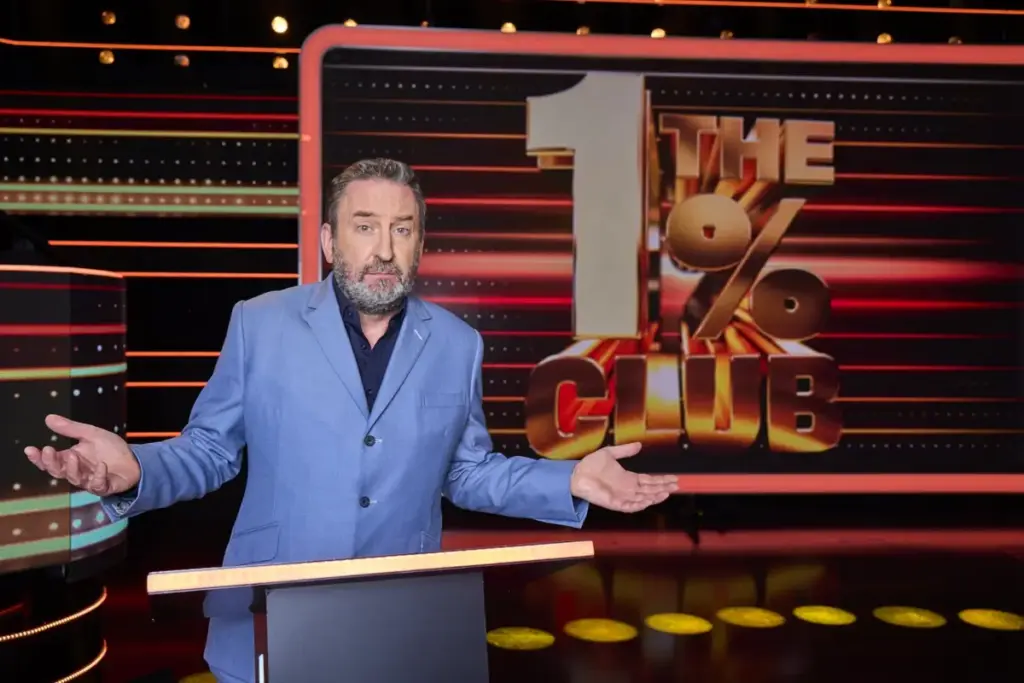
Since its debut on British television screens in 2022, ITV’s The 1% Club—skilfully hosted by comedian Lee Mack—has established itself as a premier destination for prime-time brain teasers. Unlike traditional game shows that lean heavily on trivia, general knowledge, or high-speed buzzer skills, this format demands pure lateral thinking, cognitive agility, and pattern recognition. One hundred contestants enter the arena, each vying for a share of a life-changing cash prize, but they must survive an increasingly difficult gauntlet of logic-based puzzles. The ultimate hurdle, of course, is the titular final question: a conceptual trap designed to be solved by only one percent of the British public.
However, the psychological tension of the studio environment does not merely manifest at the very end of the game. Recent reruns of episodes originally broadcast in 2024 have reignited nationwide debate across social media platforms, drawing fierce attention to two starkly different extremes of the show’s design philosophy. On one end of the spectrum lay an intricate, heavily criticized visual puzzle involving coffee mugs that left viewers and contestants alike calling it "the worst question in the show’s history." On the other end sat a deceptively straightforward pictorial riddle involving a thermometer and a dog, which baffled audiences not because of its complexity, but because an astonishing number of players managed to get it wrong.
This deep dive examines the mechanics of both puzzles, analyzes the psychological pressures of competing under studio lights, and explores why The 1% Club continues to captivate millions by exploiting the quirks of human perception.
Detailed Chronology: Two Episodes, Two Extremes
To understand how The 1% Club can simultaneously alienate audiences with hyper-obscure visual logic and infuriate them with apparent simplicity, one must look closely at the chronological rollout of the recent controversial broadcasts.
The Mug Puzzle: A Masterclass in Frustration
During one of the heavily discussed rerun episodes originating from the 2024 production blocks, contestants were presented with an illustrative graphic depicting two distinct rows of ceramic mugs, four to a row. The top row featured words printed on the side of each vessel: HAT, LOG, OLD, and ROW. The bottom row displayed four distinct names: ALF, SUE, MEG, and BEN.

The prompt delivered by Lee Mack was seemingly simple yet profoundly opaque: "Whose mug belongs on the top shelf with the others?"
As the thirty-second timer ticked down, studio tension reached a fever pitch. When the buzzer sounded, the scale of the carnage became clear. A staggering 20 contestants crashed out of the game entirely, having locked in incorrect answers. An additional 18 players were forced to expend their coveted "passes"—a safety net allowing them to skip a question—just to survive the round.
Viewers at home were equally bewildered. Digital platforms erupted with critiques. "Worst question the show has ever had," one disgruntled viewer posted on X (formerly Twitter). Another chimed in, writing, "This is officially the most annoying question of the evening."
Unpacking the Logic
The solution, when revealed by Lee Mack, relied on an ultra-lateral observation that completely bypassed traditional reading habits. The crucial missing element was not the printed text itself, but the physical structure of the objects: the mug handles.
Mack explained the solution to the stunned studio audience:

- On the top row, if you imagine the handle of each mug functioning visually as the letter C placed directly in front of the printed word, new words are formed: C + HAT = CHAT; C + LOG = CLOG; C + OLD = COLD; C + ROW = CROW.
- On the bottom row, applying the exact same rule to the names yields nonsense combinations for three of the options—except for ALF. When prefixed with the handle’s implied C, the name transforms into CALF.
Therefore, ALF’s mug belonged on the top shelf. Lee Mack later delivered a deadpan joke to a contestant who had panicked and used a pass: "If they had made the handles red that would have helped, wouldn’t it?"
The "Hot Dog" Paradox: When Simplicity Breeds Failure
In stark contrast to the mug puzzle, a second repeated episode from December 2024 provided a puzzle so fundamentally elementary that it triggered a completely different kind of public outcry.
Contestants were shown a composite image: a thermometer positioned against a glowing backdrop of the sun, placed directly next to a photograph of a shaggy, long-haired dog. The accompanying question was direct: "What food is represented here?"
The intended answer was as obvious as visual puns get: Hot dog.
Yet, in a display of collective brain freeze that stunned viewers at home, 15 contestants failed to lock in the correct answer within the allotted time. The studio fallout immediately bled into social media commentary.

"15 people out on this? Where are they getting the contestants from?" one incredulous viewer asked online. Another echoed the sentiment, stating, "Yep, we were shocked," while a satirical comment suggested the answer must be a "mercury mutt."
However, amidst the mockery, more sympathetic voices emerged to defend the contestants. One experienced quiz enthusiast offered a note of caution: "Trust me. When you’re under the lights and on the spot, nothing is as easy as it looks."
Supporting Context & Metrics: The Science of Studio Pressure
Why do intelligent people crumble under the mechanics of The 1% Club? The show’s enduring appeal lies in its inverted difficulty curve. Unlike conventional game shows where questions start easy and end hard for the home viewer, The 1% Club begins at the 90% difficulty tier—meaning 90% of the British public can answer it—and scales down mathematically until reaching the final 1% question.
The Cognitive Load of the Studio Environment
Cognitive psychologists studying game show performance note several factors that impair decision-making under televised conditions:
- Time Compression: Having only 30 seconds to process a visual puzzle creates acute physiological arousal (the fight-or-flight response), which narrows attentional focus and inhibits lateral thinking.
- The "Curse of Overthinking": When contestants know a show is designed to trick them, they routinely reject obvious answers (such as "hot dog") in favor of complex, multi-layered hypotheses, leading to self-sabotage.
- Visual Distraction: In the mug puzzle, the brain naturally focuses on semantics—reading the words as lexical units—rather than structural morphology (the shape of the handle as a typographical character). Breaking this perceptual set in seconds is exceptionally difficult.
| Puzzle Type | Contestants Eliminated | Primary Cognitive Trap | Public Reaction |
|---|---|---|---|
| The Mug Puzzle | 20 (plus 18 passes used) | Semantic fixation / Ignoring physical structure | Labelled "the worst question in show history" |
| The "Hot Dog" Puzzle | 15 | Overcomplication / Studio anxiety | Widespread shock and disbelief online |
Official Statements and Industry Reception
Producers of The 1% Club have long defended the show’s rigorous vetting process for puzzle design. Every question undergoes extensive play-testing with demographic groups across the UK to ensure that the statistical difficulty ratings—ranging from 90% down to the final 1%—are mathematically accurate before the cameras roll.

Speaking on the balance of accessibility and frustration, production insiders note that the occasional "easy" question failing to clear the room is an inherent risk of live-environment television. The contrast between high-level lateral puzzles like the "CALF" mug problem and low-level rebus puzzles like the "hot dog" graphic is precisely what generates the watercooler moments that drive the show’s ratings on ITV and streaming services like ITVX.
Furthermore, the show’s landmark achievements—such as the historic moment a Liverpool student became the first person ever to walk away with the full £100,000 top prize—underscore that the puzzles, while difficult, are entirely solvable for those possessing exceptional mental agility.
Future Outlook
As The 1% Club continues its dominant run across British television, cementing its status as a staple of modern entertainment, the expectations for its puzzle designers are higher than ever. With millions of viewers tuning in to play along from their living rooms, the friction between sofa-bound confidence and studio-floor panic remains the show’s greatest asset.
Future seasons are expected to lean further into these psychological paradoxes, challenging both studio contestants and home audiences to look past the obvious, question their assumptions, and remember that sometimes a mug handle is not just a handle—it is a letter waiting to be read. Until then, the debate over what constitutes a "fair" puzzle will undoubtedly rage on across digital platforms every single week.