No, age isn’t just a number. But it is not a harbinger of gym doom, either. With smart adjustments to your training regimen, long past your 50s you will feel strong, resilient, and fully capable of packing on muscle.
Yes, staying in shape gets progressively harder with each passing decade. However, it is far from impossible—and it is a pursuit that a rapidly growing demographic of men is chasing and dominating. Think of the men in their 50s crushing Hyrox races and Ironman finish lines, or guys in their 50s and 60s sporting physiques that rival those of 20-somethings. You already know your potential: you can do more than merely maintain your fitness as you age. You can thrive, hit new personal records, and make serious muscular gains.
Witness iconic figures like Lenny Kravitz, well past age 60, sporting abs that routinely break the internet. Look at Hugh Jackman, still deadlifting like Wolverine, or Jason Statham, deep into his 50s and still performing his own high-octane action stunts. Your own quest for muscle can continue long past the half-century mark, provided you learn from the master trainers who have mastered the longevity game. You may no longer be able to endure the soul-crushing intensity of "hypertrophy hell," but you are certainly not headed for Jazzercise and speed-walking, either.
"You don’t have to change everything you’re doing," advises former bodybuilder Bryan Krahn, C.S.C.S., author of Men’s Health Muscle After 40 and creator of the Max Muscle at 50 program. "Just work smart."
Detailed Chronology: The Four-Step Evolution of Ageless Training
To successfully transition your fitness journey from a young man’s high-risk grind to a sustainable, lifelong powerhouse routine, you must execute a calculated, multi-stage evolution.
Step 1: Overhaul Your Mindset
If you are an older guy still approaching your workouts with the reckless abandon of your 20s, you are destined for the injured reserve. And if you are young and already tired of nagging joint pain and chronic tweaks, take note—the following four mental adjustments will save your joints and extend your lifting career by decades.
Dumbbells Are Your Friend: Barbell lifting is universally treated as the gold standard of the gym, but it severely restricts your limbs from moving through their natural, comfortable arcs of motion. As your connective tissues inevitably lose elasticity with age, consider ditching rigid barbell presses in favor of dumbbell variations, which allow natural joint tracking.
Embrace Bodybuilding Moves: Total-body compound lifts like cleans and heavy squats are CrossFit staples, but classic bodybuilding-style isolation exercises—such as biceps curls and lateral raises—belong firmly in your rotation. Your central nervous system and joints recover from isolation movements much faster than from maximal heavy lifts, allowing you to train with higher frequency (aim for twice weekly).
Work Hard, Recover Harder: Your body is still fully capable of surviving brutal, high-intensity workouts, but it requires significantly more targeted TLC to bounce back. Double down on your recovery protocols. Trainer Bobby Maximus, author of Maximus Body, notes that he spends more time in the spa and recovery room than the gym these days. Mirror this approach: for every 30 minutes you spend lifting, invest a solid hour in foam rolling, mobility work, or restorative yoga.
Set Hard Limits on Your Training: An extra minute of burpees today is never worth sacrificing tomorrow’s session. "Your work capacity is starting to decline," Krahn explains, "along with your ability to recuperate." Always cap your training sessions with a strict time limit (e.g., 45 minutes) or track your volume rigorously—commit to 12 working sets, and not a single one more.
Step 2: Identify and Combat the Real Enemy
The single greatest threat to your fitness longevity does not come from heavy iron or bad luck; it comes from inside your own biology. Sarcopenia—the progressive, age-related loss of skeletal muscle mass and function—quietly erases 3 percent to 8 percent of your muscle mass every single decade starting in your 30s. Fortunately, you can fight back aggressively.
Build Power, Not Just Strength: According to Dr. Brad Schoenfeld, a veteran muscle researcher, you cannot beat sarcopenia simply by lifting heavy weights for traditional strength. You must develop a unique, explosive brand of strength known as power. Traditional strength is your ability to lift a 20-pound weight; power is your ability to move that exact same weight quickly. Integrate power training into your routine twice weekly using lighter loads: perform 3 sets of 6 reps, taking a full 2 seconds to lower the weight under control, and exploding upward in 1 second or less.
Eat Strategically for Muscle Retention: Heavy training breaks down muscle fibers, and without adequate protein, your body cannot rebuild them. Miss this crucial window, and your muscles will never fully recover or grow. Dr. Schoenfeld recommends consuming 35 to 40 grams of high-quality protein per meal (roughly equivalent to a dedicated protein shake or 4 to 6 ounces of lean meat). "Most people," he warns, "simply do not get sufficient protein intake to offset catabolic aging."
Step 3: Fall in Love with the "Little Things"
The big, flashy, badass exercises (like power cleans and max-effort snatches) are undeniably fun, but it is the small, unglamorous movements with nerdy names that keep your body structurally sound and bulletproof.
"Subtle exercises make a world of difference for injury prevention, superior conditioning, and maximum performance," says NASM trainer Kirk Charles, a fitness writer well past 60. Master these three foundational movements:
Elevated Hip Bridge Hold: Designed to fortify your hamstrings—the crucial muscle group you rely on every time you bend over to pick up an object off the floor. Lie with your back flat on the ground, your heels resting on a sturdy chair, toes pointed upward toward the ceiling, and knees slightly bent. Engage your core, drive your heels downward into the chair, and elevate your hips as high as possible until they form a straight line with your knees and shoulders. Squeeze your hamstrings hard and hold this isometric contraction for 20 to 30 seconds. That constitutes 1 rep; aim for 5 sets.
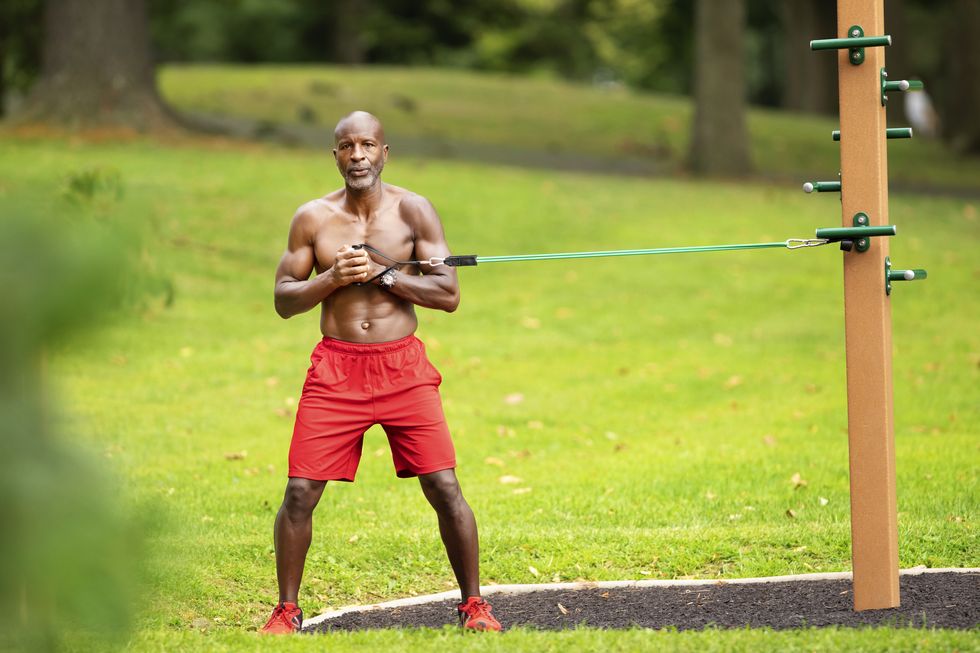
Pallof Press: Your ultimate weapon against chronic lower-back pain. Anchor a resistance band to a stable post just below shoulder height. Grasp the band with both hands held tightly against your chest, rotate so your left shoulder faces the anchor point, and step laterally away until the band is fully taut. Brace your core like you’re about to take a punch, then press your arms straight out in front of your chest. Hold for 2 seconds, and return to the starting position. Perform 3 sets of 12 to 15 reps per side.
Resistance Band Pull-Apart: Midback strength is essential for safeguarding your shoulders against long-term wear and tear. Stand upright while holding a light resistance band in both hands in front of you. Keep your core braced, palms facing each other, and a slight, permanent bend in your elbows. Keeping your arms strictly parallel to the floor, pull your hands wide apart, aggressively squeezing your shoulder blades together at the peak of the movement. Pause briefly, then return with control. Complete 3 sets of 15 reps.
Step 4: Optimize Smart Movements & Fix the Dangerous Ones
Your body does not care whether you can successfully execute Instagram’s trendiest, most dangerous exercise variations (and neither do your workout partners). Build functional muscle and stay injury-free by favoring bio-mechanically safe movements while systematically modifying riskier ones.
3 Superior Movements to Adopt:
Romanian Deadlift (RDL): Not every lifter possesses the optimal hip mobility required to safely deadlift from a dead stop on the floor. RDLs solve this by letting you start from the top, hinging at the hips, pushing your glutes backward, and protecting your spine.
Floor Press: Replicates the exact chest-building mechanical benefits of barbell and dumbbell bench presses while drastically limiting shoulder joint extension, keeping your rotator cuffs out of harm’s way.
Hollow Hold: A gymnastics-derived core staple that requires you to lie flat on your back, press your lower lumbar spine firmly into the floor, and elevate both your legs and shoulder blades simultaneously. It builds ironclad, all-around core stability.
3 Risky Moves That Need Tweaking:
Max-Height Box Jump: While explosive, maximum-height box jumps carry a high risk of Achilles tendon ruptures and missed landings. Lower the box by at least 10 inches below your absolute max, or substitute them with depth drops to train deceleration safely.
Wide-Grip Pull-Up: Extreme wide grips place excessive torque on the shoulder capsules. Swap them for neutral-grip pull-ups (palms facing each other) with your hands positioned slightly wider than shoulder-width to protect your shoulders for the long haul.
Barbell & Dumbbell Military Press: Overhead pressing requires exceptional thoracic and shoulder mobility that many aging lifters simply lack. Switch to landmine presses, which allow your arms to track naturally at a supportive angle slightly in front of your torso.
Supporting Context & Metrics: The Science of Ageless Lifting
Understanding the physiological data behind aging and muscle retention helps demystify why traditional workout splits must evolve.
The Sarcopenia Curve: Medical data indicates that adults lose roughly 3% to 8% of their muscle mass per decade after turning 30, with the rate of decline accelerating significantly after age 60. Resistance training is the single proven pharmaceutical-grade intervention capable of reversing this trend.
Protein Synthesis Resistance: Aging skeletal muscle exhibits an increased resistance to the anabolic effects of amino acids. While a 20-year-old might trigger maximum muscle protein synthesis with 20 grams of protein, individuals over 50 require 35 to 40 grams per meal to overcome this blunted anabolic response.
Connective Tissue Remodeling: Tendons and ligaments experience reduced blood flow and collagen turnover as we age. This biological shift necessitates longer warm-up periods, higher repetition ranges with moderate weights, and strict adherence to tempo control (such as eccentric lowering phases) to stimulate tissue remodeling without inducing micro-tears that outpace recovery.
Official Statements and Expert Perspectives
The shift toward longevity-focused fitness is heavily endorsed by the fitness industry’s leading minds and veteran practitioners who continue to lead by example.
"I pay attention to little things. If I dial in sleep, stress, and nutrition, I can continue to train at a high level."
— Bobby Maximus, trainer and author of Maximus Body
"I’m doing more resistance training as I get older to maintain muscle mass. I’ve always been big on cardio activities, but I realized I must do more weight training for strength and muscle building."
— Kirk Charles, NASM Trainer and Fitness Columnist
"You don’t have to change everything you’re doing. Just work smart. Focus on compound efficiency, protect your joints, and prioritize recovery windows."
— Bryan Krahn, C.S.C.S., author of Muscle After 40
Future Outlook: The Longevity Fitness Paradigm
The cultural perception of aging in the gym has undergone a seismic shift. No longer are individuals over 50 relegated to aquatic aerobics or recumbent stationary bikes. As sports science, nutritional insights, and advanced programming methodologies converge, the future of fitness belongs to the "eternal lifter."
By swapping ego-lifting for targeted biomechanics, prioritizing recovery with the same religious fervor as training, and combating sarcopenia through explosive power output and optimized protein intake, the modern athlete can rewrite the aging script. The takeaway is clear: your best years in the gym are not behind you—they are waiting to be built, one smart, calculated repetition at a time.