Executive Overview
Greece is once again reeling from the devastating human and environmental toll of its summer fire season, as a pair of fast-moving, simultaneous wildfires tore through the island of Salamina, located just west of Athens in the Attica region. The dual blazes, which erupted on the afternoon of Sunday, August 16, 2026, transformed a peaceful coastal landscape into a zone of absolute devastation within a matter of minutes. Driven by erratic, gale-force winds and fueled by parched vegetation under a Level 4 "very high risk" weather warning, the fires trapped residents and tourists alike, destroying homes, incinerating vehicles, and leaving behind a staggering wake of destruction.
Tragically, the disaster has claimed at least two lives—believed to be an elderly couple trapped by the advancing walls of fire—while leaving ten others injured, some critically. The emergency response was massive, deploying hundreds of firefighters, specialized ground teams, and a fleet of aerial drops alongside an unprecedented maritime evacuation effort. Coast Guard vessels, commercial passenger-cargo ships, and local ferries rallied to rescue more than 500 stranded individuals from beaches shrouded in thick, choking smoke.

As investigations into the origins of the blazes get underway amid suspicions of illicit dumping grounds and potential arson, political leaders and emergency officials are facing mounting scrutiny over the country’s ongoing vulnerability to climate-fueled environmental crises. This comprehensive report details the chronology of the disaster, the heroic rescue operations, the human cost, and the broader political ramifications for a nation pushed to its limits.
Detailed Chronology of the Disaster
The First Sparks: Sunday Afternoon
The emergency command center of the Hellenic Fire Department received the first distress call at precisely 14:43 local time (12:43 BST) on Sunday. According to initial local reports, the first fire ignited in an adjacent plot of land filled with garbage on Andromachis Street within the Peristeria area of Salamina.

What followed was a terrifying demonstration of how rapidly modern wildfires can escalate under extreme weather conditions. Fueled by dry tinder and powerful seasonal winds, the flames did not merely creep—they exploded across the terrain. Within a staggering seven minutes of the initial alert, the fire had broken containment lines, surging across the landscape and triggering a localized explosion as it engulfed residential properties in Peristeria.
Compounding the chaos, a second major fire broke out mere minutes later, at 15:03 local time, in Kaki Vigla within the Selinia district. Situated roughly 9 to 10 kilometers (5.5 to 6 miles) apart from the Peristeria front, the near-simultaneous ignition of two massive fires sent immediate shockwaves through local municipal leadership. Thodoris Zannis, the deputy mayor of Salamina, noted the alarming coincidence in statements to Greek broadcaster ERT, describing how one of the fronts rapidly "took over the entire mountain" with virtually no escape routes left for residents.

The Race Against Time: Evacuations and Sea Rescues
As the twin fire fronts converged on populated areas and popular tourist zones, local authorities recognized that traditional land evacuation routes were quickly becoming impassable. Police and municipal leaders urgently commanded residents and holidaymakers in vulnerable coastal pockets—particularly in Kolones and Saterli—to abandon their properties and flee toward the shore.
Greek Police issued emergency text alerts and direct warnings, instructing those in Kolones to use Peristerion Avenue to reach Saleri beach. However, as the smoke descended and flames blocked roadways, hundreds of people found themselves trapped on the southern coast with the sea as their only barrier against the inferno.

In response, the Hellenic Coast Guard, alongside local authorities, orchestrated a massive maritime rescue operation. Two ferry boats, alongside passenger-cargo vessels and local craft, were immediately requisitioned to pull stranded citizens directly from the beaches. By late afternoon, the scale of the evacuation became clear: 571 people were successfully pulled from the beaches of Salamina. A significant portion of the evacuees—362 individuals—were safely transported by ship to the port of Faneromeni, while others were held on nearby vessels acting as floating safe havens.
Containment and Ground Operations
Back on land, the Hellenic Fire Department scrambled to reinforce its positions. What began as a localized response quickly ballooned into a massive inter-agency effort. By early evening, the deployment reached 260 professional firefighters, supported by 10 specialized pedestrian teams from the 1st EMODE, 48 fire engines, water tankers, and heavy machinery supplied by local government bodies.

The aerial battle was equally intense. Operating under punishing wind shears and through dense plumes of smoke, a total of 18 aerial assets—comprising 10 fixed-wing aircraft and 8 specialized firefighting helicopters—pounded the fire fronts with continuous water drops. Despite these immense efforts, the sheer velocity of the wind prevented immediate containment, turning Sunday afternoon into a desperate fight for survival.
Supporting Context & Metrics
Human Toll and Medical Updates
The human cost of the Salamina disaster became evident as emergency crews combed through burned-out residential zones. Firefighters recovered two bodies from a property engulfed by the flames; preliminary reports indicate the victims are an elderly couple. Official identification and formal autopsies were scheduled to take place to confirm their identities.

Health Minister Adonis Georgiadis confirmed that 10 individuals in total sustained injuries ranging from severe burns to acute smoke inhalation. The victims span a wide age demographic, from 15 to 89 years old.
- Hospitalizations: Five patients were rushed to local and regional hospitals. Among them, a female burn victim suffered second-degree burns covering 25% of her body surface and required emergency transfer to Thriasio Hospital. Another elderly man, rescued directly from his home in Kaki Vigla, was admitted to Salamina Hospital.
- Outpatient Care: Three patients were treated and subsequently discharged, while others received immediate first aid at the scene from paramedics for smoke-related complications.
Infrastructure and Municipal Disruptions
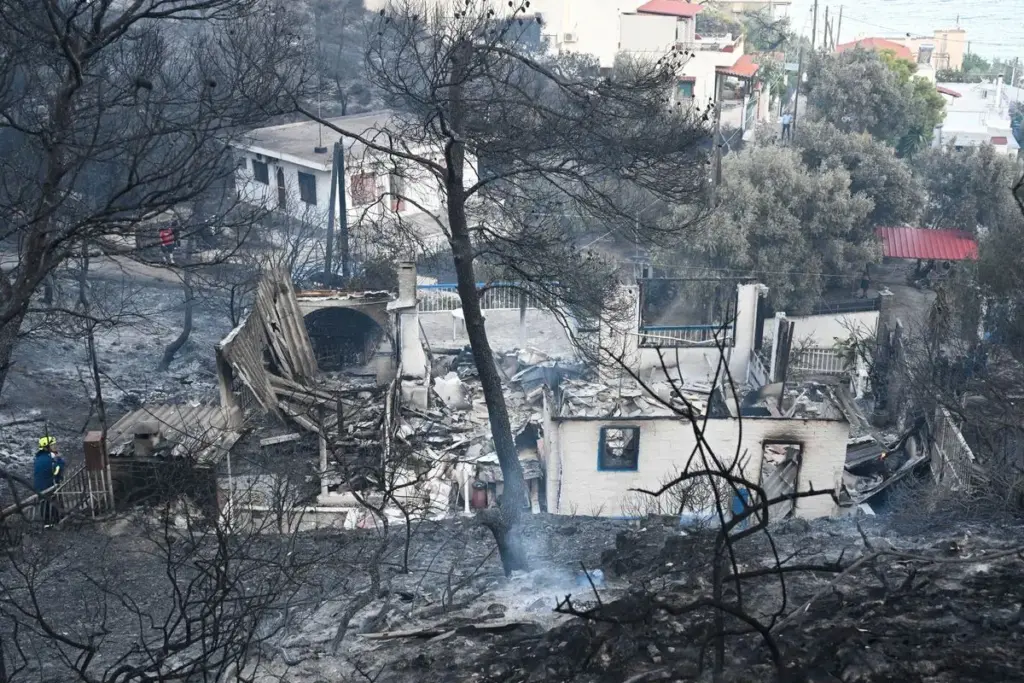
The physical infrastructure of southern Salamina suffered catastrophic blows. Multiple residential homes, outbuildings, and personal vehicles were left completely gutted or reduced to smoldering rubble, as evidenced by harrowing photographic documentation from the aftermath.

Public services were severely impacted in the interest of public safety. The Salamina Bus Station announced the immediate cancellation of all Line 8 routes servicing the Peristeria and affected coastal sectors. Transport officials confirmed that buses would remain sidelined until safety inspections could guarantee clear passage for passengers and employees, while the remainder of the island’s transit network operated under close observation.
The Broader Greek Fire Season
Salamina was not the only front testing Greece’s emergency infrastructure during this brutal weekend. Concurrently, firefighters entered a grueling second day of battle against a stubborn wildfire on the island of Skyros. Local officials on Skyros praised the rapid mobilization of approximately 3,000 regional reinforcements, while fire service specialists deployed heavy excavators to carve firebreaks through difficult terrain.

These persistent outbreaks underscore a broader, grim reality for Greece: an escalating cycle of intense fire seasons driven by prolonged dry spells, rising temperatures, and systemic climate shifts that stretch the state’s disaster-response capabilities to their absolute limits.
Official Statements and Political Reactions
The tragedy has predictably ignited a fierce political debate regarding the state’s preparedness and long-term environmental strategy.

Kyriakos Antonopoulos, Mayor of Skyros, and Giorgos Panagopoulos, Mayor of Salamina, both highlighted the harrowing conditions under which local municipalities are forced to operate. Mayor Panagopoulos noted during the height of the crisis: "The situation is difficult. There are two major fires, homes are under threat, and we have asked the police to bring us two ferry boats… so that we can use them for people if we see that the situation becomes much more difficult."
Meanwhile, opposition parties sharply criticized the government’s handling of the disaster prevention framework. Greece’s left-wing Syriza party issued a blistering statement condemning what it described as recurring structural failures:

"The tragedy that unfolded today in Salamis, with two more people dead from the fire and several burned, with major damage to homes and the environment, adds to the heavy toll of yet another fire season that is testing the country’s resilience and, above all, the State’s ability to protect human life."
Syriza called for an immediate overhaul of current environmental management, demanding holistic planning, advanced meteorological forecasting, and proactive mitigation rather than reactive crisis management. "Otherwise," the statement warned, "we will continue with declarations of political complacency before every fire season and with tragedies that we will not be able to prevent."

The Investigation: Garbage Dumps and Arson Projections
Questions surrounding the ignition sources of the twin blazes have prompted immediate criminal inquiries. Local reports from residents on Andromachis Street suggest that the Peristeria fire originated in an adjacent plot of land utilized as an unofficial garbage dump—a known hazard during high-heat, low-humidity summer months when discarded materials can easily ignite.
Given the alarming coincidence of two major fires breaking out within minutes of each other nearly 10 kilometers apart, the specialized Arson Crimes Division of the Hellenic Police has taken over the investigation. Authorities are scrutinizing whether negligence, illegal waste management, or deliberate foul play was behind the dual outbreaks that brought Salamina to its knees.

Future Outlook
As night fell over the Saronic Gulf on Sunday, ground crews on Salamina continued their painstaking mop-up operations, damping down hotspots to prevent reignition under lingering overnight winds. While the immediate maritime evacuation successfully spared hundreds from the path of the flames, the psychological and physical scars left on the island will take months—if not years—to heal.
The events of August 16, 2026, serve as a stark, tragic reminder of the compounding threats posed by modern climate pressures combined with local infrastructure vulnerabilities. For Greece, the immediate priority remains securing ongoing containment and supporting the displaced and injured. However, as the political fallout deepens, the pressure on Athens to transition from emergency firefighting to a more robust, preventative environmental paradigm has never been more urgent.