Executive Overview
The intersection of digital creator culture and traditional formal education has reached a monumental milestone. As the academic year swings into full gear, YouTube and Google.org—the philanthropic arm of Alphabet Inc.—have announced a joint $2.5 million grant directed squarely at Class CrunchLabs, the ambitious educational channel spearheaded by beloved engineer, former NASA scientist, and YouTube powerhouse Mark Rober.
This substantial financial infusion is designed to fortify and expand a revolutionary free science curriculum that Rober first conceptualized to bridge the gap between high-production digital entertainment and rigorous classroom standards. Boasting over 83.6 million subscribers on his primary channel, Rober has leveraged his immense digital footprint to address a persistent crisis in modern education: underfunded classrooms, depleted teacher resources, and a severe lack of engaging STEM (Science, Technology, Engineering, and Math) materials for students in the critical developmental window between the third and eighth grades.
With YouTube serving as the primary distribution partner, Class CrunchLabs launched just in time for the 2026–27 school year, rolling out a slate of over 1,000 meticulously produced, high-energy videos. Developed in close consultation with the National Science Teaching Association (NSTA) to guarantee alignment with educational benchmarks, the curriculum covers complex scientific principles—ranging from the physics of collisions to the intricacies of electromagnetism—through an engaging, gamified, and cinematic lens.
By injecting an additional $2.5 million into the ecosystem, Google.org and YouTube are ensuring that the platform can scale its infrastructure, accelerate localization efforts into dozens of languages, conduct vital educational research, and—most importantly—keep the entire curriculum completely free of charge for educators worldwide. This comprehensive report explores the genesis of Class CrunchLabs, the mechanics of its rollout, the strategic backing of corporate philanthropy, and the long-term implications for global education.
Detailed Chronology: From Concept to Global Classroom
To fully appreciate the magnitude of the $2.5 million grant, it is essential to trace the deliberate, highly calculated trajectory of Class CrunchLabs from a visionary digital blueprint to a deployed global educational force.
Phase 1: The Epiphany and the Initial Announcement (Late 2025)
The genesis of Class CrunchLabs can be traced back to a glaring systemic flaw that Mark Rober observed firsthand: the financial burden placed upon everyday educators. Teachers across the globe routinely spend hundreds, sometimes thousands, of dollars out of their own pockets to secure teaching aids, worksheets, and supplementary videos, many of which fail to capture the imagination of digital-native students.
Recognizing this injustice, Rober announced in late 2025 that he would pivot a significant portion of his creative and financial capital toward building a comprehensive science curriculum. Rather than monetizing the content behind paywalls or subscription models, he vowed to give it away entirely for free to any teacher, school district, or homeschooling parent who wished to utilize it. This initiative was designed as a natural pedagogical extension of CrunchLabs, his popular subscription-based science kit brand that teaches kids how to build and engineer physical toys.
Phase 2: Funding, Partnerships, and Pedagogical Alignment (Early–Mid 2026)
Turning a grand vision into a scalable reality required unprecedented capital and institutional backing. Rober committed an astonishing $55 million of his own resources to jumpstart the project. Securing YouTube as the anchor distribution partner guaranteed that the content would have immediate access to the world’s largest video-sharing infrastructure.
Recognizing that raw entertainment value alone does not constitute a valid lesson plan, Rober and his team engaged in rigorous institutional collaboration. They partnered directly with the National Science Teaching Association (NSTA). This partnership ensured that every module, video, and assignment met or exceeded state and national science education standards.
Furthermore, the operational roadmap tackled a massive logistical hurdle: global accessibility. The project was engineered to roll out lesson plans tailored specifically for students in grades 3 through 8, with localized video content slated for translation across 34 different languages, breaking down geographical and linguistic barriers to quality STEM education.
Phase 3: The 2026–27 School Year Launch and World Teachers’ Day Milestone
True to their word, Rober and YouTube made good on their promises, officially delivering "more than 1,000 banger videos" just in time for the opening bell of the 2026–27 academic year.
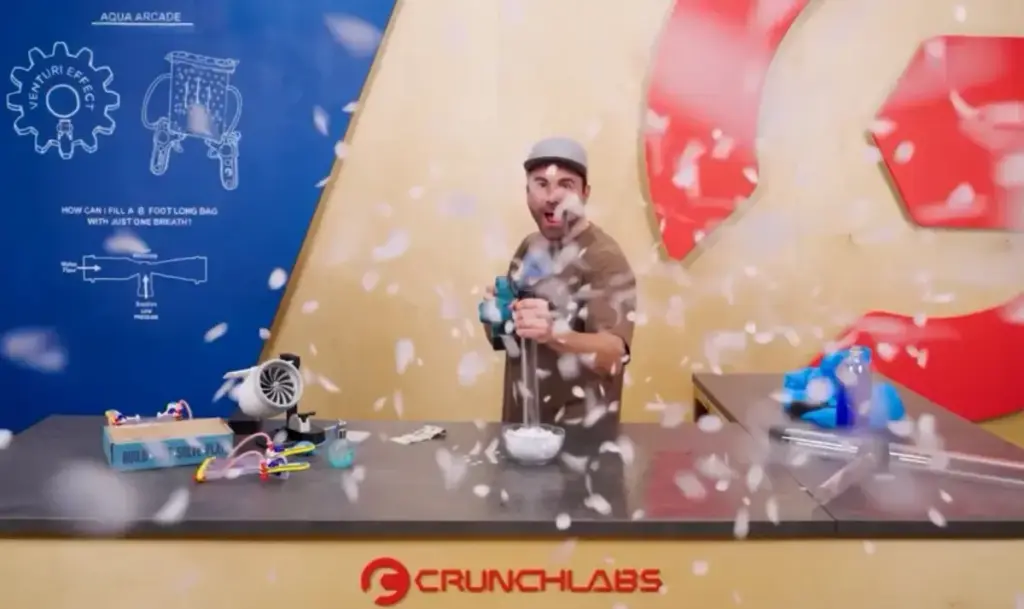
The initial curriculum drop transformed abstract physical concepts into tangible, visual spectacles. Lessons on collisions, electromagnetism, and mechanics were brought to life through signature Rober-esque experiments—combining high-stakes engineering challenges with humor and narrative drive. To maximize student engagement, Rober brought in high-profile digital co-stars, such as Geoguessr savant Trevor Rainbolt, proving that cross-genre digital talent can successfully converge in the name of academic literacy.
To punctuate the success of the rollout, YouTube and Google.org formally announced the $2.5 million grant to coincide with World Teachers’ Day. In a symbolic gesture mirroring the traditional apple given to educators, Rober and his corporate partners delivered a globally accessible, financially unencumbered resource capable of transforming classrooms from rural districts to urban centers.
Supporting Context & Metrics: The Anatomy of Class CrunchLabs
The success of Class CrunchLabs cannot be measured by views alone; it is defined by its meticulous structural design, financial backing, and deliberate pedagogical choices.
The Problem: The Teacher Pay Penalty and Content Deficits
Mark Rober’s motivation for Class CrunchLabs was rooted in economic reality. During the initial rollout, Rober famously articulated the plight of the modern educator:
"These poor teachers, they actually pay money for content that’s not good. They’re paying their own money, and they don’t have much. So we’re just gonna put it out there."
Educational research consistently demonstrates that teachers spend an average of $500 to $800 annually out of pocket for classroom supplies and digital lesson plans. By absorbing the massive production costs—initially through his $55 million personal commitment and now bolstered by the $2.5 million Google.org grant—Rober has effectively neutralized the financial barrier to entry for high-end educational media.
Curriculum Structure and Engagement Mechanics
Class CrunchLabs is not merely a playlist of cool science tricks; it is a structured, standards-aligned curriculum. Key components include:
- Target Demographic: Tailored specifically for middle-tier learners in grades 3 through 8, a crucial developmental window where many students either develop a lifelong passion for STEM or become alienated by dry, rote instruction.
- Content Volume: An initial library exceeding 1,000 modular video assets designed to integrate seamlessly into existing lesson plans.
- The "Banger" Philosophy: Leveraging creator economy pacing, high-production editing, and gamification to compete directly with the myriad distractions vying for young minds. Collaborations with internet personalities like Trevor Rainbolt (Mission Maglev ft. Geo Rainbolt) act as a bridge, utilizing familiar internet culture to validate and anchor complex physical science concepts.
- Multilingual Reach: Designed from the ground up to transcend English-speaking markets, with localized deployment spanning 34 languages.
The Role of Google.org and YouTube
While YouTube provides the digital plumbing—hosting, streaming architecture, discovery algorithms, and global reach—Google.org provides the philanthropic engine. The $2.5 million grant functions as a direct injection of non-dilutive, mission-driven capital. Unlike venture capital investments that demand financial returns, this grant is explicitly earmarked to subsidize the operational overhead of keeping the platform free, funding ongoing academic research, and scaling international localization efforts.
Official Statements and Industry Perspectives
The convergence of Big Tech philanthropy and creator-led education has generated significant enthusiasm across both the digital media landscape and the educational sector.
Katie Kurtz, YouTube Global Head of Youth and Learning
In an official statement detailing the grant allocation, Katie Kurtz emphasized the cultural and educational significance of Rober’s transition from viral creator to institutional educator:
"For years, Mark Rober has been the internet’s favorite science teacher, and now he is bringing that same magic directly to classrooms. At YouTube, we are incredibly proud to support Mark on this massive labor of love, providing the platform to help him scale his hands-on, standards-aligned curriculum to teachers and students everywhere."
Mark Rober’s Educator-First Philosophy
Rober’s ongoing commitment highlights a broader cultural shift within the creator economy. Rather than treating education as a secondary, monetization-driven vertical, top-tier creators are increasingly utilizing their immense financial leverage to solve systemic societal problems. By timing major project milestones around observances like World Teachers’ Day, Rober continuously underscores that his primary constituency is not the algorithm, but the boots-on-the-ground educators shaping the next generation of engineers, scientists, and critical thinkers.
Future Outlook: What Lies Ahead for Class CrunchLabs?
With the foundational rollout of Class CrunchLabs successfully integrated into the 2026–27 school year, attention now turns to the future. The newly acquired $2.5 million grant from Google.org and YouTube is not merely a retroactive reward for past success; it is a strategic accelerator for phase two of the project.
1. Deepening International Localization
Translating educational content into 34 languages is a monumental task that requires more than simple subtitles. True localization involves cultural adaptation, accurate scientific translation, and often localized voice talent. The grant will directly fund the linguistic expansion required to make Class CrunchLabs a truly borderless educational resource, reaching underserved student populations in developing nations where access to high-end laboratory equipment is severely limited.
2. Expanding Research and Pedagogical Iteration
To maintain its partnership with organizations like the NSTA, Class CrunchLabs must continually evaluate its efficacy. A portion of the grant funding will be funneled into educational research—tracking student engagement metrics, retention rates, and comprehension benchmarks across diverse classroom environments. This data-driven feedback loop will allow Rober’s team to refine existing modules and design future curricula with pinpoint accuracy.
3. Scaling the Creator-Collaborator Model
The inclusion of digital creators like Trevor Rainbolt demonstrated that educational content can successfully cross-pollinate with internet culture without losing its academic integrity. Future iterations of Class CrunchLabs are expected to expand this model, inviting other prominent creators, scientists, and specialists to co-host units, thereby keeping the content fresh, culturally relevant, and endlessly engaging.
Conclusion
The partnership between YouTube, Google.org, and Mark Rober’s Class CrunchLabs represents a watershed moment for modern pedagogy. By merging the unbridled engagement of top-tier digital entertainment with rigorous, NSTA-aligned academic standards—and keeping it entirely free for cash-strapped teachers—this initiative has redefined what is possible in educational philanthropy. As Class CrunchLabs continues to expand its global footprint and linguistic reach, it stands as a shining beacon of how technology and creative vision can unite to empower educators and inspire the scientists of tomorrow.