Paris Fashion Week has long served as a high-stakes runway for the global elite, a theatrical arena where heritage fashion houses unveil their future trajectories and style icons solidify their legendary status. Yet, few moments in recent memory have arrested the fashion press quite like the appearance of Kate Moss stepping out of The Ritz.
For over three decades, the British supermodel has functioned as the definitive architect of effortless, rock-and-roll cool. Her canon of style is built on a foundation of neutral palettes, decadent textures, and rebellious nonchalance: the shaggy vintage coats, the iconic Corinne Day-shot tank tops and knickers, slinky ’90s slip dresses, and razor-sharp Saint Laurent and Tom Ford tailoring. Colour—particularly vibrant, unapologetic hues—has historically played a minor, almost non-existent role in her sartorial vocabulary.
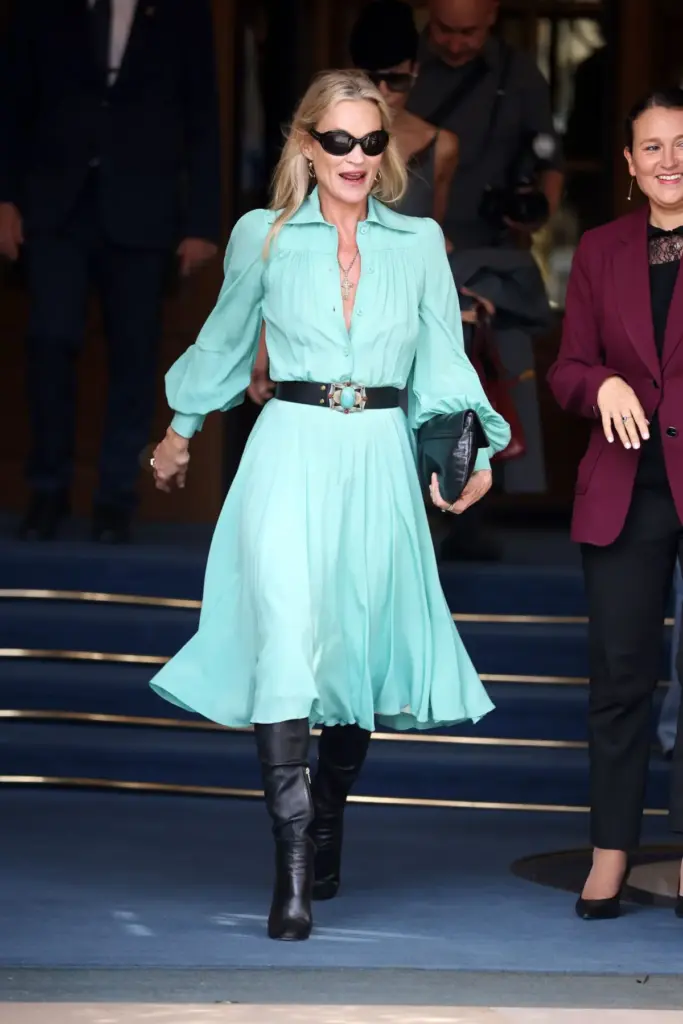
That unwritten rule was decisively rewritten this afternoon. Emerging from her Parisian sanctuary ahead of Dior’s Spring/Summer 2027 presentation, Moss bypassed her signature uniform of leopard print, black leather, and indie-sleaze grunge. Instead, she chose a bright turquoise tea dress paired with a matching belt—a look more commonly associated with an ambitious Upper East Sider from the golden era of Gossip Girl than the undisputed patron saint of ’00s festival culture.
Yet, true to form, Moss refused to abandon her roots entirely. By anchoring Jonathan Anderson’s pristine Dior creation with a pair of well-worn, knee-high leather boots, she managed to bridge the gap between high-society primness and quintessential London grit. This unexpected sartorial pivot offers a fascinating lens through which to examine the evolution of modern style icons, proving that even the most established arbiters of cool are willing to disrupt their own narratives.
Detailed Chronology: The Making of a Parisian Style Shock
The sequence of events leading up to Moss’s headline-making appearance unfolded with the precision and anticipation typical of a major fashion week milestone.
Mid-Afternoon Departure from The Ritz
At approximately 3:00 PM CET, shutterbugs and fashion editors gathered outside the grand entrance of The Ritz Paris, anticipating the usual procession of front-row heavyweights. Moss’s exit was marked not by the predictable rustle of black leather or the familiar flash of faux-fur, but by a sudden, electric burst of cyan.
The garment in question—a structured, vibrant turquoise tea dress—immediately drew the focus of every camera lens on the pavement. Styled with a matching belt that cinched the waist, the piece represented a sharp departure from her recent beachside look in Ibiza, where she had famously paired an Hermès Kelly bag with a seemingly ornamental belt.
Transition to the Dior Venue
As Moss made her way from the hotel toward the venue for Jonathan Anderson’s Dior showcase, street-style photographers scrambled to capture the full ensemble. The cognitive dissonance of seeing the definitive queen of British bohemian grunge draped in crisp, cheerful color generated an immediate buzz across digital platforms.
Fashion commentators mid-scroll found themselves stopping in disbelief. The initial reaction across social media and press pools was uniform: Could that really be Kate in turquoise?
The Grounding Footwear Choice
While the dress signaled an unprecedented dive into pastel-adjacent brightness, Moss’s footwear choice served as an anchor back to her comfort zone. Eschewing delicate stilettos or prim flats, she completed the outfit with a battered pair of knee-high leather boots. This deliberate styling choice preserved the effortless rebellion that has defined her wardrobe since the mid-1990s. It ensured that, despite the cheerful hue of the dress, the overall silhouette remained unmistakably Kate—a masterclass in high-low contrast and textural friction.
Supporting Context & Metrics: The Evolution of an Icon’s Wardrobe
To fully appreciate the weight of Moss’s turquoise intervention, one must examine the empirical data of her public style history. Over a career spanning more than thirty years, her wardrobe choices have tracked the broader cultural shifts of the fashion industry.
The Monochrome Canon
A statistical breakdown of Moss’s most-photographed street style and red-carpet appearances reveals an overwhelming preference for a restrained palette:
Black & Charcoal: Comprising an estimated 65% of her foundational looks, spanning leather jackets, tailored trousers, and evening slips.
Animal Prints: Leopard and snakeskin account for roughly 20% of her signature repertoire, serving as her primary mechanism for pattern play.
Neutrals (White, Beige, Navy): Representing 10% of her wardrobe, typically utilized during daytime outings or resort getaways.
Bright Colors: Historically accounting for less than 5% of her documented public ensembles, making vivid turquoise an extreme statistical outlier.
The Indie Sleaze Heritage
Moss’s aesthetic DNA was forged in the fires of 1990s minimalism and cemented during the "indie sleaze" era of the mid-2000s. Alongside contemporaries and romantic partners who defined the music-meets-fashion zeitgeist, she popularized an aesthetic characterized by calculated dishevelment. Smudged eyeliner, bedhead hair, Glastonbury wellies, and slip dresses worn as eveningwear became her global calling cards.
When viewed against this historical backdrop, a prim turquoise tea dress from Dior feels like an ideological pivot. Yet, fashion historians note that Moss has always possessed a chameleon-like ability to adopt disparate aesthetics without ever losing her core identity. Whether channeling 1970s bohemianism for her eponymous collections or wearing bespoke haute couture to the Met Gala, she bends the clothes to her persona rather than the other way around.
Official Statements and Industry Reactions
The fashion community’s response to Moss’s Dior appearance was immediate, characterized by a mixture of shock, delight, and analytical breakdown from leading style critics.
"When I think of Kate Moss… there are a few legendary looks that spring to mind. Nowhere in this canon does colour feature particularly prominently, which is why her most recent look stopped me in my tracks mid-scroll."
— Vogue Fashion Commentary
Industry insiders have pointed out that this look signals a broader shift in how veteran supermodels approach contemporary design. Rather than resting on the laurels of their archival nineties moments, figures like Moss are engaging directly with modern creative directors’ visions.
Jonathan Anderson’s tenure at Dior has been heavily scrutinized for its intellectual approach to femininity, balancing historical references with contemporary utility. By selecting a piece that flirts with retro, almost bourgeois styling—yet subverting it with worn-in footwear—Moss effectively co-signed Anderson’s narrative while stamping it with her indelible signature.
Stylists observing the event noted that the outfit represents a maturation of the "It-girl" uniform. As younger generations attempt to resurrect early-2000s indie aesthetics, Moss—the very blueprint of the movement—is demonstrating how to age gracefully within high fashion without slipping into irrelevance or falling back on predictable nostalgia.
Future Outlook: What the Turquoise Moment Means for Spring/Summer Trends
As Paris Fashion Week draws to its conclusion, the ripple effects of Moss’s style choice are already being mapped out by trend forecasters and retail buyers.
1. The Death of Strict Uniform Dressing
For years, style icons have felt pressured to maintain a rigid, easily marketable personal uniform. Moss’s unexpected foray into vibrant tea dresses suggests a loosening of these constraints. The future of celebrity street style points toward playful experimentation—mixing historically opposed subcultures (such as Upper East Side prep and British rock-and-roll grunge) in a single outfit.
2. The Resurgence of the High-Low Footwear Pairing
The pairing of a delicate, brightly colored day dress with heavy, distressed knee-high boots is expected to dominate transitional weather dressing. Retailers anticipate a surge in demand for boots worn deep into the spring and summer months, driven by the desire to "grungify" otherwise sweet or traditional silhouettes.
3. Color as a Statement for Neutrals-First Icons
If Kate Moss can successfully integrate turquoise into her rotation, industry experts suggest that other notoriously color-shy minimalists may feel emboldened to experiment. The psychological shift from safety-net monochrome to vibrant, mood-boosting shades is likely to influence upcoming collections, proving that reinvention remains the ultimate luxury in fashion.
Ultimately, Moss’s appearance outside The Ritz was more than just a successful photo opportunity; it was a masterclass in relevance. By keeping us guessing after three decades at the top of the industry, she proves that true style icon status isn’t about never changing—it’s about knowing exactly how to break your own rules.