Executive Overview
Is fashion art? Does it truly belong within the hallowed, climate-controlled halls of a museum? In Paris, the answer has always been an emphatic oui, but never has that validation been articulated with such depth, rigor, and historical sweep as it is now.
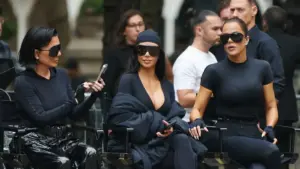
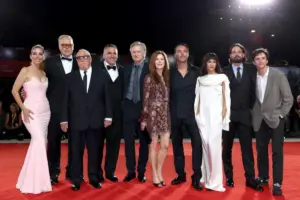
At the Musée des Arts Décoratifs (MAD), the international fashion community gathered for the official opening of “Look: 40 Years of Fashion at the Museum.” This blockbuster exhibition pulls back the curtain on four decades of textile curation, presenting a tightly edited yet breathtaking selection of 40 iconic ensembles culled from decades of historic programming. Spanning everything from aristocratic 18th-century French court attire to bleeding-edge contemporary acquisitions—such as an Alainpaul ensemble from the designer’s fall 2026 collection conceptualized around MAD’s own hidden mechanical inner workings—the showcase represents only an infinitesimal fraction of a treasure trove that runs more than 80,000 pieces deep.
Far more than a standard greatest-hits compilation, "Look" serves as a meta-exhibition. It is an intellectual and physical investigation into how clothing transitions from ephemeral runway statement to immortalized museum artifact. By examining the entire lifecycle of a garment—from the volatile sparks of a designer’s initial psychological impulse to the painstaking, multi-decade conservation efforts required to keep it alive—MAD has mounted a definitive manifesto on the cultural and historical gravity of dress.
Detailed Chronology & Curation: The Evolution of Textile Heritage
To understand the magnitude of "Look," one must trace the evolutionary arc of MAD’s fashion department over the last forty years. The museum has staged more than 70 distinct fashion exhibitions, transforming itself from a decorative arts repository into one of the most intellectually rigorous fashion institutions in the world.
The exhibition is mapped out to mirror the very lifespan of a garment. Curator Sophie Lemahieu designed the journey to begin inside the cerebral ecosystem of the creator. Visitors are immediately plunged into the private, often chaotic world of the atelier through rare, rarely displayed ephemera. Among these historical touchstones are the scaled-down wooden mannequins that legendary couturière Madeleine Vionnet used to drape every single creation in the early 20th century, alongside tissue paper-lined drawers brimming with bejeweled, sculptural shoes by Roger Vivier.
The Anatomy of Inspiration: Mood Boards and Ephemera
Moving deeper into the galleries, the exhibition offers rare glimpses into the psychological genesis of modern collections. Visitors encounter the feminist mood board created by Maria Grazia Chiuri for her watershed debut Christian Dior haute couture show in spring 2017. Nearby sits a magpie’s dream: a dense, hyper-textured "mood box" assembled by Josephus Thimister during his tenure at Balenciaga in the 2010s, stuffed haphazardly with raw fabrics, experimental accessories, and shimmering silvery star sequins.
These artifacts demystify the creative process, proving that greatness is rarely accidental. They reveal the frantic, tactile research that precedes a collection’s public consecration.
The Central Nave: Pop Culture and Runway Monoliths
Stepping into the museum’s grand central nave, the visitor is confronted by iconic moments where fashion crossed over into the collective global consciousness.

- John Galliano for Dior (Spring 1998): A breathtaking haute couture black-and-gold kimono ensemble that married European tailoring traditions with extreme Japanese theatricality.
- Guy Laroche (1972): The notorious, cheek-grazing, backless black velvet dress worn by actress Mireille Darc that sent seismic shockwaves through conservative society when it premiered onscreen.
Surrounding these centerpieces is an elite pantheon of modern design royalty. Seminal creations by Thierry Mugler, Yves Saint Laurent, Christian Dior, Hubert de Givenchy, Alexander McQueen, Christian Lacroix, Helmut Lang, Hussein Chalayan, Iris van Herpen, Valentino, Nicolas Ghesquière, Paco Rabanne, Rei Kawakubo, and Karl Lagerfeld (for Chanel) converse effortlessly across decades.
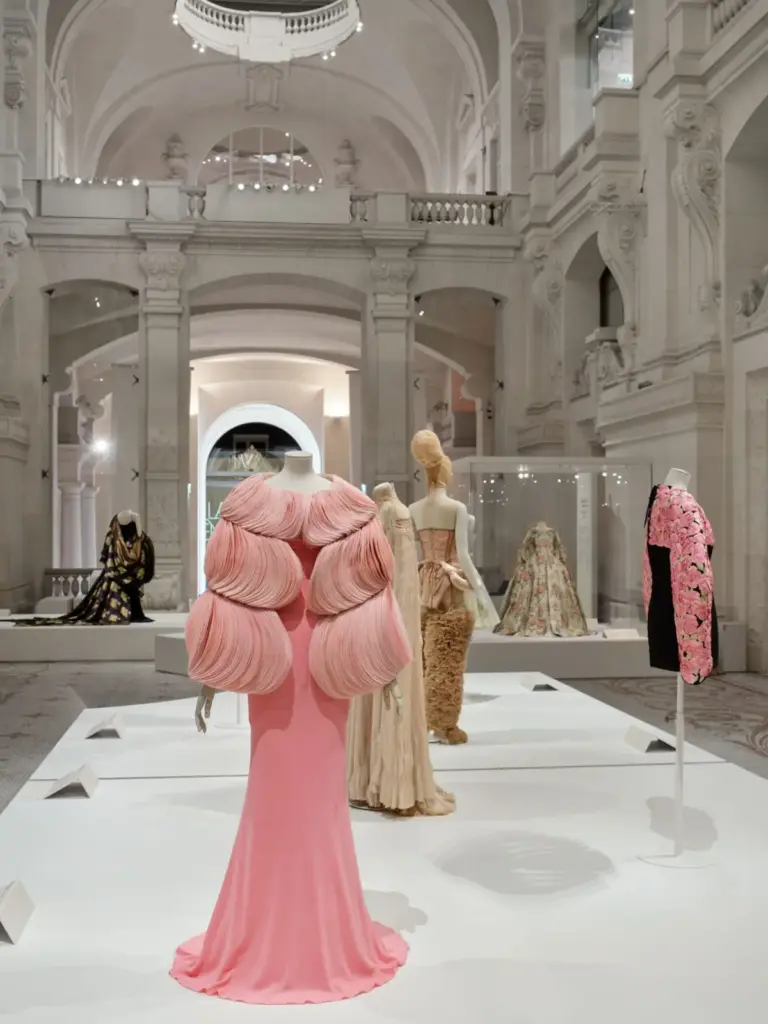
Pop culture moments are equally well-represented. The exhibition features Jean Paul Gaultier’s iconic quilted satin corset and ruffled leg designs alongside Alexandre Vauthier’s sculptural black ruffled mini-dress from the spring 2020 couture collection—the very dress worn by Rihanna to the ultra-exclusive Oscars after-party hosted by Beyoncé and Jay-Z. Another visual anchor is Valentino’s dramatic pink cape and gown, a millefeuille confection of silk organza, crepe, and silk from the designer’s haute couture fall 2007 collection, which was first spotlighted during his 45th anniversary exhibition and now stars on the poster for "Look."
Supporting Context & Metrics: Grassroots Movements and Archival Cross-Pollination
While haute couture dominates the narrative of high fashion, "Look" wisely steps outside the pristine white cube to acknowledge fashion in its most grassroots, disruptive expressions.
The Politics of Dress: The Gilets Jaunes
One of the most provocative displays in the scenography touches on the utilitarian origins of clothing as a socio-political tool. Featured prominently is the original neon-yellow safety vest that unexpectedly sparked the working-class gilets jaunes (Yellow Vests) uprising in France in 2018. The inclusion of the vest gains historical irony through an archival link to Karl Lagerfeld, who famously modeled one for a French road safety campaign with the deadpan tagline: "It’s yellow, it’s ugly, it doesn’t go with anything—but it could save a life." Little did the fashion world know that the mundane safety garment would soon become the global uniform of economic dissent.
Unlocking the Archives: A Century of Cross-Pollination
Surrounding the main installations are dense galleries filled with sketches, posters, doll-sized miniature mannequins, mood boards, swatch albums, technical patterns, brass buttons, intricate embroideries, and raw calico toiles. These items retrace the laborious taxonomy of how fashion is engineered, manufactured, and eventually preserved for posterity.
Crucially, the exhibition highlights the rich cross-pollination of fashion history, proving that no designer operates in a vacuum. By placing garments side-by-side across centuries, striking historical echoes emerge:
- A avant-garde look from John Galliano’s viral, hyper-theatrical Maison Margiela Artisanal couture show of spring 2024 can be traced directly back to a russet-fringed silk couture dress presented by Madeleine Vionnet exactly 100 years prior.
- A 19th-century textile motif filters down a century and a half later into an ensemble by Dries Van Noten, who meticulously reprised both its tulip motif and the loose, multicolored floating threads on its underside for a pair of striking coats in his spring 2014 collection.
- Maggy Rouff—a name largely forgotten by the contemporary consumer—is resurrected via a 1930s-era waxed silk satin slip dress that looks so effortlessly modern it could have stepped off a runway yesterday.
Official Statements & Curatorial Insights
The intellectual weight of the exhibition rests on the shoulders of its curatorial team, who view the MAD’s vast archives not as a static graveyard of old textiles, but as a living, breathing laboratory for future inspiration.
During a heavily attended international press preview, curator Sophie Lemahieu reflected on the psychological and operational scope of the exhibition:

"It’s like a major flashback," Lemahieu remarked, gesturing toward the sprawling timeline of garments. "The show’s arc covers the lifespan of a garment. It begins inside a designer’s mind, how they share ideas, what happens in the atelier—then how things arrive at a moment of consecration, why they become part of an exhibition, and then what goes into preserving and valorizing them."
Lemahieu emphasized that the archival preservation process is fundamentally generative rather than archival in the traditional, passive sense:
"That’s the thing about the archives," she added. "It’s not just about storage—every time we look at them, we discover something new."
This perspective reframes the museum curator not merely as a custodian of the past, but as an active participant in the ongoing dialogue of contemporary style. By stripping away the commercial pressures of the seasonal fashion calendar, exhibitions like "Look" allow garments to be judged on their purely sculptural, sociological, and technical merits.
Future Outlook: The Legacy of "Look" and the Future of Museum Curation
As the boundaries between fine art, performance, and commercial design continue to dissolve, "Look: 40 Years of Fashion at the Museum" arrives at a critical cultural juncture. Major fashion houses are increasingly building their own private museums, but institutional spaces like the Musée des Arts Décoratifs retain a vital, objective authority. They possess the unique ability to contextualize fashion within the broader history of human material culture.
The exhibition raises essential questions for the future of fashion scholarship: How will the digital era—defined by hyper-fast micro-trends and ephemeral digital artifacts—be curated for future museums? Can the tactile genius of a physical garment ever be fully captured in an age dominated by virtual runaways?
While those questions remain open for the next generation of curators to answer, MAD’s current retrospective offers a comforting reassurance. Fashion is not merely disposable commerce; it is an enduring archive of human desire, rebellion, and artistic genius.
“Look: 40 Years of Fashion at the Museum” runs at the Musée des Arts Décoratifs (MAD) in Paris from September 30, 2026, through April 4, 2027.