Beyond the Blue Suede Shoes: How Costume Designer Stacey Battat Mapped Priscilla Presley’s Silent Emancipation Through Fashion
Executive Overview
When Sofia Coppola’s cinematic adaptation of Elvis & Me—the groundbreaking 1985 memoir by Priscilla Presley—graced the silver screen, moviegoers braced themselves for a visual feast. Elvis Presley, the undisputed King of Rock ’n’ Roll, remains one of the most influential style icons of the twentieth century. With his penchant for peacocking, bedazzled jumpsuits, exaggerated capes, and unapologetic theatricality, his wardrobe defined the flamboyant excesses of the 1960s and 1970s. Yet, in Priscilla, starring Jacob Elordi as the magnetic musical titan and Cailee Spaeny as his vulnerable, wide-eyed wife, the sartorial focus shifts dramatically.
Rather than celebrating rock-and-roll extravagance, the film’s costume department, spearheaded by veteran designer Stacey Battat—who previously collaborated with Coppola on The Bling Ring and The Beguiled—uses clothing to tell a far more restrained, intimate, and ultimately devastating story. Through Battat’s meticulous vision, fashion becomes the primary language of entrapment, control, and, finally, liberation.
The narrative arc of Priscilla is mapped directly onto the fabrics, hemlines, and beauty regimes imposed upon a young girl plucked from relative obscurity and thrust into the gilded cage of Graceland. By tracing Priscilla’s evolution from an adolescent military brat wearing innocent pastel cardigans to an empowered woman reclaiming her natural curls and wide-leg trousers in 1970s Los Angeles, Battat offers a masterclass in psychological costume design. This comprehensive review and investigative deep dive explores how every stitch in Priscilla serves as a silent witness to a historic unfolding of female independence.
Detailed Chronology: A Sartorial Evolution from West Germany to Graceland
Act I: The Innocence of Bad Kreuznach (Late 1950s)
The film opens in West Germany, where fourteen-year-old Priscilla Beaulieu lives with her family on a United States Army base. To establish her youthful innocence and the stark cultural distance between her ordinary upbringing and the mythic American dream, Battat and her team immersed themselves in archival research. They scoured vintage issues of Vogue and Harper’s Bazaar dating back to the late 1950s and early 1960s, hunting for authentic textiles, silhouettes, and color palettes that would ground the opening acts in unpretentious realism.
In these early scenes, Spaeny’s Priscilla is defined by softness and approachability. She wears pastel-hued knit cardigans, sweet A-line skirts, and delicate heart-shaped necklaces that signify youthful romance before it has been corrupted by celebrity. One particularly striking sequence recreates a real historical photograph: Priscilla standing on a tarmac, waving goodbye to Elvis as he departs Germany for the United States. In both reality and the film, she wears a modest plaid dress paired with a sheer headscarf tied neatly beneath her chin.
This wardrobe establishes a baseline of uncorrupted authenticity. Priscilla is a civilian, a dependent military child whose clothing choices are dictated by maternal guidance, teen trends of the era, and personal comfort. It is a visual language that will soon be systematically dismantled and rewritten by her future husband.
Act II: The Gilded Cage of Graceland (1960s)
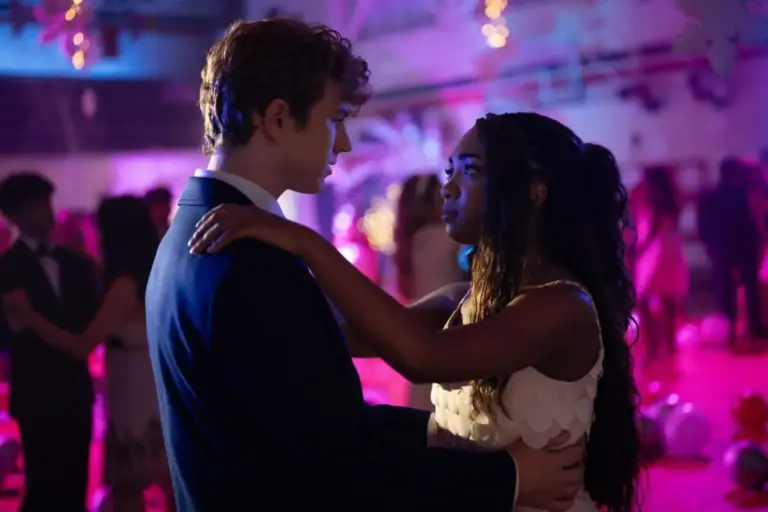
When Priscilla relocates to Memphis, Tennessee, to live within the imposing walls of Graceland under the watchful eye of the Presley entourage, her wardrobe undergoes a dramatic, involuntary metamorphosis. The innocent A-line skirts and cheerful hair ribbons are abruptly replaced by operatic evening gloves, dramatic bouffants, and glamorous cocktail dresses.
This shift is not organic; it is explicitly orchestrated. In a pivotal scene that highlights the psychological dynamics of their relationship, Elvis takes Priscilla on a private shopping spree, dictating precisely what she should wear, how she should style her hair, and how much makeup she should apply.
"That obviously dictates the costumes she wears later," Battat explains, reflecting on the scene where Elvis insists that Priscilla dye her natural brown hair jet-black and line her eyes with heavy, dramatic cat-eye makeup. From this moment onward, Priscilla is boxed into a curated aesthetic. Elvis harbored intense aversions to specific prints and earthy tones—banning patterns and browns from her closet—which resulted in a restricted color palette dominated by Elvis-approved shades of powder pink, ice blue, and stark white.
Despite the grandeur of her public-facing life, a significant portion of the narrative unfolds behind closed doors. Within the private corridors of Graceland, Priscilla is frequently seen wandering in pastel-toned lingerie sets and ethereal nightgowns. These garments serve a dual purpose: they emphasize her domestic containment while highlighting her physical fragility against the sprawling, intimidating backdrop of her husband’s empire.
Act III: The Wedding of the Century (1967)
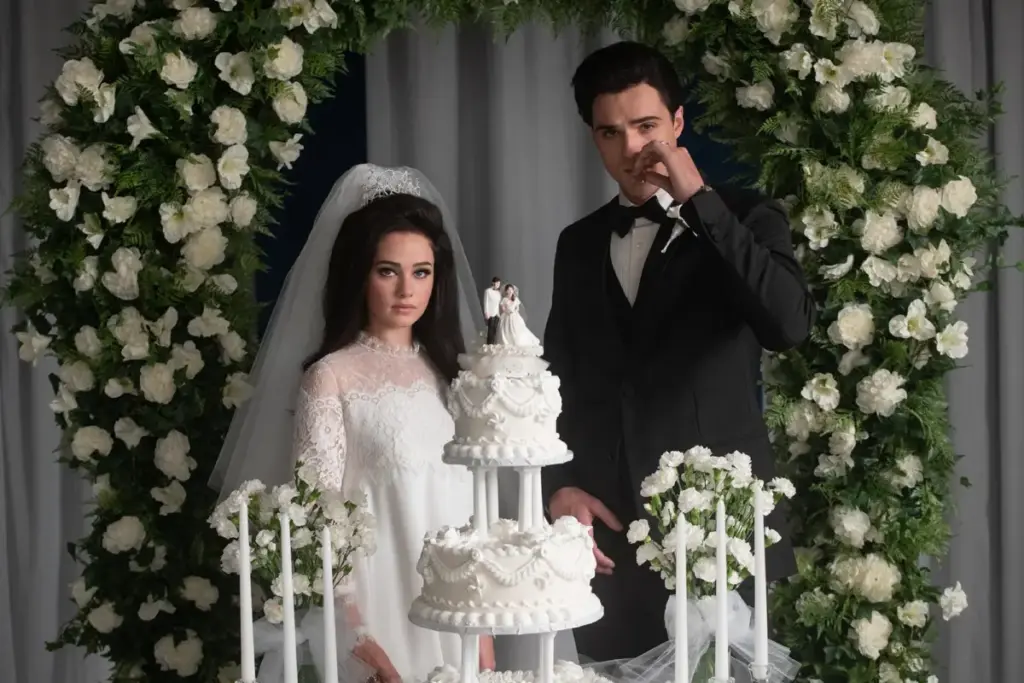
No examination of Priscilla Presley’s life or style is complete without addressing her historic May 1, 1967, wedding to Elvis in Las Vegas. Recreating this monumental cultural moment required unprecedented collaboration between the film’s wardrobe department and legendary fashion houses.
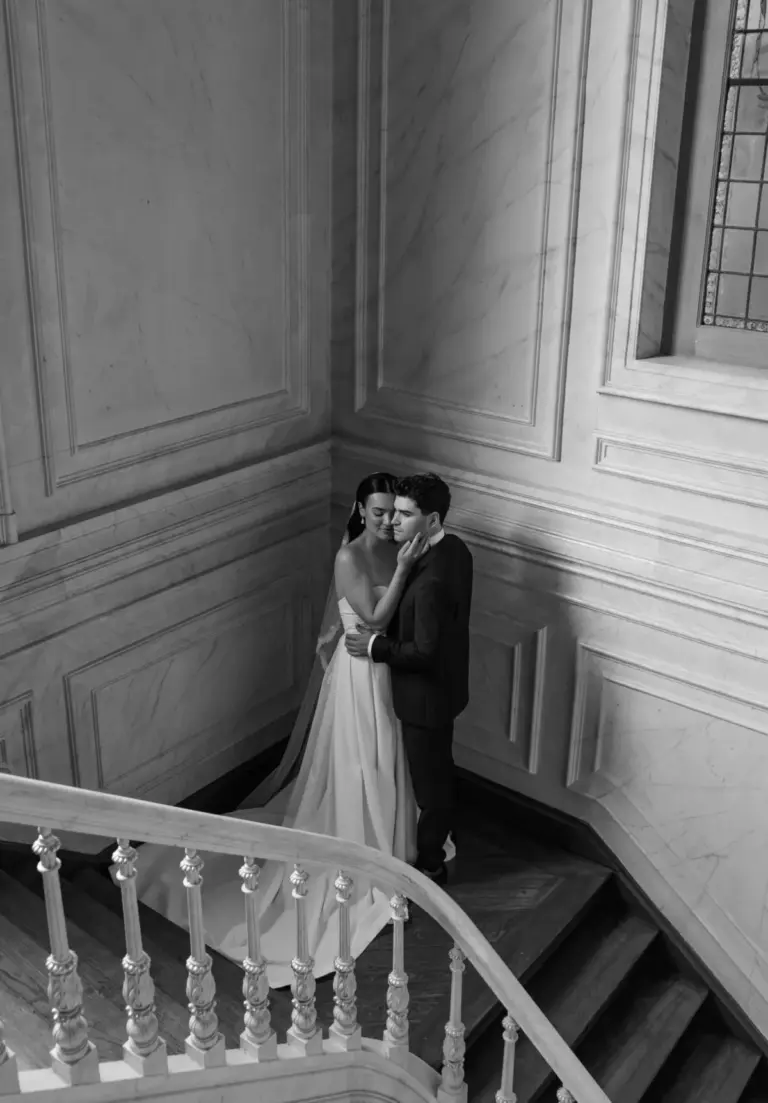
Battat partnered directly with Chanel and Valentino to recreate the iconic wedding attire. Chanel meticulously reconstructed Priscilla’s floor-length, lace-trimmed A-line wedding gown, complete with a voluminous tulle veil and a sparkling rhinestone tiara. Meanwhile, Valentino tailored Elvis’s sharp, bespoke black-and-silver brocade wedding suit.
"The look contains many allusions to the original dress," Battat notes, discussing the logistical hurdles of historical replication. "A portion of it had to be structurally altered to accommodate Cailee’s physical stature [standing at 1.56 meters, or approximately 5 feet 1 inch]."
Every detail, down to the dramatic eye makeup and the towering beehive updo, was painstakingly matched to the archival photographs of the Las Vegas ceremony. This commitment to accuracy extends to the immediate aftermath of the wedding, including the striking, vibrant pink dress Priscilla wears when leaving the hospital after the birth of their daughter, Lisa Marie.
Act IV: The Divergence and Liberation (1970s)
The emotional climax of Priscilla hinges on physical and emotional distance. In the film’s second half, Elvis reaches the absolute zenith of his career, performing high-octane, theatrical residencies in Las Vegas, while Priscilla remains increasingly isolated in Los Angeles. As their marriage steadily disintegrates, their sartorial paths diverge into entirely opposite directions.
Elvis fully embraces the bombastic, superhero-esque aesthetic of his late-career touring years. He sheds his classic leather jackets and tailored suits in favor of flamboyant, jewel-encrusted jumpsuits—masterpieces of stage wear crafted for the film through a collaboration with BK Enterprises, the historical creators of Elvis’s real stage costumes.
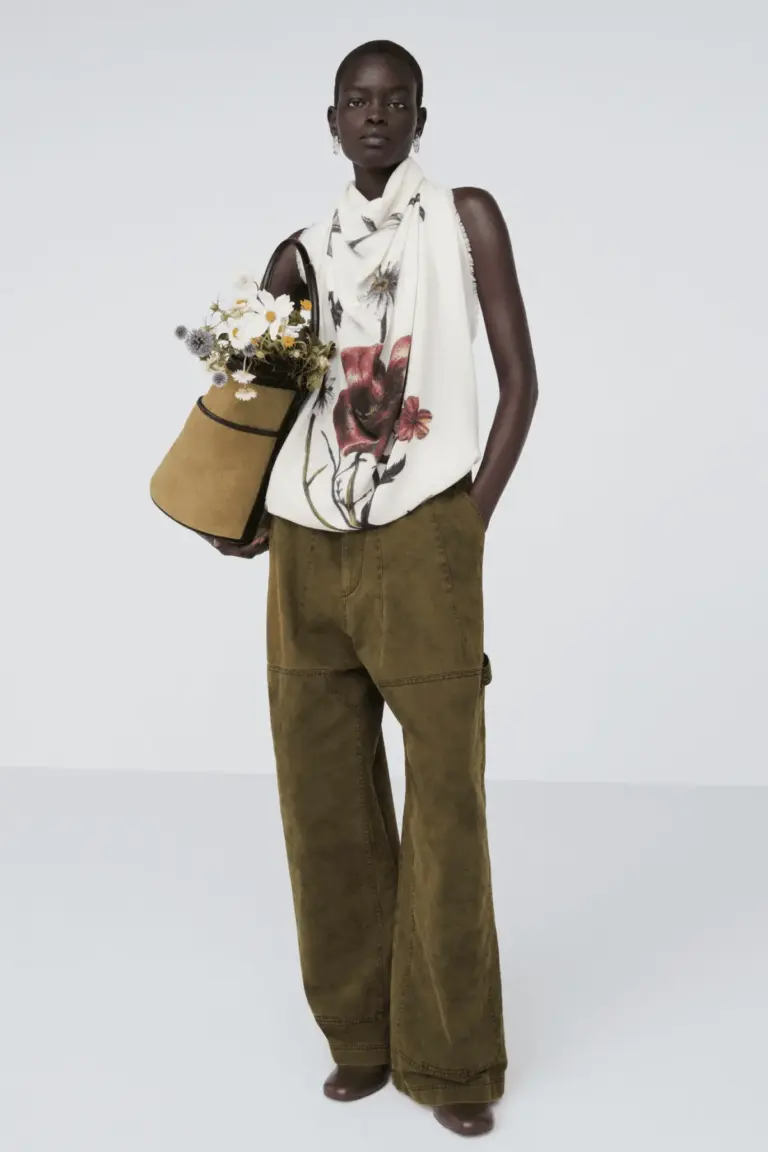
Conversely, Priscilla begins shedding the suffocating expectations of her marriage, gravitating toward the relaxed, earthy counterculture trends of the early 1970s. She abandons the heavy makeup, trades her form-fitting mini dresses for loose-fitting trousers and bohemian prints, and—most importantly—allows her natural brown hair to return in soft, cascading curls.
Supporting Context & Metrics: The Semiotics of Cine-Costuming
To fully appreciate the narrative weight of Priscilla, one must analyze the quantitative and qualitative choices made behind the scenes. Costume design in biographical cinema operates on a spectrum between documentary recreation and psychological interpretation.
- Archival Precision vs. Narrative Flow: Battat and her team reviewed hundreds of hours of home videos, tabloid clippings, and high-fashion spreads from Vogue and Harper’s Bazaar. However, rather than copying every historical outfit verbatim, approximately 60% of the film’s wardrobe was custom-built from scratch to ensure it enhanced Spaeny’s physical performance and reflected the psychological state of the character in real time.
- The Color Psychology: The color restriction enforced by Elvis in the script acts as a visual metaphor for gaslighting and control. The overwhelming presence of sugary pinks and artificial blues in the Graceland sequences creates an unsettling, dollhouse-like atmosphere. When Priscilla finally breaks free, earthy browns, natural textures, and unconstrained silhouettes flood the screen, symbolizing her psychological return to earth.
- Scale and Contrast: Standing at just 1.56 meters tall, Cailee Spaeny’s physical stature was intentionally leveraged by Battat to emphasize her vulnerability when placed next to Jacob Elordi (who stands at 1.96 meters, or 6 feet 5 inches). The towering hair and heavy gowns initially dwarf her, making her physical emancipation in the final scenes all the more triumphant when she finally occupies physical space on her own terms.
Official Statements and Design Insights
In exclusive discussions regarding the conceptualization of the film’s visual identity, Stacey Battat revealed how a single archival image unlocked the emotional core of the entire project.
Reflecting on a photograph taken of Elvis and Priscilla in 1970—at a time when their emotional estrangement was palpable—Battat noted the profound sadness etched into Priscilla’s posture.
"Sofia [Coppola] and I looked at this picture together and we both agreed that Priscilla looked like she felt profoundly uncomfortable," Battat shares. "I think that photograph strongly mirrors how we see the two of them later in the film."
Battat elaborated on the collaborative nature of translating real-life trauma into wearable art:
"We looked at historical photos of Elvis and Priscilla and thought about the image they consciously projected to the world. I think he became increasingly theatrical and costumey—heavy makeup, excessive jewelry, and exaggerated sideburns. She, on the other hand, gradually removes her mask and strips away the performance."
This contrast between Elvis’s escalating artifice and Priscilla’s stripping away of artifice forms the thematic backbone of Coppola’s cinematic thesis. While Elvis hid behind the armor of a living monument, Priscilla found her strength in stripping away the armor entirely.
Future Outlook: The Cultural Legacy of Priscilla’s Aesthetic
The release of Priscilla has already sent shockwaves through the contemporary fashion and beauty industries. Just as Baz Luhrmann’s 2022 biopic Elvis sparked a renewed interest in 1950s menswear and rockabilly subcultures, Coppola’s film has initiated a massive cultural resurgence centered around 1960s minimalism, mod fashion, and dramatic retro beauty standards.
Fashion forecasters note a significant uptick in consumer demand for pastel knitwear, A-line shift dresses, sixties-style headscarves, and oversized cat-eye sunglasses. Furthermore, beauty influencers and runway stylists have eagerly adopted the "Priscilla-core" aesthetic, characterized by voluminous beehives, pale glossy lips, and dramatic winged eyeliner.
Beyond immediate retail trends, Priscilla has permanently shifted how biographical films approach costume design. Critics and film historians alike are praising Battat’s work as a gold standard in utilizing wardrobe not merely as window dressing or historical pastiche, but as an active narrative agent. By showing how clothes can both confine and liberate the human body, Priscilla offers a timeless meditation on identity, autonomy, and the courage it takes to step out of the spotlight and into one’s own truth.
Priscilla is available to stream and view in cinemas nationwide.