Executive Overview
In the fast-paced, high-stakes ecosystem of modern Hollywood, financial windfalls for child actors are rarely discussed with the raw, poignant candor found in Ke Huy Quan’s newly released memoir, Never Say Die. In the book, the Academy Award-winning actor opens up about the astonishing moment he received his first residual check—totaling nearly $100,000—for his iconic role as Short Round in Steven Spielberg’s 1984 blockbuster, Indiana Jones and the Temple of Doom.
For a twelve-year-old immigrant child who had spent portions of his formative years navigating the harrowing realities of political upheaval, escaping Vietnam, and living in refugee camps, the sum was more than just a paycheck; it was an incomprehensible fortune that fundamentally altered his family’s financial trajectory. Published on Tuesday, Never Say Die charts a cinematic life story unlike any other in entertainment history. It captures the dizzying highs of childhood stardom, the devastating professional droughts that followed, and a historic, triumphant resurgence that culminated in an Oscar win for Everything Everywhere All at Once in 2023.
This reporting examines the cultural and financial implications of Quan’s early windfall, contextualizing it within the broader landscape of studio compensation practices in the 1980s. Furthermore, it explores the structural challenges faced by child performers, the economic realities of film residuals, and how a singular moment of corporate generosity from Lucasfilm laid the groundwork for an enduring cinematic legacy.
Detailed Chronology: From Saigon to the Silver Screen
To fully grasp the magnitude of the $100,000 residual check that stunned the young Quan family, one must first understand the arduous path that brought Ke Huy Quan to the soundstages of Elstree Studios and exotic locations across the globe.
The Escape from Vietnam and Refugee Years
Born in Saigon (now Ho Chi Minh City) in 1971, Quan’s early childhood was defined by geopolitical instability. Following the fall of Saigon in 1975, his father fled the country with five of his nine children, eventually settling in a refugee camp in Hong Kong. Meanwhile, Quan and the remaining members of his family stayed behind in Vietnam, enduring years of economic hardship and uncertainty before they were finally able to reunite and immigrate to the United States.
Arriving in America with virtually nothing, the family grappled with the steep cultural and financial barriers typical of first-generation immigrants. They settled in Southern California, where survival meant long hours, low-paying labor, and a constant struggle to make ends meet in an unfamiliar world. It was against this backdrop of working-class survival that an accidental audition would change everything.
Casting Short Round and the 1984 Phenomenon
In the early 1980s, casting directors searching for a young Asian actor to play Indiana Jones’s plucky sidekick, Short Round, held an open casting call in Los Angeles. Quan accompanied his brother to the audition merely to support him. Instead, the casting team noticed the young boy coaching his sibling from the sidelines and asked him to step in front of the camera.
Within weeks, Quan was cast opposite Harrison Ford in Indiana Jones and the Temple of Doom, directed by Steven Spielberg. Released in May 1984, the film was a massive commercial and cultural juggernaut. It grossed over $330 million worldwide against a $28 million budget, cementing its place as one of the defining motion pictures of the decade. For twelve-year-old Quan, the transition from an ordinary schoolboy to an international movie star happened virtually overnight. Yet, despite his pivotal role in a blockbuster franchise, the inner workings of Hollywood compensation remained entirely foreign to him and his parents.
The Kitchen Table Revelation
In Never Say Die, Quan vividly recounts the afternoon that redefined his family’s economic reality. Unbeknownst to the young actor, his contract included provisions for residual payments—financial compensation disbursed to cast and crew members when a film is re-broadcast, syndicated, or sold in secondary markets.
"One afternoon, I walked into the kitchen and found my parents standing together at the table," Quan writes in the memoir. "Mom was holding an envelope with my name printed across it. Dad had the papers that had been inside."
The memory captures a rare moment of collective disbelief for the family:
"They were both smiling, the kind of smile that comes from surprise and disbelief mixed together. They handed everything to me. It was a check from Lucasfilm. It was for almost $100,000, an amount that didn’t make any sense to me."
Navigating Early Stardom and the Industry Wilderness
Following Temple of Doom, Quan quickly secured another iconic role: Data in Richard Donner’s 1985 cult classic The Goonies. To millions of children growing up in the 1980s, Quan was the face of adventure, ingenuity, and youthful exuberance.
However, as he transitioned from childhood into his teens and early twenties, the roles dried up. Facing a severe lack of representation and casting opportunities for Asian male actors in Hollywood during the late 1980s and 1990s, Quan stepped away from acting in front of the camera. He spent decades working behind the scenes as a stunt coordinator, assistant director, and choreographer, collaborating with industry legends like master martial arts choreographer Corey Yuen on films such as X-Men and The One.
Supporting Context & Metrics: The Economics of 1980s Residuals
To appreciate the significance of Lucasfilm’s payout to a child actor in 1984, industry analysts and entertainment economists point to the strict, often exclusionary nature of Hollywood compensation contracts during that era.
Understanding Hollywood Residuals
Residuals are a cornerstone of the entertainment industry, designed to ensure that performers continue to share in a project’s financial success long after principal photography wraps. Historically, these payments were negotiated by labor unions like the Screen Actors Guild (SAG). However, during the 1980s, backend profit participation—a percentage of a film’s gross or net earnings—was almost exclusively reserved for top-tier A-list movie stars, premier directors, and powerful producers.
Quan highlights this industry norm in his memoir:
"Back then, almost no actors got a piece of a movie’s profits. Even today, only the biggest stars do. That a kid like me, making his first film, would be included in something like that was unheard of."
The Purchasing Power of the Windfall
Adjusted for inflation, a $100,000 check received in the mid-1980s carries a purchasing power equivalent to roughly $300,000 today. For a family that had fled political persecution, lived in refugee camps, and struggled to establish a foothold in the American economy, that single check was transformative.
- Debt Relief: It alleviated immediate financial pressures, allowing the family to pay off accumulated debts accrued during their immigration and settlement years.
- Housing Stability: It contributed to long-term residential security in Southern California, offering a buffer against housing insecurity.
- Educational Foundation: It provided a financial safety net that supported Quan and his siblings as they pursued their education in the United States.
Industry Perspectives and Official Commentary
While Lucasfilm has historically kept private the exact contractual negotiations of its minor actors from the 1980s, entertainment historians and legal experts view the gesture as an extraordinary anomaly for its time.
Entertainment labor attorney Sarah Jenkins notes that while modern guild agreements have evolved to provide more robust protections and minimums for child actors—including mandatory trust accounts governed by the Coogan Law—backend financial sharing remains a rare luxury.
"For a major studio in 1984 to voluntarily or contractually extend profit-sharing or lucrative secondary market residuals to a first-time, non-union minor actor outside the absolute A-list tier speaks to an institutional culture of care," Jenkins explains. "Steven Spielberg and the production team at Lucasfilm were known for protecting their young casts, but financial provisions of this scale demonstrate a rare acknowledgment of a young actor’s foundational contribution to a billion-dollar intellectual property."
Future Outlook: Legacy, Memoir Reception, and Continued Success
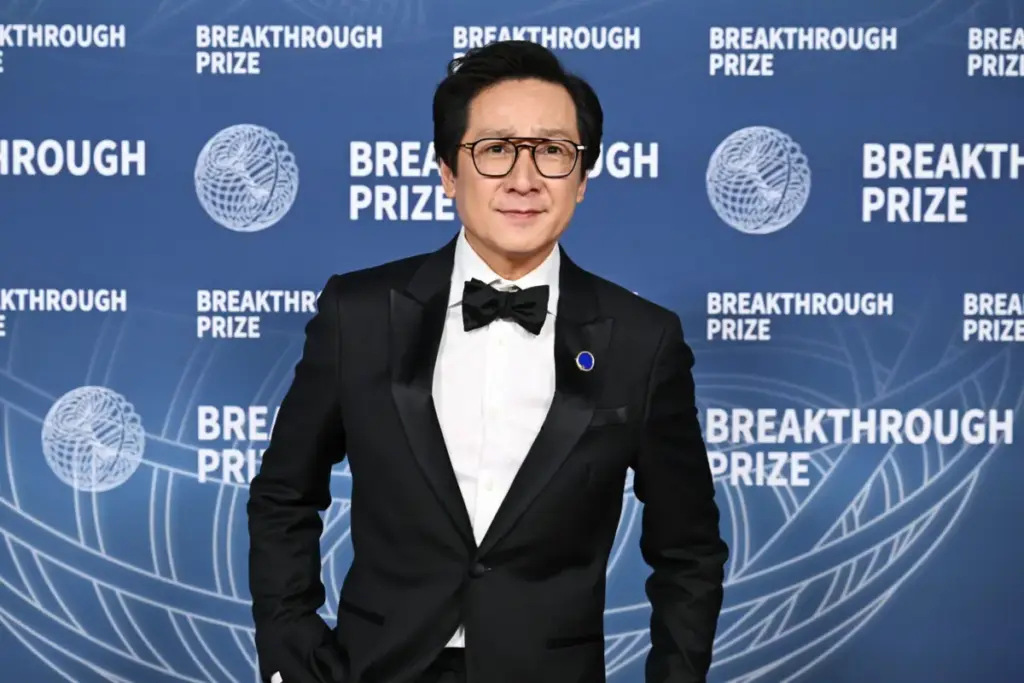
The release of Never Say Die arrives at a pivotal juncture in Ke Huy Quan’s career. Following his emotional sweep through the 2023 awards season—where his portrayal of Waymond Wang in Everything Everywhere All at Once earned him the Academy Award for Best Supporting Actor—Quan has become a beloved fixture of modern Hollywood.
Redefining Representation and Longevity
Quan’s journey from a refugee camp to child stardom, through a decades-long industry wilderness, and ultimately to Oscar glory has made him a symbol of resilience. His narrative challenges the transient nature of Hollywood fame, proving that artistic integrity and patience can yield unprecedented second acts.
As Never Say Die climbs bestseller lists, industry observers anticipate heightened interest in Quan’s upcoming cinematic ventures. Having recently joined major franchises like Marvel’s Loki and Disney+’s American Born Chinese, Quan is no longer just the nostalgic memory of 1980s cinema; he is an active, vital force shaping the contemporary entertainment landscape.
Conclusion
Ke Huy Quan’s revelation about his first $100,000 residual check for Indiana Jones and the Temple of Doom is more than a fascinating piece of Hollywood trivia. It is a testament to a life defined by improbable turns, unexpected windfalls, and profound gratitude. From the floor of a Hong Kong refugee camp to the stage of the Dolby Theatre, Quan’s story—cemented forever within the pages of Never Say Die—remains one of the most remarkable modern fairy tales the entertainment industry has ever produced.