Executive Overview
For centuries, the luminous, iridescent pearl occupied a predictable and carefully guarded space within the global lexicon of style. Long associated with quiet restraint, homogeneous decorum, and the polite inheritance of a grandmother’s jewelry box, the classic pearl strand was the ultimate symbol of bourgeois propriety. It spoke of high teas, presidential inaugurations, and strict sartorial rules.
Today, that narrative has been utterly upended. We have officially reached peak pearl, but not as the fashion industry once knew it. Across global runways—from the theatrical avant-garde of Vaquera and Simone Rocha to the historic houses of Valentino and Chanel—pearls have broken free from their traditional constraints. Stacked, oversized, hyper-layered, and aggressively reinvented, the gemstone has evolved into a vehicle for raw individuality and personal expression.
Most significantly, pearls have gone punk.
This transformation is not merely a fleeting seasonal whim; it is a profound cultural collision between high-society elegance and anti-establishment rebellion. Driven by unexpected cross-industry collaborations, boundary-pushing independent high-jewelry designers, and a renewed appreciation for subversive heritage, the modern pearl has emerged as an emblem of modern rebellion. By juxtaposing the pristine, organic geometry of the ocean’s most delicate gem with heavy metal, gothic iconography, and raw punk attitude, contemporary fashion has rewritten the rules of luxury.
Detailed Chronology: From Demure Tradition to Subversive Rebellion
To understand how the pearl shed its conservative skin, one must trace its journey through the annals of fashion history—a trajectory defined by moments of calculated shock and stylistic evolution.
The Mid-20th Century: The Era of Strict Decorum
In the post-war era, the single-strand Akoya pearl necklace reigned supreme. Worn as a uniform by icons like Jackie Kennedy, Grace Kelly, and Audrey Hepburn, pearls were synonymous with immaculate taste and adherence to social norms. They were classic, predictable, and firmly entrenched in the upper echelons of polite society. To alter or mishandle them was stylistic heresy.

Fall 1987: Vivienne Westwood Ignites the Spark
The first major fracture in the pearl’s pristine facade occurred on the runway of British fashion’s ultimate iconoclast, Vivienne Westwood. For her Fall 1987 collection, Westwood introduced a subversive take on pearls, weaponizing their prim connotations against the very society that birthed them. Three years later, in 1990, she cemented her legacy as the godmother of punk pearls by releasing the infamous Three-Row Pearl Pearl Drop Choker—a design featuring an orb-embossed central clasp that instantly bridged the gap between regal pageantry and punk rock anarchy.
Concurrently, pop culture icons like Madonna were redefining the gemstone. During her Like a Virgin era in the mid-1980s, Madonna famously piled thick, heavy strands of pearls alongside vintage rosaries, heavy crucifixes, and raw lace. She wore them not with a Chanel tweed suit, but with distressed bustiers, crucifix earrings, and crucifixes—proving that the gemstone could transcend its upper-class origins and thrive in downtown New York subcultures.
The 2010s: The Avant-Garde Avant-Luxe
As the twenty-first century progressed, independent designers began experimenting with the physical structure of the pearl itself. In 2010, pioneer Melanie Georgacopoulos began challenging conventional perceptions by cutting, drilling, and embedding pearls into unorthodox settings, pushing the boundaries of what the gem could endure structurally and aesthetically.
The 2020s to Present: The Runway Explosion and Modern Collaborations
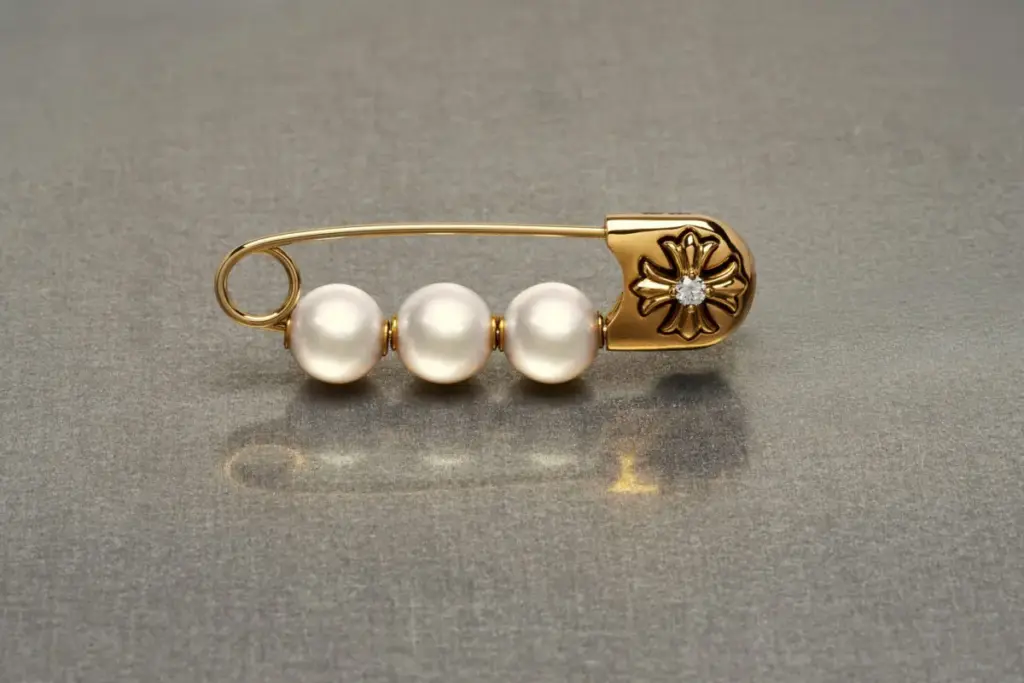
By the mid-2020s, the trend reached critical mass. Pearls conquered menswear, streetwear, and high fashion simultaneously. Brands like Mikimoto—historically the custodians of cultured pearl perfection—began partnering with counter-culture icons like Chrome Hearts. The resulting collections merged the world’s finest Akoya pearls with 22K yellow gold, gothic crosses, and safety pin motifs, signaling a full-scale institutional embrace of the punk aesthetic. Today, in 2026, the market for reimagined pearls is vast, encompassing everything from high-jewelry capsules to custom heirloom redesign services.
Supporting Context & Metrics: The Anatomy of the Trend
The resurgence of the pearl is supported by distinct shifts in consumer behavior, manufacturing techniques, and design philosophies.
Materiality and Contrast
The core appeal of the modern "punk pearl" lies in visual and tactile contrast. Pearls are inherently organic, fragile, and soft (ranking relatively low on the Mohs scale of mineral hardness). When paired with aggressive, industrial materials—such as oxidized sterling silver, heavy gunmetal cuffs, titanium chains, and studded leather—the tension creates a compelling visual narrative.

Designers are utilizing these contrasting elements to subvert expectations:
- Melanie Georgacopoulos’s "Eclipse" Capsule: This high-jewelry collection sandwiches lustrous pearls between the stark, dark edges of gunmetal-hued metal cuff bracelets, creating an illusion of a celestial eclipse formed by industrial and organic matter.
- Gaia Repossi and Sophie Bille Brahe: These contemporary designers have stripped pearls of their traditional stringing, instead embedding them directly into modernist architectural rings or lining them meticulously into tiny, studded hoop earrings that command attention rather than whisper in the background.
- Upcycling and Heirloom Transformation: Services like Marla Aaron’s "Your Pearls Reimagined" allow consumers to take inherited, unused family heirloom pearl strands and completely overhaul them. By stringing them on vibrant, neon-colored cords and adding edgy, gemstone-studded charm loops, sentimental value is preserved while contemporary grit is injected.
Demographic Shift: Gender Fluidity and Age-Agnostic Appeal
Unlike the targeted marketing of past decades, which positioned pearls strictly as feminine bridal or maturity gifts, today’s pearl market is entirely ageless and gender-agnostic. Men’s fashion has fully embraced the pearl necklace, with male style icons and athletes regularly sporting multi-layered strands on red carpets and courtside.
As Andreas Kronthaler, creative director of Vivienne Westwood, noted in an interview with ELLE:
"There’s nothing more flattering than pearls. They play with the whites of your eyes and teeth; pearls really talk to you. And they work on everybody, from young to old, women and men, everyone. You can wear them all the time—it’s one of the few things you can. You can even wear them for breakfast!"
Official Statements and Industry Insights
The evolution of the pearl from a symbol of conformity to a badge of individuality has been closely monitored by the luxury sector’s leading creative forces. Industry collaborations offer a clear window into this strategic pivot.
When Japanese luxury pearl titan Mikimoto joined forces with Los Angeles-based gothic-luxury house Chrome Hearts for their second collaborative collection, it sent a definitive message to the jewelry world. The resulting five-piece collection—featuring Akoya pearls and diamonds set in luscious 22K yellow gold, punctuated by Chrome Hearts’ signature gothic crosses and safety pin brooches—was designed for an exclusive clientele. Available only at select flagship boutiques in Tokyo, London, New York, and Mikimoto’s Ginza store, the collection proved that high-end heritage brands are eager to tap into the rebellious energy of streetwear and subculture.

Industry analysts note that this shift reflects a broader consumer desire for personalization and irony in luxury. Consumers no longer wish to purchase static symbols of wealth; instead, they seek items that tell a complex story. By wedding the ultimate symbol of traditional luxury (the pearl) with the iconography of punk (safety pins, crosses, heavy hardware), brands are offering a sophisticated form of sartorial irony.
Future Outlook: Where the Trend Goes From Here
As we look toward the remainder of the decade, the punk pearl trend shows no signs of slowing down. Rather than fading into a passing novelty, the subversion of classic jewelry codes has become a permanent fixture of modern design philosophy.
1. Advanced Material Experimentation
Expect to see further technical innovation in how pearls are treated. The integration of pearls with unconventional substances—such as carbon fiber, raw titanium, ceramic coatings, and recycled industrial plastics—will continue to push the envelope of high jewelry and avant-garde fashion.
2. The Rise of Hyper-Personalization
With services that allow consumers to dismantle and rebuild vintage strands gaining mainstream traction, the future of pearl ownership is inherently sustainable and deeply personal. The days of keeping a pristine pearl necklace locked away in a velvet box for special occasions are officially over. The modern directive is to wear them hard, layer them recklessly, and mix them with unexpected wardrobe staples—from a tailored Savile Row suit to a distressed leather biker jacket.
3. Permanent Cultural Integration
Ultimately, the punk pearl represents a maturation of modern style. It teaches us that tradition and rebellion do not have to be mutually exclusive. By taking the most traditional element of historical dress and filtering it through a lens of individualistic grit, contemporary fashion has proven that true elegance is not about following the rules—it’s about knowing how to break them with style.