Executive Overview
Spain is undergoing an unprecedented cultural and economic renaissance, cementing its status as the premier audiovisual production hub in the European Union. Fueled by a combination of state-backed financial engineering, world-class technical infrastructure, and an abundance of creative talent, the Spanish screen sector has evolved into a global juggernaut.
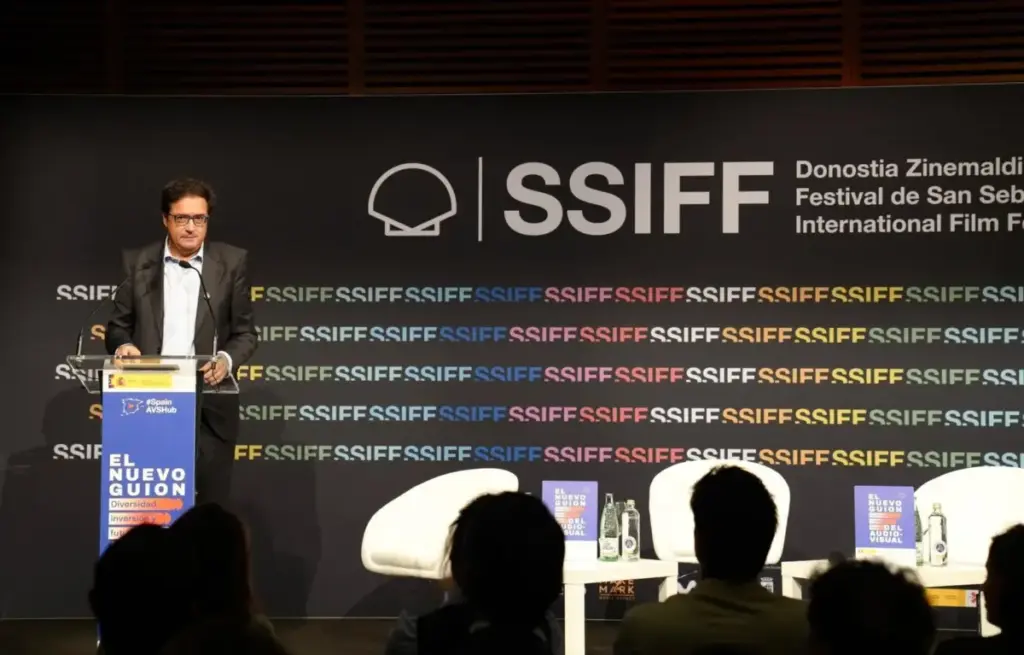
Speaking at the San Sebastian Film Festival during a keynote address titled The New Script of the Audiovisual Industry, Óscar López, Spain’s Minister for Digital Transformation and Public Administration, articulated a clear message: the government’s commitment to the screen sector is permanent, unyielding, and designed to weather political cycles.
López’s declarations arrived at a watershed moment for the country’s creative economy. Hours after his address, La Bola Negra, a highly anticipated feature from Spanish auteurs Javier Calvo and Javier Ambrossi, clinched the coveted TIFF People’s Choice Award at the Toronto International Film Festival—a distinction historically recognized as a reliable bellwether for Academy Award contention. Simultaneously, Spanish content continues to dominate global streaming metrics, accounting for more titles in Netflix’s all-time non-English Top 10 than any other nation globally.
Underpinning this creative triumph is a massive financial commitment. Through the Spain Audiovisual Hub Plan and the newly mobilized Spain Crece Fund, the Spanish government has injected approximately €1.6 billion into the ecosystem. This strategic capital infusion has triggered a dramatic structural transformation, creating tens of thousands of jobs, driving a 31% year-on-year growth in domestic production for 2025, and capturing the attention of international heavyweights and independent producers alike.
Detailed Chronology & Event Breakdown
The revelations surrounding Spain’s media boom unfolded over a packed weekend of high-level panels, industry presentations, and international accolades at the San Sebastian Film Festival.
Sunday Keynote: Minister Óscar López at San Sebastian
Taking the stage at The New Script of the Audiovisual Industry, Minister Óscar López delivered an emphatic defense of long-term state intervention in the arts and digital economies.
"When a public policy works, it should be maintained without a deadline. It is the golden age for our audiovisual sector," López told an audience of international executives, producers, and policymakers.
López traced the sector’s trajectory from a landscape rich in talent and locations but starved of institutional backing, to a modernized, heavily capitalized powerhouse. He credited the Spain Audiovisual Hub Plan as the institutional anchor that made it possible to design an economic transformation on an unprecedented scale.
The TIFF Triumph: La Bola Negra Takes Toronto
The timing of the minister’s address was punctuated by international validation. Just hours after the keynote, word broke from Canada that La Bola Negra, directed by the creative duo Javier Calvo and Javier Ambrossi, had secured the prestigious TIFF People’s Choice Award.
The Toronto audience prize has a storied history of flagging future Oscar contenders, instantly positioning the film as a major international player and validating Spain’s contemporary narrative ambitions on the global stage.
Panel Insights: Industry Leaders Weigh In
The festival hosted three primary panel discussions dissecting the future of European content, venture capital, and the convergence of linear and digital broadcasting:
- The Venture Capital Catalyst: Moderated discussions highlighted the operational impact of SETT (the Spanish Society for Technological Transformation). Independent producers who have worked across Hollywood and the UK praised the agile nature of Spain’s new funding mechanisms. Miriam Segal of Good Film Studios noted that for the first time in her career as an independent producer, state-backed capital security allowed her to issue competitive "pay-or-play" deals to high-profile talent. Meanwhile, José Carlos García of Ánima Kitchen detailed how SETT’s backing has enabled the animation studio to aggressively scale up talent acquisition and execute a pipeline of three high-end animated features over a five-year horizon.
- The European Roadmap: A cross-border panel featuring representatives from Spain, Greece, and Denmark debated the delicate balance between preserving European cultural diversity and achieving global scale. Carla Redondo of Spain’s Ministry of Digital Transformation framed Europe’s fragmentation not as a weakness, but as its defining strength. Delegates from Greece (Ekkomed) and Denmark underscored the necessity of administrative harmonization, regional coproduction, and leveraging incoming international productions to build permanent domestic infrastructure.
- The Evolution of Linear Television: Challenging the narrative of traditional television’s demise, executives from Mediaset España, RTVE, Atresmedia, and Movistar Plus argued that linear broadcasting has successfully mutated into a multifaceted digital ecosystem. Fernando Hernaiz of Mediaset insisted that television is no longer just a broadcast medium, but an integrated continuum of technology, writing, creation, and commerce.
Supporting Context & Metrics: The Numbers Behind the Boom
The anecdotal success of Spanish series and films is firmly backed by hard data. A sneak peek of the upcoming comprehensive study by Olsberg SPI—presented by the Spain Film Commission’s Juan Manuel Guimerans and Olsberg’s Leon Forde—paints a vivid picture of a macro-economic engine operating at maximum capacity.
Economic Impact and Growth Metrics (2020–2025)
- Direct Production Expenditure: Estimated at a staggering €20 billion between 2020 and 2025.
- Gross Value Added (GVA): Generated nearly €18 billion in total economic value for the Spanish economy.
- Production Growth: Domestic audiovisual production surged by 31% in 2025 alone.
- Investment Surge: Direct industry investment registered a massive 45% increase, while GVA rose by 38%.
- Global Market Share: Spain is now officially the largest production market within the European Union. Furthermore, Spanish productions account for an astonishing nine of the eleven most-watched television series across Europe, according to ministerial figures.
Employment and Spillover Effects
The human capital footprint of the sector has undergone a radical expansion:
- Job Creation: Employment in the audiovisual sector has more than doubled since 2020, skyrocketing from 30,900 workers to over 64,000 professionals by 2025.
- The Supply Chain Multiplier: According to the Olsberg SPI data, more than 50% of the jobs generated by film and television production are realized outside direct crew positions—benefiting vital auxiliary supply chains including construction, hospitality, transport, and technology services.
Leon Forde of Olsberg SPI described the audiovisual sector as a delicate, interdependent "ecosystem" where every species is indispensable, noting that continued data collection is crucial to fine-tuning public policy. The full, unabridged Olsberg-SPI report is scheduled for release on September 22.
Official Statements and Institutional Vision
The transformation of Spain’s media landscape has been engineered through close cooperation between public administrators and private creative enterprises. The policy framework relies on targeted, high-impact state investments designed to de-risk private capital deployment.
Óscar López on Permanent State Commitment
Minister Óscar López underscored that the government views the creative sector not merely as a cultural vanity project, but as a critical pillar of Spain’s digital and industrial economy.
"We had the talent, the ideas and the locations. What was missing was political will and a significant injection of capital," López stated, reflecting on historical under-funding.
He highlighted the Spain Audiovisual Hub Plan as an unprecedented institutional commitment. With €1.6 billion successfully deployed to date, the strategy is shifting into its next phase: leveraging the financial might of SETT (the Spanish Society for Technological Transformation).
SETT and Private Sector Empowerment
SETT is slated to inject an additional €450 million directly into leading Spanish production and media technology companies, including prominent players like Lazona, Good Films, and Aurora Media.
Private sector leaders have been vocal about the operational impact of these funds. Miriam Segal, founder of Good Film Studios, offered high praise for the nation’s production infrastructure:
"I didn’t know about this incredible industry infrastructure or the government’s extraordinary passion and commitment to the sector. For the first time as an independent producer, this support has enabled me to offer pay-or-play deals to actors."
Similarly, José Carlos García of animation titan Ánima Kitchen emphasized that SETT’s intervention has provided the financial runway necessary to secure intellectual property, recruit top-tier digital artists, and execute multi-year strategic slates that secure Spain’s leadership in European animation.
Future Outlook: Challenges and Horizons
While the immediate outlook is overwhelmingly positive, policymakers and industry stakeholders gathered at San Sebastian are acutely aware of the systemic hurdles that lie ahead as the global entertainment landscape evolves.
Regulatory Harmonization and Audience Fragmentation
During the broadcasting and digital platforms panels, executives from RTVE, Atresmedia, and Movistar Plus pointed to audience fragmentation as an ongoing operational challenge. As viewers scatter across a proliferating array of subscription video-on-demand (SVOD) platforms, free ad-supported streaming television (FAST) channels, and social media ecosystems, traditional measurement models are struggling to keep pace.
Panelists called upon European regulators to establish agile, modernized legislative frameworks that can adapt at the speed of digital innovation without stifling indigenous creativity.
Infrastructure Expansion and Regional Capacity
To sustain a workforce that has doubled in five years, Spain must continue upgrading its physical infrastructure. Projects like the Ciudad de la Luz complex in Alicante are emblematic of this push, offering world-class soundstages and water tanks capable of attracting massive Hollywood studio tents while simultaneously nurturing local independent features.
The Path Forward
As Spain approaches the full publication of the Olsberg SPI data and prepares to deploy the latest round of SETT venture capital, the country’s strategic roadmap is clear. By treating storytelling as an export-grade industrial product backed by sovereign venture capital, flexible regional funding, and deep creative freedom, Spain has successfully transitioned from a scenic backdrop for foreign filmmakers into an autonomous, self-sustaining global content powerhouse.
With critical darlings like La Bola Negra leading the charge toward the international awards season, and foundational studios expanding their operational footprints, Spain’s audiovisual golden age shows no signs of waning.