Executive Overview
In what has become one of the deadliest transportation disasters in the recent history of Cape Verde, a horrific bus crash on the island of Fogo has left 25 people dead and numerous others severely injured. The tragic incident occurred on Saturday, September 5, 2026, when a vehicle carrying a group of primary and secondary school students veered off a mountain road and plunged approximately 30 metres into a steep, rocky ravine in the northern region of the island.
The journey was meant to be a joyous occasion—an annual excursion traditionally organized by the dedicated bus driver as a heartfelt gift to reward the students he safely transported to and from school throughout the academic year. Tragically, the driver was among those who lost their lives in the catastrophe.
The remote and treacherous terrain of the rocky valley severely hampered initial rescue operations, requiring emergency personnel to work tirelessly through the night under arduous conditions to reach the wreckage and extract survivors. In the wake of the tragedy, the island nation has been plunged into profound grief. President José Maria Neves announced two days of national mourning, joining local communities and grieving families at emotional memorial services where rows of coffins were laid to rest. As the nation begins the agonizing process of healing, the government has vowed to launch a rigorous and comprehensive inquiry into the structural and environmental causes of the accident to prevent such a catastrophe from ever recurring.
Detailed Chronology of the Disaster
The Genesis of the Journey: A Driver’s Generosity
The events leading up to the tragedy began on the morning of Saturday, September 5, 2026. Education officials confirmed that the vehicle was chartered for an annual student excursion—a beloved tradition eagerly anticipated by the children. The driver, widely respected within the local community for his unwavering dedication to his daily school run, had organized the outing entirely out of goodwill, intending to treat the primary and secondary students to a day of leisure before the resumption of heavy academic duties.
As the bus navigated the winding, elevated roadways of northern Fogo, it carried a full complement of young passengers brimming with youthful excitement. Little did the families know that this routine celebratory trip would end in unimaginable devastation.
The Plunge: Veering Off the Cliff
According to preliminary reports from transport authorities and emergency services, the accident occurred mid-journey when the bus abruptly veered off the narrow, unyielding mountain road. Eyewitness accounts and initial forensic assessments indicate that the vehicle lost traction or steering control near a sharp bend, sending it hurtling over the edge of a sheer cliff.
The bus dropped an estimated 30 metres—roughly 100 feet—before violently impacting the floor of the rocky valley below. The sheer magnitude of the fall resulted in catastrophic structural damage to the vehicle, leaving it mangled and trapping dozens of passengers inside the wreckage.
The Midnight Rescue Operations
The remote geography of the crash site immediately presented a monumental hurdle for first responders. The steep, rocky valley made physical access exceptionally difficult, forcing rescue teams to navigate treacherous footpaths in the dark while carrying specialized extraction equipment.

Emergency services, local volunteers, and civil protection units mobilized rapidly, but the complexity of the terrain meant that systematic triage and rescue efforts extended deep into the night. Ambulances and medical personnel formed an urgent relay between the ravine and the nearest medical facility.
According to Dr. Dionisio Semedo, a senior physician at the São Francisco de Assis Regional Hospital on Fogo, the first wave of casualties—comprising both the deceased and the critically injured—began arriving at the hospital doors between 11:00 PM and midnight on Saturday. The medical staff worked through the night under immense emotional and physical strain, stabilizing trauma patients and processing the heartbreaking influx of victims.
Supporting Context & Metrics: Infrastructure, Geography, and National Impact
The Geography of Fogo Island
To fully understand the mechanics of the disaster, one must examine the unique and challenging geography of Fogo, one of the islands comprising the Sotavento group of Cape Verde. Dominated by Pico do Fogo, an active stratovolcano, the island’s topography is characterized by steep volcanic slopes, dramatic cliffs, and winding, narrow roadways that demand exceptional driving skill and rigorous vehicle maintenance.
While these dramatic landscapes draw tourists from around the globe, they present inherent logistical dangers for daily commuters and school transportation networks. Roads carved into volcanic rock often lack modern safety barriers or guardrails, transforming a momentary mechanical failure or driver miscalculation into a potentially fatal event.
Toll and Human Cost
The human toll of the Fogo bus crash is unprecedented for a single-vehicle accident in Cape Verde in recent years.
- Total Fatalities: 25 confirmed deaths, including the driver and a significant number of school-aged children.
- Injured: Scores of survivors sustained severe polytrauma, fractures, and internal injuries, requiring immediate specialized care at regional and national medical facilities.
- Impacted Communities: The loss of 25 young lives in a tight-knit island community has sent shockwaves through the educational and social fabric of northern Fogo, leaving classrooms conspicuously empty and families shattered.
Immediate State and Community Response
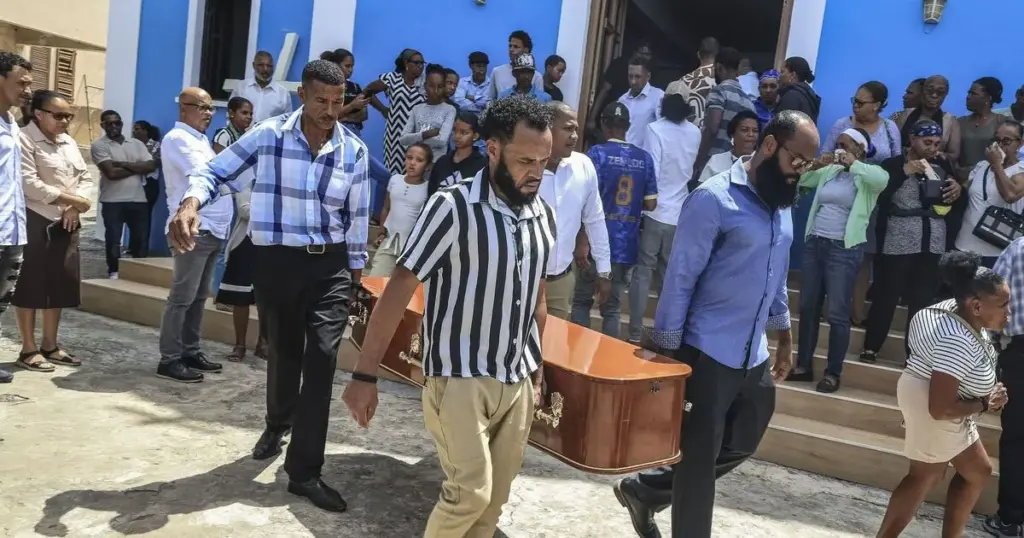
The swiftness of the local response underscored the solidarity of the Cape Verdean people. Neighbors, community elders, and relatives rushed to the hospitals to donate blood, offer psychological support to grieving parents, and assist civil authorities in identifying the victims. By Sunday morning, the community’s collective grief manifested in poignant religious and cultural farewells. Local media reported that seven victims were laid to rest early Sunday morning, while subsequent solemn burials continued throughout the day.
Images broadcast nationally and internationally captured the harrowing sight of residents and relatives carrying coffins across the rugged landscape. By Sunday afternoon, the nation’s leadership converged on a local church to participate in a solemn Mass, standing shoulder-to-shoulder with grieving families before an altar surrounded by 18 coffins, representing a profound collective mourning.
Official Statements and Governmental Action
Presidential Intervention and National Mourning
In direct response to the national tragedy, the government of Cape Verde acted swiftly to provide institutional support and accountability. President José Maria Neves addressed the nation, expressing his profound sorrow and declaring two official days of national mourning beginning Sunday, September 6, 2026. During this period, flags flew at half-mast across all government buildings and public institutions.

In his public address, President Neves emphasized that political and administrative priorities were entirely focused on the victims and their loved ones:
"Right now, the priority is to show solidarity with the families of the victims. No words can adequately console parents who have lost their children in such a sudden and brutal manner, but the entire nation stands with them in this dark hour."
Furthermore, the President formally announced that the administration would mandate an independent, thorough inquiry into the exact circumstances surrounding the crash. Investigators have been tasked with examining every potential contributing factor, including vehicle roadworthiness, mechanical integrity, road design and signage, and the precise trajectory of the bus prior to its descent into the ravine.
Educational and Transport Authorities
Ministry of Education officials released concurrent statements praising the late driver’s long-standing service, noting that his intention was purely benevolent. However, the tragedy has inevitably sparked intense national debate regarding the oversight of informal or semi-formal school excursion arrangements. Transport safety advocates have called for stricter protocols governing student transportation, mandatory vehicle safety inspections for vehicles operating on high-risk mountain routes, and the immediate installation of protective guardrails on vulnerable stretches of Fogo’s road network.
Future Outlook: Safety Reforms and Healing
As the immediate emergency response transitions into long-term recovery, Cape Verde faces critical questions regarding infrastructure safety and the regulation of public transport.
Infrastructure Overhaul and Road Safety
The Fogo tragedy has exposed vulnerabilities in the island’s transport infrastructure. Civil engineers and municipal planners are under increasing pressure to re-evaluate mountain roadways. Key areas of focus for the upcoming fiscal periods are expected to include:
- Installation of Safety Barriers: Erection of heavy-duty crash barriers and guardrails along high-altitude cliff edges and hairpin turns.
- Enhanced Vehicle Inspections: Implementation of rigorous, mandatory safety checks for all buses and commercial vehicles operating on challenging terrain.
- Driver Training Programs: Introduction of specialized defensive driving certifications for operators navigating steep volcanic gradients.
Psychological and Community Recovery
Beyond physical infrastructure, the psychological scars left by the accident will take years to heal. The Ministry of Health has deployed teams of trauma counselors and psychologists to Fogo Island to assist surviving students, bereaved families, and frontline rescue workers who experienced the harrowing conditions of the crash site. Schools in the affected districts are rolling out specialized support programs to help young students process the sudden loss of their peers and mentors.
The bus crash of September 5, 2026, will forever remain etched in the collective memory of Cape Verde as a stark reminder of the fragility of life and the urgent imperative for uncompromising safety standards on the nation’s roads. As investigations continue and the nation emerges from its days of mourning, the legacy of the victims will compel lasting reforms aimed at ensuring no other family suffers such an unimaginable loss.