Executive Overview
In the volatile ecosystem of modern social media, few metrics carry as much immediate cultural weight as the "ratio." When a reply surpasses the original post in likes, engagement, and virality, it serves as a public rebuke of the author. On a recent evening, the official X (formerly Twitter) account for Ubisoft’s blockbuster franchise Assassin’s Creed delivered a masterclass in this phenomenon, overwhelmingly outperforming a post by the platform’s owner, Elon Musk.
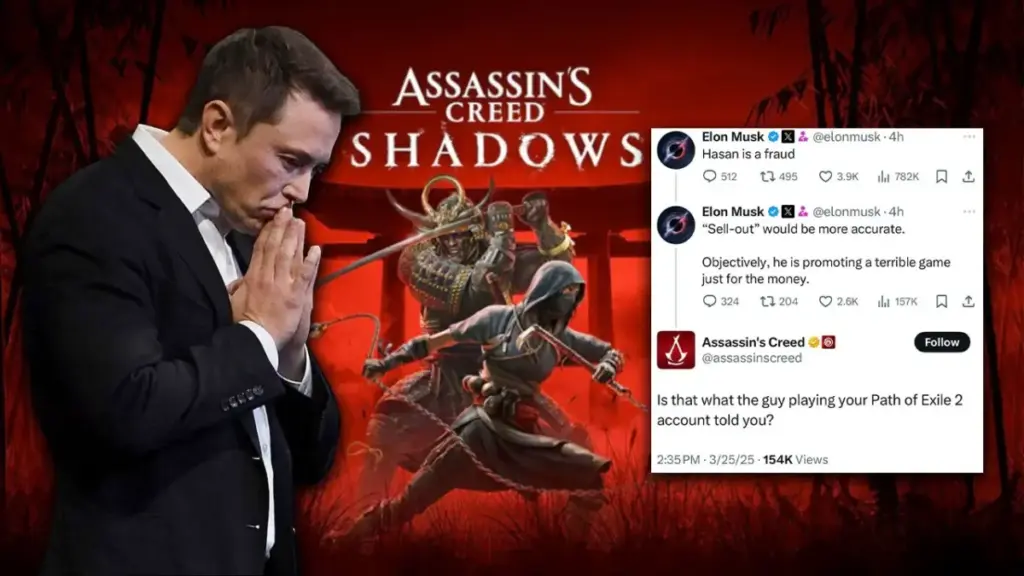
The digital confrontation began when Musk waded into a gaming-industry dispute, lobbing severe accusations at prominent leftist Twitch streamer Hasan Piker. Musk labeled Piker a "fraud" and a "sell-out" for promoting Assassin’s Creed: Shadows in a paid sponsorship deal with Ubisoft. Seizing the moment, the social media manager behind the @AssassinsCreed handle fired back with a sharp, instantly viral jab referencing Musk’s own recent, highly publicized gaming scandals: "Is that what the guy playing your Path of Exile 2 account told you?"
Within hours, the tweet amassed over 400,000 likes, overshadowing Musk’s original commentary and triggering a massive wave of memes, mockery, and internet commentary. This incident was not merely an isolated internet spat; it represents a convergence of corporate brand voice, influencer politics, and the hyper-scrutinized online persona of the world’s richest man. By weaponizing Musk’s well-documented "fraud gamer" controversy against him on his own platform, the Assassin’s Creed marketing team demonstrated the perils of high-profile tech executives engaging in culture-war debates within the gaming community. This comprehensive report explores the chronology of the event, the underlying gaming controversies, the public reaction, and the broader implications for brand engagement on social media.
Detailed Chronology of the Digital Clash
The Catalyst: Grummz, Ubisoft, and Hasan Piker
The tensions leading up to the viral exchange were rooted in ongoing culture-war debates surrounding the upcoming release of Assassin’s Creed: Shadows. The title, set in feudal Japan, has been a frequent target of conservative and anti-woke commentators within the gaming sphere.
The flashpoint occurred when notorious video game critic and internet commentator @Grummz (Mark Kern) publicly criticized Ubisoft. Grummz took aim at the publisher’s decision to partner with leftist political commentator and Twitch streamer Hasan Piker, sponsoring him to showcase and play Assassin’s Creed: Shadows. Grummz argued that utilizing politically divisive influencers to market video games alienates core consumers and reflects poorly on the development team.
Musk Weighs In
As the post gained traction within anti-Ubisoft circles, Elon Musk—an active user known for inserting himself into trending cultural and political topics on his platform—decided to weigh in. Quote-tweeting the criticism, Musk escalated the rhetoric, calling Hasan Piker a "fraud" and a "sell-out." Musk asserted that Piker was promoting a "terrible game just for the money," lending his immense algorithmic reach to the ongoing backlash against Ubisoft’s marketing strategy.
The Strike: @AssassinsCreed’s Devastating Reply
Almost immediately, the social media team managing the official @AssassinsCreed account recognized an opportunity to flip the narrative. Rather than issuing a standard corporate defense of their marketing campaign or game quality, the account bypassed the critique entirely and launched a direct ad hominem attack on Musk’s personal credibility.
Replying directly to Musk, the account posted:
"Is that what the guy playing your Path of Exile 2 account told you?"
The response was an instant knockout blow. It combined corporate snark with deep-cut internet lore, instantly neutralizing Musk’s moral high ground by reminding millions of users about his recent, deeply embarrassing exposure as a boosted gamer. Within hours, the tweet eclipsed Musk’s metrics, garnering upwards of 400,000 likes and generating a viral tidal wave of quote tweets, memes, and celebratory reactions from internet users across the political spectrum.
Supporting Context & Metrics: The "Fraud Gamer" Backstory
To fully understand why the Assassin’s Creed reply resonated so deeply across the internet, one must examine the events of earlier that year, when Elon Musk was forced to publicly confront allegations that he was faking his gaming prowess.
The Path of Exile 2 Debacle
Musk had spent weeks cultivating an image as a hard-core, elite gamer, frequently livestreaming his playthroughs of Grinding Gear Games’ complex action-RPG, Path of Exile 2. He broadcasted himself operating a high-ranking, heavily optimized character, projecting an image of deep mechanical mastery and intense personal dedication to the grind.
However, veteran players and community experts quickly noticed severe discrepancies between Musk’s supposed high-level status and his actual gameplay. During livestreams, Musk routinely blundered across maps, demonstrated a fundamental lack of understanding regarding endgame mechanics, and made tactical errors that contradicted the capabilities of the character he was piloting.
Public Data and Account Boosting
Skeptical fans dug into publicly available game telemetry and telemetry data associated with his account. The findings were damning: game data indicated that Musk’s account was either actively playing from Asian servers or utilizing a VPN to log in from Asia—an inexplicable logistical choice for a resident of Texas, unless the account was being managed remotely.
Veterans concluded that Musk had hired professional gamers—a practice known as "account boosting" or paying for carry services—to level up his characters and acquire elite gear, allowing him to pose as a master gamer without putting in the required hours.

As the backlash mounted and video essays dissected the charade, Musk eventually confessed to the practice on X. Attempting to normalize the shortcut, he wrote: "It’s impossible to beat the players in Asia if you don’t, as they do!"
This admission cemented his reputation in gaming circles as a "fraud gamer"—someone more interested in the clout and aesthetic of high-tier gaming than the actual earned experience. Consequently, when Musk accused Hasan Piker of selling out for money, the internet immediately recognized the supreme irony of the accusation, setting the stage for the Assassin’s Creed team’s mic-drop moment.
The Broader Battlefield: Hasan Piker, Grummz, and Elden Ring
The corporate ratio was only one front in a multi-day digital war. Following the initial exchange, Hasan Piker and Elon Musk engaged in a secondary, highly publicized war of words, heavily mediated and amplified by Grummz.
The Challenge and the Block
Upon seeing Musk’s "sell-out" accusations, Hasan Piker responded directly, turning the conversation away from corporate marketing budgets and toward interpersonal bravado. Piker mocked Musk’s gaming credibility and openly challenged the billionaire to a live duel in FromSoftware’s notoriously difficult action-RPG, Elden Ring.
As the back-and-forth escalated across screenshots and quote-tweets, Musk fired back by labeling Piker "chickens—," pointing out that Piker had blocked him on X (formerly Twitter). The petty nature of the dispute—involving multi-millionaires and corporate entities arguing over video game streaming sponsorships and skill levels—provided endless entertainment for chronically online observers.
Yet, while the Piker-Musk feud generated plenty of noise, it was the corporate entity of Assassin’s Creed that ultimately stole the spotlight, proving that traditional marketing accounts could successfully adopt modern internet shitposting culture to dominate the algorithm.
Official Statements and Public Reaction
The reaction to the @AssassinsCreed ratio was swift, widespread, and overwhelmingly unified in its amusement. Internet users flooded the platform with memes, reactions, and expressions of shock that a mainstream corporate account had so brazenly mocked the platform’s owner.
Viral Memes and Cultural Acceptance
Many users immediately deployed classic internet memes to signal their respect for the corporate social media manager’s bravery. A popular refrain across the replies was a variation of the phrase, "I was unfamiliar with your game," a meme used to express sudden, begrudging respect for someone who pulls off an unexpected and devastating maneuver.
Other users highlighted the sheer poetic justice of the moment. Accounts pointed out the immense irony of Musk purchasing Twitter for $44 billion largely to champion absolute "free speech" and unbridled discourse, only to find himself routinely "cooked" and ratioed on his own digital turf by video game publishers and streamers.
One prominent X user, @soundaholism, publicly declared that the brilliant ratio had single-handedly inspired them to purchase Assassin’s Creed: Shadows at full price upon release, foregoing their usual strategy of waiting for a post-launch discount. This sentiment was echoed by others who noted that the marketing value of the viral tweet likely outweighed thousands of dollars in traditional advertising spend.
Future Outlook: Corporate Brand Voice and Platform Dynamics
The incident between Elon Musk and the Assassin’s Creed social media account highlights a broader, ongoing evolution in how corporate entities interact with digital media platforms and their user bases.
The Rise of the "Unfiltered" Brand Account
Gone are the days when corporate social media accounts strictly adhered to polite, sanitized, risk-averse public relations guidelines. Modern brand accounts—particularly in entertainment, gaming, and fast-food sectors—frequently adopt the snarky, confrontational, and meme-literate tone typical of native internet users. By leaning into internet subcultures, drama, and direct engagement with public figures, brands can achieve unprecedented organic reach.
However, this high-risk strategy requires a delicate touch. Brands that attempt edgy social media tactics often risk alienating segments of their consumer base if they misread cultural sensitivities. In this specific case, Ubisoft walked a fine line: while some anti-woke factions within the gaming community remained critical of the publisher, the broader internet population overwhelmingly sided with the Assassin’s Creed account simply due to the universal appeal of seeing a billionaire publicly humbled over a gaming controversy.
Implications for X (Twitter) Under Musk
As X continues to evolve under Musk’s ownership—with shifting algorithmic priorities, reduced moderation teams, and an emphasis on verified creator payouts—the platform has increasingly become an arena where high-profile figures are subjected to unfiltered public scrutiny. The fact that an official corporate account could so flagrantly mock the platform’s proprietor without immediate algorithmic suppression or administrative retaliation serves as a testament to the platform’s current wild-west ecosystem.
Ultimately, the clash between Elon Musk and Assassin’s Creed will be remembered as a defining viral moment of the year—a reminder that in the hyper-connected digital age, no amount of capital or platform ownership can shield a prominent public figure from the relentless, meme-driven memory of the internet gaming community.