Executive Overview
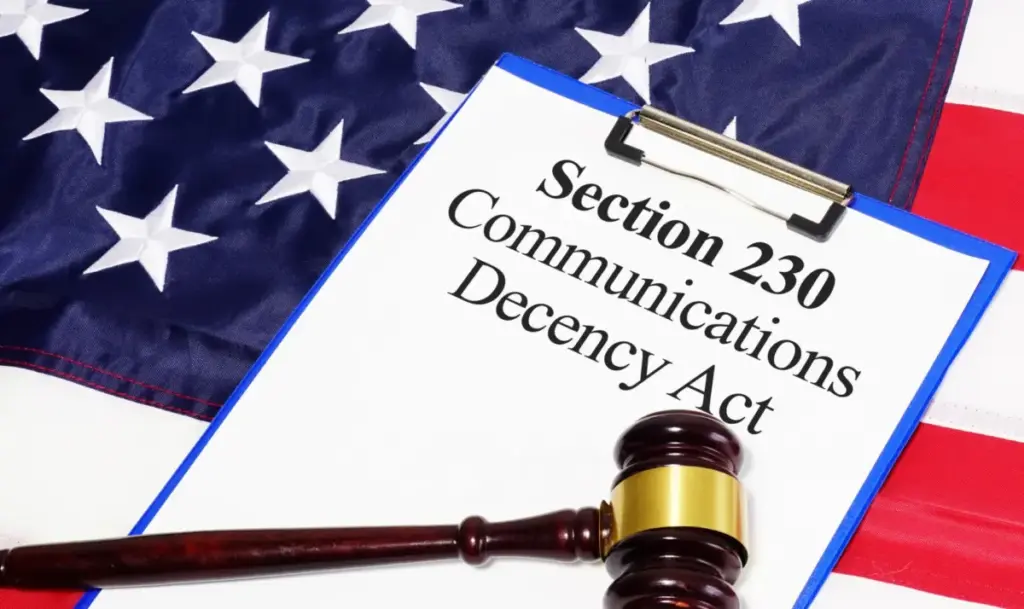
As the Communications Decency Act of 1996 approaches its landmark 30th anniversary, its most consequential and fiercely debated provision—Section 230—faces its most severe existential threat to date. For three decades, this modest 26-word statutory provision has served as the foundational bedrock of the modern internet. By shielding consumer technology platforms from legal liability for the user-generated content they host, Section 230 catalyzed the growth of the digital economy, enabling everything from early message boards and user-reviewed marketplaces to the sprawling ecosystems of today’s social media monoliths.
In theory, the statute offers a straightforward "safe harbor": platforms are protected from being treated as the publishers or speakers of third-party content, provided they act in good faith to remove violative material when notified. In practice, this immunity has allowed Big Tech enterprises—including Meta, Alphabet (YouTube), and ByteDance (TikTok)—to successfully fend off a litany of high-profile legal challenges, regulatory overreaches, and civil lawsuits.
However, the legal armor that has long protected Silicon Valley is fracturing. A cascade of recent appellate court rulings and milestone jury verdicts have pierced the traditional interpretation of Section 230. By drawing a sharp legal distinction between passive content hosting and active algorithmic recommendation, courts have cleared the path for thousands of consolidated lawsuits targeting social media companies over youth mental health crises, platform addiction, and real-world harms.
Simultaneously, Section 230 has become the epicenter of a high-stakes, highly polarized political war. A persistent coalition of conservative lawmakers views the statute as a shield for corporate censorship and an impediment to holding tech giants accountable for societal decay. Conversely, digital rights watchdogs, civil liberties organizations, and tech policy experts warn that dismantling or aggressively gutting Section 230 will not yield accountability—rather, it will eviscerate online free expression, bankrupt smaller startups, and fundamentally fracture the open web as we know it. As these watershed legal battles proceed, the future of digital discourse hangs in the balance.
Detailed Chronology of a Legal Paradigm Shift
The erosion of Section 230’s absolute immunity did not happen overnight; it is the culmination of a systematic, multi-year chipping away of precedent by plaintiffs’ attorneys, appellate panels, and federal judges increasingly willing to interrogate how modern platforms actually operate under the hood.
The Cracks Form: The 2024 Algorithmic Turning Point
For years, technology companies successfully argued that any harm caused by content appearing on a user’s feed was shielded by Section 230, because the underlying text, video, or image was ultimately created by a third-party user. That defense met a brick wall in August 2024.
In a landmark decision that broke sharply from decades of established legal precedent, a federal appeals court ruled that TikTok must face a wrongful death lawsuit holding the platform responsible for the viral and lethal "blackout challenge." The plaintiff argued that TikTok’s proprietary recommendation algorithm actively pushed dangerous content directly to impressionable minors. The presiding judge reasoned that an algorithm is not merely a passive bulletin board; it is an active curatorial tool designed, weighted, and deployed by the platform itself. Consequently, algorithmic amplification fell outside the protective parameters of Section 230’s safe harbor, transforming how courts view platform liability.
The Floodgates Open: The 2025–2026 Addiction Verdicts
If the 2024 TikTok ruling cracked the foundation, the events of early 2026 blew the doors wide open. In a California courtroom, a civilian jury reached a verdict that sent shockwaves through Silicon Valley: YouTube and Meta were found legally liable for contributing to a plaintiff’s severe social media addiction and subsequent mental health decline.
This was not merely a localized victory for a single litigant. Because discovery and legal standards established in bellwether trials set benchmarks for mass tort litigation, the verdict effectively unlocked the floodgates. Thousands of pending, pre-packaged lawsuits—filed by families, school districts, and municipalities claiming that social media platforms intentionally engineered their products to exploit psychological vulnerabilities in children—were suddenly primed for trial.
The Procedural Dead End: The 9th Circuit Ruling
Desperate to halt the avalanche of impending trials, Meta and TikTok launched aggressive procedural maneuvers. They petitioned the courts to dismiss the consolidated addiction suits outright, arguing that Section 230 barred the claims before they could even be heard by a jury.
The 9th U.S. Circuit Court of Appeals firmly rejected this gambit. In a decisive blow to Big Tech’s legal strategy, the court ruled that Section 230 can function strictly as an affirmative legal defense during adjudication—it cannot be weaponized as a procedural toll-booth to bypass a hearing or evade judicial discovery entirely. With this ruling, the legal dam broke: Meta, YouTube, and TikTok would have to face the music in open court, exposing their internal metrics, product design documents, and executive communications to public scrutiny.
Supporting Context, Economics, and Metrics
To understand why the dismantling of Section 230 carries such systemic risk, one must examine the economic and operational realities of the modern internet. Platforms operating at global scale ingest petabytes of data every single second. Without statutory protection against the endless liability of user submissions, the traditional business model of user-generated content becomes mathematically and financially untenable.
The Scale Dilemma
Consider the sheer volume of content uploaded daily across major platforms:
- YouTube users upload over 500 hours of video every minute.
- TikTok serves billions of short-form video views daily, with algorithmic feeds continuously adapting to micro-behavioral inputs.
- Meta’s family of apps processes billions of daily interactions, photos, posts, and direct messages across global populations.
Under a strict liability regime—where platforms are treated as traditional publishers legally liable for every piece of defamatory, dangerous, or illegal content posted by users—the administrative burden of pre-screening every post would require workforces numbering in the millions, coupled with draconian, hyper-conservative content-removal policies. Alternatively, platforms would simply cease operating entirely, unable to absorb the existential risk of perpetual litigation.
The Algorithmic Distinction
The core legal battleground has shifted from what is hosted to how it is distributed. Historically, Section 230 protected platforms regardless of whether they used automated moderation tools or basic sorting mechanisms (such as chronological feeds).
However, modern platforms rely on sophisticated machine-learning recommendation engines optimized for engagement, retention, and ad revenue. Plaintiffs’ attorneys have successfully reframed the debate: they argue that when an algorithm proactively targets vulnerable demographics with addictive or self-harm-inducing content to maximize "dwell time," the platform is no longer acting as a neutral digital landlord. It is acting as an active manufacturer and distributor of a defective product. This pivot from defamation and free speech law into product liability law represents an ingenious, highly effective end-run around traditional Section 230 jurisprudence.
Official Statements and the Political Landscape
While plaintiffs and tech companies battle in federal courts, a parallel war is being waged in the halls of Congress. The political consensus around Section 230 has completely fractured, though the motivations driving reform span a deeply polarized ideological spectrum.
The Conservative Crusade Against Big Tech
The most vocal, aggressive opponents of Section 230 belong squarely to the Republican party, though their grievances are historically rooted in grievances over political censorship rather than product design.
- Senator Ted Cruz (R-TX), ranking member of the Senate Commerce Committee, has repeatedly called for sweeping structural reforms, arguing that Big Tech companies abuse their safe harbor protections to suppress conservative viewpoints while avoiding accountability for biased moderation practices.
- Congressman Jimmy Patronis (R-FL) took an even more uncompromising stance following the social media negligence verdicts, publicly urging Congress to completely repeal Section 230. Patronis argued that tech executives have hidden behind the statute for too long while profiting off the psychological distress of children.
- Senator Josh Hawley (R-MO) remains one of the statute’s staunchest and most visible critics, frequently petitioning the U.S. Supreme Court to clarify and drastically narrow the scope of Big Tech immunity.
- Prior to his passing, Senator Lindsey Graham (R-SC) spearheaded legislative efforts to sunset Section 230 immunity entirely, attempting to build bipartisan momentum around regulatory frameworks that would force platforms to answer for online harms.
The Underlying Irony
This conservative push for reform is dripping with historical irony. For years, Section 230 served as an indirect shield for social media companies against right-wing legal challenges regarding content moderation. When conservative outlets and political figures—such as PragerU—sued platforms for alleged political censorship, courts routinely dismissed the claims by citing Section 230. Furthermore, high-profile conservative state officials, such as Texas Attorney General Ken Paxton (a close ally of Donald Trump), found their legislative attempts to restrict social media moderation (such as Texas HB 20) stymied by federal preemption rooted in Section 230.
Now, seeing an opening created by youth addiction lawsuits and algorithmic liability, the GOP has seized a golden opportunity to dismantle Big Tech safeguards using public health and child safety as a battering ram where free speech arguments previously stalled.
Future Outlook: The Precipice of Internet Transformation
As Section 230 enters its third decade, the path forward is fraught with peril and uncertainty. Civil liberties watchdogs, legal scholars, and tech policy organizations are sounding the alarm bells, urging lawmakers and judges to weigh the systemic consequences of a post-Section 230 world.
Organizations like the Cato Institute and the Center for Democracy & Technology (CDT) have cautioned that eviscerating the safe harbor will not create a utopia of digital safety; rather, it will trigger a chilling effect on online expression. Without Section 230, platforms will face an impossible choice: over-censor user speech to near-zero tolerance to avoid lawsuits, or shut down entirely. Smaller startups and independent web platforms—which lack the legal war chests of Meta or Google—would be wiped out overnight, permanently cementing a corporate duopoly of entrenched tech giants who might afford compliance at the expense of open competition.
What Lies Ahead?
- The Supreme Court Interventions: Legal experts anticipate that the U.S. Supreme Court will ultimately be forced to definitively define the boundaries of algorithmic immunity, settling the split between federal circuits.
- Settlement Waves: Faced with the prospect of unsealed discovery and thousands of individual jury trials over social media addiction, Meta, YouTube, and TikTok may opt for massive, multi-billion-dollar settlement settlements, mirroring the historical trajectories of the tobacco and opioid industries.
- Legislative Gridlock vs. Compromise: While populist pressure to repeal or radically sunset Section 230 remains high in Washington, any actual legislative rewrite must navigate the treacherous waters of the First Amendment. Crafting a statute that targets harmful algorithmic design without trampling on protected speech is a legislative needle that has yet to be successfully threaded.
Conclusion
Section 230 may have imperfections, and in individual courtroom battles, it has occasionally shielded corporations from immediate accountability. Yet, on the macro scale, it remains the structural cornerstone upon which the modern internet was built. Tearing it down in a fit of populist legislative retribution or judicial overreach is a high-stakes gamble. As these watershed lawsuits grind forward, policymakers, judges, and the public must tread carefully—for in dismantling the safe harbor, we risk destroying the open, expressive, and interconnected web entirely.