By Zofia Zwieglinska
Luxury Briefing Special Report
Executive Overview
For years, the overarching narrative surrounding London Fashion Week (LFW) has fluctuated between survival and revitalization. Critics have frequently questioned whether the British capital can maintain its status alongside Milan, Paris, and New York in an era dominated by hyper-digital spectacles and algorithm-friendly viral moments. Yet, as the dust settled on the Spring 2027 collections, LFW delivered a plot twist that caught industry veterans off guard: it traded viral social media hype for cold, hard commercial value.
According to data released by the British Fashion Council (BFC), accredited buyer attendance surged by 19% year-over-year, while international buyer attendance experienced a staggering 41% jump. Major global retailers, retail executives from luxury flagships, and international stockists flooded the British capital, looking to place orders rather than simply capture content.
However, this commercial resurgence laid bare a paradox that is increasingly defining the modern luxury landscape. While physical front rows were packed with decision-makers wielding checkbooks, LFW’s digital footprint cratered. Data from analytics firms Lefty and Insights by Karla Otto revealed that total social media posts concerning the event fell by 57% year-over-year, while total Earned Media Value (EMV) plummeted 24% to $27.3 million.
This stark divergence—booming physical attendance coupled with contracting online visibility—complicates the prevailing "London is back" narrative. It suggests a fashion week that is arguably more useful to designers’ bottom lines, yet leaves them fighting an uphill battle for digital mindshare. As the industry navigates a shifting economic climate where "vibes" no longer guarantee inventory sell-through, London’s Spring 2027 season serves as a fascinating case study in what happens when a fashion week prioritizes commercial utility over digital virality.
Detailed Chronology: The Spring 2027 Showcase
The Spring 2027 season kicked off with a palpable sense of renewed optimism, though the traditional media and creator schedules felt noticeably leaner than in previous years. Rather than catering to the infinite scroll of TikTok or Instagram Reels, the week’s strongest collections focused squarely on garment construction, tactile luxury, and wearable storytelling.
The Heavyweights Set the Tone
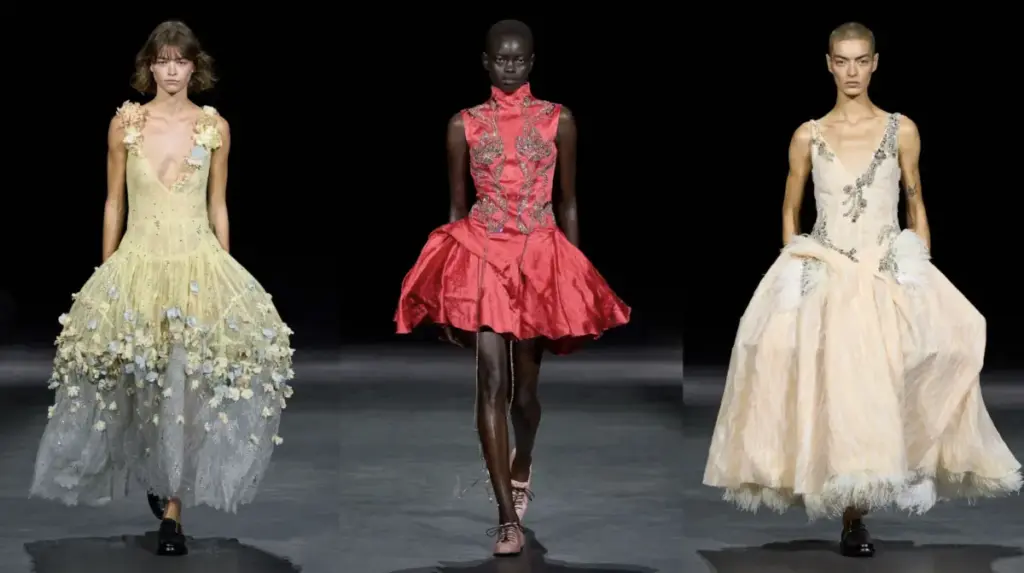
Early in the week, heritage houses and established London fixtures anchored the schedule with collections that emphasized traditional craftsmanship over shock-value staging. Erdem, Roksanda, Burberry, Simone Rocha, and Alexander McQueen emerged as the critical and commercial darlings of the week.
According to Simon Longland, Director of Buying for Fashion at Harrods, these houses successfully orchestrated a return to romance and historical references, underscored by a compelling tension between hyper-femininity and menswear-inspired tailoring. Erdem, in particular, dominated buyer conversations. Rather than resting on its laurels, the label pushed its signature design language forward through innovative silhouettes, intricate textile treatments, and an uncompromising level of craftsmanship.
Mid-Week Realities: Independent Designers and Global Ambitions
As the calendar shifted to independent labels and emerging talent, the focus pivoted from heritage prestige to the grueling mechanics of international scaling. Designers like Daniel Fletcher at Mithridate and Susan Fang presented collections that sought to bridge the gap between runway fantasy and global wholesale viability.
Fletcher utilized the context of LFW to reassure international markets of the Guangzhou-headquartered brand’s manufacturing prowess, emphasizing physical touchpoints. Meanwhile, Susan Fang demonstrated how sustainable, category-diverse growth—spanning Korean ready-to-wear markets and robust U.S. custom bridal orders—can insulate a young brand from the volatility of wholesale retail.
The High-Street Shift and Closing Out
As the week drew to a close, research from influencer marketing platform Billion Dollar Boy underscored a parallel shift in the U.K. creator economy. High-street titan Marks & Spencer (M&S) and heritage-adjacent players captured a massive share of digital creator impressions, overshadowing several legacy luxury houses in pure volume.
By the time the final look graced the runway, it was clear that the week had bifurcated: high-street retailers captured the digital masses, international buyers secured the luxury orders, and independent designers were left to bridge the chasm between the two.
Supporting Context & Metrics: The Numbers Behind the Narrative
To truly understand the Spring 2027 edition of London Fashion Week, one must dissect the hard data provided by industry analysts, which paints a complex picture of a transforming fashion ecosystem.
The Buyer Boom vs. The Digital Slump
The BFC’s figures are undeniably positive for a city that has historically struggled to retain its homegrown talent against the financial gravity of Paris and Milan:
- Total Accredited Buyers: Up 19% year-over-year.
- International Buyers: Up 41% year-over-year, signaling renewed confidence from overseas department stores and multi-brand boutiques.
Conversely, the digital metrics compiled by Lefty and Insights by Karla Otto tell a sobering story of declining online engagement:
- Total Social Media Posts: Down 57% year-over-year.
- Total Earned Media Value (EMV): Down 24%, slipping to $27.3 million.
Brand-Level Breakdown: Who Won the Digital Game?
Attention was far from evenly distributed among the houses showing in London. Burberry retained its crown atop Lefty and Karla Otto’s Instagram ranking, generating $10.8 million in EMV. However, even this powerhouse figure represented a 36% drop compared to the previous year.
Other heritage mainstays experienced even steeper digital contractions:
- Alexander McQueen: Generated $1.6 million in EMV (down 46% year-over-year).
- Mulberry (celebrating its Christopher Kane debut): Generated $388,000 in EMV.
The High-Street vs. Luxury Creator Split
Adding nuance to the digital conversation, research from Billion Dollar Boy revealed that traditional luxury houses are increasingly losing the volume game to accessible high-street giants on social media:
- Marks & Spencer (M&S): Captured 39% of total creator impressions among U.K.-based accounts analyzed.
- Mulberry: Captured 24%.
- High-Street Aggregate: Collectively drove 58% of all creator impressions during the window.
- Luxury Brands Aggregate: Accounted for the remaining 42%.
This data suggests that while luxury brands command high-value prestige, everyday consumers and content creators are far more galvanized by accessible, high-street activations—a reality that forces luxury marketing teams to rethink their return on investment for physical runway shows.
Official Statements and Industry Insights
The divergence between commercial influx and digital deflation prompted widespread reflection among retail leaders and creative directors alike.
Laura Weir, CEO of the British Fashion Council:
"A 41% increase in accredited international buyers matters because designers need customers as well as audiences. To see major British houses choosing London alongside extraordinary emerging talent, retailers opening the industry to consumers, and international buyers discovering businesses they want to take into new markets is exactly what London Fashion Week should do."
Simon Longland, Director of Buying for Fashion at Harrods:
"We continue to invest where we see the strongest expression of a designer’s vision. Our clients come to Harrods for the extraordinary, so our focus remains on pieces that feel truly special, distinctive, and difficult to find elsewhere. Erdem was unmistakably Erdem, but moved his language forward through new silhouettes, techniques, and an extraordinary level of craftsmanship. The interplay between masculine and feminine felt particularly relevant."
David Thielebeule, Fashion Director at Bloomingdale’s:
"London felt less about one big idea and more about designers sharpening their individual points of view. The commercial opportunity was clothes with personality and big imagination that still make sense in a woman’s wardrobe. London has always been brilliant at fantasy. This season, the most compelling moments were when that fantasy felt real and often even wearable."
Daniel Fletcher, Creative Director at Mithridate:
"The challenge we face as a young brand is getting people to trust the quality and craftsmanship behind the clothes. It can feel so different when you see something on the runway compared to seeing it in a store. We want people to be able to feel the clothes, touch them, and see them in person."
Susan Fang, Independent Designer:
"People are still ordering collections from four years ago. I’m glad the clothes can feel timeless, particularly for special occasions. The U.S. is already a significant custom-order market for us, particularly for wedding dresses."
Future Outlook: Navigating the Post-Hype Era
As the fashion industry digests the results of London Fashion Week Spring 2027, the overarching question is no longer whether London can generate viral moments, but whether it even needs to.
For decades, the metric of success for a fashion week was tied to column inches, celebrity front rows, and explosive social media reach. However, as economic pressures mount and consumers experience digital fatigue, the return of international buyers carrying genuine purchasing power points toward a healthier, more sustainable definition of industry success.
Nevertheless, independent designers cannot afford to ignore the digital sphere entirely. While physical stockists and international wholesale accounts provide immediate revenue stability, long-term brand equity in the global market still relies heavily on digital discovery. Emerging talents face the delicate task of balancing high-cost runway presentations with targeted, ROI-driven marketing strategies that resonate with consumers who may never step foot inside Harrods or Bloomingdale’s.
Ultimately, London’s Spring 2027 season succeeded in bringing the people who write orders back into the room. The next test for the British capital and its independent creative class is whether they can convert that renewed physical interest into deep, enduring retail partnerships—and build businesses capable of holding the world’s attention long after the runway lights go out.