Executive Overview
In the sprawling pantheon of Hollywood misfires, few disasters possess the staggering, high-minded audacity of Exorcist II: The Heretic. Released in the summer of 1977, William Friedkin’s original 1973 supernatural masterpiece The Exorcist had terrorized global audiences, rewriting box-office records and leaving viewers emotionally and psychologically battered. When Warner Bros. sought a follow-up, they handed the reins to visionary British director John Boorman. Fresh off the gritty success of Deliverance, Boorman rejected the obvious path—more blood, more bile, more demonic child-torture—opting instead to craft a metaphysical, psychedelic meditation on the evolution of human consciousness.
The result was an unmitigated disaster: a film so profoundly misguided that opening-night audiences openly laughed in theaters, prompting frantic, last-minute recutting by a bewildered director. Half a century later, filmmaker David Kittredge has captured this legendary Hollywood trainwreck in the new documentary Boorman and the Devil. Operating with the comedic cadence of a Christopher Guest mockumentary while chronicling genuine cinematic hubris, Kittredge’s film explores how an elite auteur’s intellectual ambitions birthed one of the most infamous critical and commercial flops in motion picture history.
Yet, Boorman and the Devil arrives at a fascinating cultural juncture. In an era dominated by "Movie Disaster Rehabilitation Culture"—where modern cinephiles relentlessly unearth, reframe, and elevate historical cinematic failures into misunderstood masterpieces—Kittredge’s documentary flirts with the notion that Boorman’s folly held shades of greatness. This piece breaks down the mechanics of that failure, the cultural forces attempting to rescue it, and the timeless lesson that artistic ambition without emotional coherence is simply, to borrow the movie’s own bizarre lexicon, a pile of Pazuzu.
Detailed Chronology: From New Hollywood Autonomy to Pasadena Pandemonium
The journey of Exorcist II is a textbook case study in the dangers of the New Hollywood era, a golden age during the late 1960s and 1970s when studios handed absolute creative freedom, or carte blanche, to directors whose recent hits made them seem infallible.
1. The Rejection and the Pivot (1973–1975)
When initially approached to direct the original The Exorcist, John Boorman declined. To his sensibilities, William Peter Blatty’s source material was fundamentally about the clinical torture of a child. However, when Warner Bros. returned three years later seeking a sequel, Boorman saw an opening. Ignoring the sage advice of Stanley Kubrick—who bluntly told him, “If you want to do a sequel to ‘The Exorcist,’ you just get more blood and gore”—Boorman resolved to make an intellectual, esoteric exploration of trauma, hypnosis, and theology.
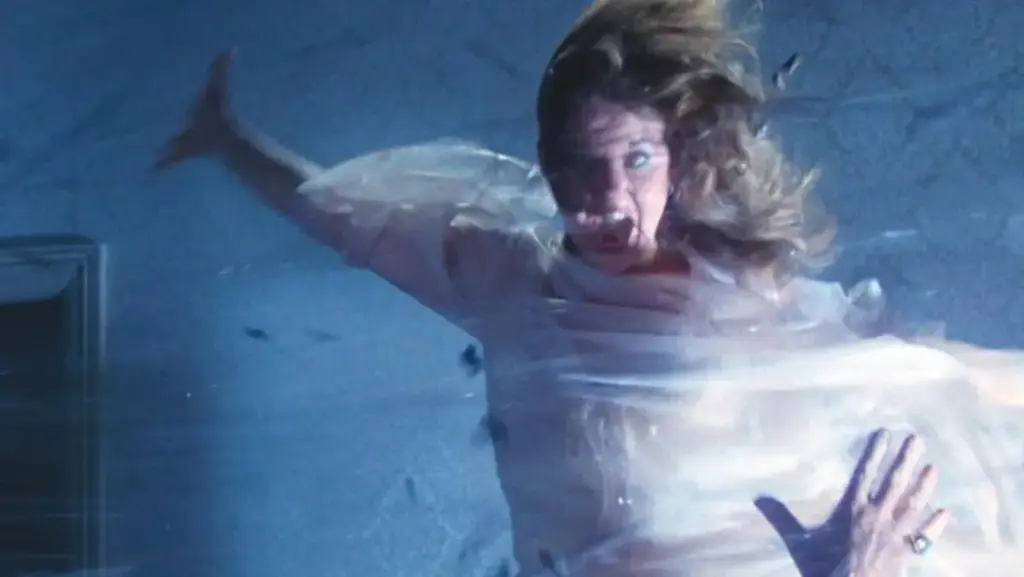
Drawing inspiration from French Jesuit theologian Pierre Teilhard de Chardin, Boorman conceptualized a world where humanity was evolving toward a collective, telepathic hive mind. He cast returning star Linda Blair as Regan, now dealing with suppressed trauma via synchronized hypnosis with her therapist, Dr. Tuskin (Louise Fletcher), and Father Philip Lamont (Richard Burton), a Vatican investigator.
2. Production Nightmares and Ballooning Budgets (1976)
The production of Exorcist II was plagued by an extraordinary convergence of poor decisions and plain bad luck. The film’s budget quickly ballooned from an initial $10 million to $15 million, making it the most expensive motion picture Warner Bros. had ever produced up to that point.
The shoot itself turned hazardous. To recreate an impoverished Ethiopian landscape, the production trucked massive quantities of dry dirt onto a Hollywood soundstage. The resulting dust storms and wind machines filled the air with particulate matter, leading Boorman to contract valley fever—a severe fungal infection. The director’s subsequent hospitalization forced a five-week shutdown of the production. Meanwhile, star Richard Burton labored through performances hampered by visible exhaustion and personal struggles, while Boorman and co-writer Rospo Pallenberg frantically hammered out script pages on the fly, unsure of what their own movie was actually about.
3. The Pasadena Premiere and the Backlash (Summer 1977)
The ultimate reckoning arrived at a sneak preview in a Pasadena theater, an event that has since passed into Hollywood folklore. As nervous Warner Bros. executives watched from the back rows, the audience sat in stunned silence before breaking into outright giggles. Midway through the screening, a furious audience member stood up and verbally threatened the filmmakers, prompting a hasty retreat by the creative team.
Despite warning signs, Warner Bros. pushed forward with a massive, unprecedented wide release: 700 theaters for a 12-week run. The strategy backfired catastrophically. Attendance plummeted by 50 percent in the second weekend as word of mouth spread. In a panic, Boorman hacked off the film’s atrocious ending and substituted a different, equally atrocious ending. It was too late. The damage was done.
Supporting Context & Metrics: The Anatomy of a Flop
To truly understand why Exorcist II: The Heretic collapsed so completely, one must examine the specific creative choices that alienated audiences and critics alike:
- The Static Drama of Synchronized Hypnosis: While the concept of telepathic connection sounded profound in theory, it translated cinematically to a profoundly static experience: characters sitting motionless in a room, staring blankly at one another while wearing metallic headbands.
- Misguided Aesthetic Choices: The set design and visual effects leaned heavily into camp. An expensive recreation of Ethiopia featured unconvincing Styrofoam boulders and blinding arc lights. Worse still, the demonic force was rebranded as "Pazuzu" and manifested not through subtle psychological dread, but via massive, buzzing swarms of locusts. James Earl Jones, portraying the African scientist Kokumo, donned a cumbersome locust mask and inexplicably spat a tomato from his mouth.
- Richard Burton’s Monotone Gravitas: A cinematic titan of unmatched pedigree, Burton delivered a performance defined by stentorian, one-note theatricality, famously intoning lines like, “E-vil… is a spiritual being” with weary detachment.
- Box Office and Financial Metrics: With a production budget scaling to $15 million—a massive sum for 1976—coupled with massive distribution and marketing expenditures for a 700-screen wide rollout, the film failed to recoup its investments domestically, cementing its status as one of the studio era’s most monumental financial losses.
Official Statements & Retrospective Perspectives
Fifty years after its disastrous release, Exorcist II continues to provoke debate, largely due to the unyielding optimism of its director and the shifting tides of film criticism.
John Boorman’s Unshaken Conviction
Seated in his country home in County Wicklow, Ireland, an 93-year-old Boorman reflects on the project in David Kittredge’s Boorman and the Devil with unwavering pride. Remarking on his career, Boorman maintains that Exorcist II contains "some of the best work I’ve ever done." Decades later, Boorman still largely blames the audience, suggesting that the film’s failure stemmed from viewers expecting a standard horror flick rather than a profound metaphysical exercise.
When discussing the unpredictable nature of the industry, Boorman offers a defense that raised eyebrows among critics:
"In my experience, successful movies have one thing in common, and that’s luck."
Contemporary Critics and the Revisionist Wave
Kittredge’s documentary enlists a roster of notable film critics—including Bilge Ebiri, Joseph McBride, and Stephanie Zacharek—to reexamine the picture. Many suggest that beneath the disaster lies a loopy, fever-dream grandeur. This line of thinking traces back to legendary critic Pauline Kael, whose positive review of Exorcist II upon its release praised its crazy, spellbinding imagery.
Kael’s outlier review helped spark an ongoing phenomenon: the rise of Movie Disaster Rehabilitation Culture. In contemporary film discourse, hipster cinephiles and postmodern critics frequently take historical duds—such as Michael Cimino’s Heaven’s Gate or Stanley Kubrick’s Eyes Wide Shut—and reframe them as misunderstood masterpieces.
Critics of this revisionist trend argue that it treats films as endlessly malleable, intellectualized "texts" rather than narrative works requiring foundational emotional logic. As one observer notes regarding Boorman’s rationalizations: "What successful movies have in common — along with luck — is artists who know what they’re doing, and are rooted in the real world, and are working at the top of their game."
Future Outlook: The Indestructible Appeal of Cinematic Folly
As Boorman and the Devil makes its rounds through film festivals and specialized platforms, it serves as a timely reminder of Hollywood’s perpetual tug-of-war between commerce and unbridled artistic ego.
The documentary does not merely mock a terrible movie; it humanizes the creator behind it, exposing the dangerous, fascinating mindset of an auteur who genuinely believed he was communing with higher cosmic truths while his cast members wore tinfoil headbands and dodged locust swarms.
Looking forward, the appetite for post-mortems on Hollywood history remains insatiable. As long as streaming platforms and boutique physical media labels continue to unearth forgotten cinematic detritus, audiences will remain fascinated by the moments when mega-budget productions spectacularly implode. Yet, as Boorman and the Devil ultimately demonstrates, no amount of retrospective refRAMING or postmodern rehabilitation can transform a foundational mess into gold. Some cinematic disasters are simply monuments to hubris—fascinating to observe from a safe distance, but impossible to redeem.