Executive Overview
The global style landscape is undergoing a subtle yet profound recalibration. While dramatic silhouettes, structural outerwear, and avant-garde footwear routinely dominate the visual discourse of international runways, the true vanguard of modern dressing is currently taking place well away from the official catwalks.
Enter the handkerchief headcovering—a versatile, unpretentious accessory that has rapidly ascended from a functional everyday staple to the undisputed crowning glory of contemporary street style.
While heavy-hitting arbiters of global cool such as Dua Lipa, Zendaya, and Gigi Hadid have undeniably cemented the look’s status as a must-have for the upcoming summer season, the true incubator of this trend lies in the bustling crowds of the spring ready-to-wear fashion weeks.
What began as an organic, grassroots styling choice among showgoers and front-row fixtures has ballooned into a full-scale international phenomenon. From the high-energy pavement outside New York’s premier presentations to the minimalist, cycle-lined cobblestones of Copenhagen, the scarf-as-hat has become the ultimate sartorial shorthand for effortless elegance.
This comprehensive report examines the trajectory of the handkerchief trend, tracking its origins, exploring its evolution across global style capitals, analyzing the broader cultural shifts fueling its popularity, and forecasting its enduring influence on the future of accessories.
Detailed Chronology: From Pavement to Podium
To understand how a humble square of fabric captured the imagination of the world’s most stylish individuals, one must retrace the exact timeline of its recent renaissance. The current iteration of the handkerchief craze did not materialize out of a vacuum, nor was it masterminded by a single heritage design house under the bright lights of a formal runway presentation. Instead, it was born on the asphalt.
The Spring 2026 Ready-to-Wear Catalyst
The narrative truly took root during the spring 2026 ready-to-wear fashion month. As editors, buyers, and influencers rushed from one venue to the next, photographers capturing the street style landscape began to notice a recurring motif. It wasn’t just about statement bags or oversized sunglasses; it was about headwear.
The traditional baseball cap and the ubiquitous bucket hat were steadily being dethroned by delicate, artfully folded squares of silk, cotton, and patterned textiles.
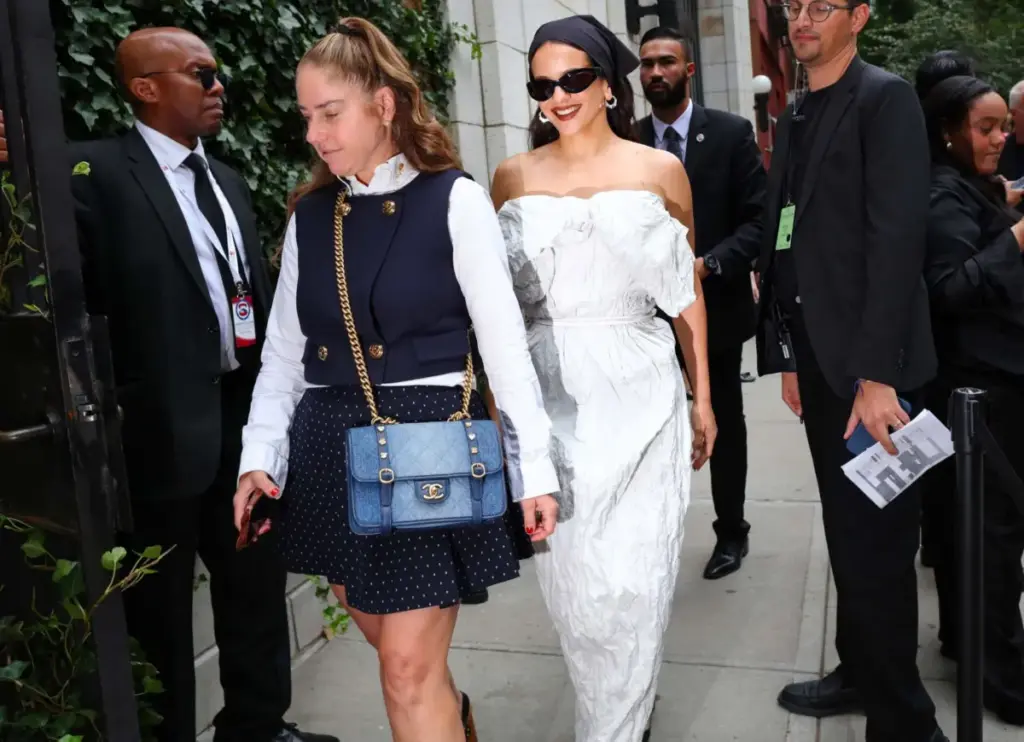
A pivotal moment occurred outside the Calvin Klein presentation. Pop royalty and fashion chameleon Rosalía arrived at the venue wearing a classic navy blue printed bandana masterfully tied over her hair. The look struck an immediate chord: it was casual yet impossibly chic, marrying a utilitarian aesthetic with high-fashion nonchalance.
Photographers scrambled to capture the moment, and within hours, images of Rosalía’s effortless styling flooded digital platforms, serving as a clarion call for fashion enthusiasts globally.

The Copenhagen Continuum
As the fashion caravan moved across the globe, the trend refused to dissipate; if anything, it gathered momentum. In Copenhagen, renowned for its distinct blend of practical functionality and avant-garde streetwear, the sartorial flourish evolved.
Showgoers in the Danish capital embraced the scarf-as-hat with unbridled enthusiasm, utilizing both solid-color iterations and loud, novelty-print versions to inject personality into their wardrobes.
In Copenhagen, the handkerchief served a dual purpose: it was a chic defense against the brisk Nordic winds and a masterclass in high-low styling. Paired with tailored wool coats, chunky sneakers, and minimalist trench coats, the headscarf proved its chameleon-like ability to adapt to entirely different regional aesthetic codes.
By the time the spring 2027 previews rolled around, the look had solidified from a transient trend into a staple of modern dressing.
Supporting Context & Metrics: The Anatomy of a Trend
The rapid adoption of the handkerchief headcovering is not an isolated incident of stylistic whim; it reflects broader shifts in how consumers approach fashion, luxury, and identity in the mid-2020s.
The Economics of Accessorizing
In an economic climate where large-scale luxury purchases—such as designer handbags and statement outerwear—face increased scrutiny, consumers are looking for high-impact, low-cost ways to refresh their wardrobes.
The handkerchief represents the ultimate entry-point luxury. Whether sourcing a vintage silk Hermès square from a curated archive, raiding a local thrift store for a retro cotton bandana, or investing in a contemporary piece from an emerging designer, the cost-per-wear ratio is remarkably favorable.
- Market Adaptability: Unlike structured hats, which require specific sizing and head shapes, a square piece of fabric can be styled to fit any individual. It can be folded into a classic peasant knot, tied under the chin in a nod to 1950s cinematic icons like Audrey Hepburn and Grace Kelly, or wrapped tightly like a modern pirate-inspired do-rag.
- Versatility in Climate: As global weather patterns become increasingly unpredictable, consumers demand clothing and accessories that transition seamlessly between varying temperatures. A lightweight cotton or silk handkerchief provides sun protection during stifling summer afternoons while offering a lightweight layer against coastal breezes.
The Celebrity Amplification Effect
While street style photographers provided the initial spark, the "holy trinity" of contemporary style—Dua Lipa, Zendaya, and Gigi Hadid—ignited a roaring fire. Each of these figures commands a massive, highly engaged global audience that treats their off-duty looks as authoritative styling manuals.
- Dua Lipa’s Bohemian Edge: Known for her penchant for Y2K revivals and effortless bohemian touches, Lipa frequently incorporates vintage-printed kerchiefs into her festival and vacation wardrobes, pairing them with oversized sunglasses and crochet separates.
- Zendaya’s Masterclass in Vintage Referencing: Zendaya and her longtime stylist, Law Roach, have consistently used red-carpet and off-duty appearances to pay homage to historical fashion icons. Her integration of headscarves bridges the gap between classic Hollywood glamour and contemporary streetwear.
- Gigi Hadid’s Casual Utility: Hadid champions the practicality of the trend, often styling bandanas during casual city outings, thereby proving that the look is just as appropriate for running errands as it is for sitting front row at Paris Fashion Week.
Official Statements and Industry Perspectives
To gauge the deeper significance of the handkerchief’s return, industry insiders, historians, and street-style documentarians have weighed in on why this particular accessory has struck such a powerful chord.
The Stylist’s Perspective
"We are seeing a collective desire for softness in fashion," notes prominent wardrobe stylist Elena Rostova. "For several seasons, we lived through an era of aggressive structures, heavy hardware, and hyper-engineered streetwear. The handkerchief offers a deliberate counter-narrative. It is fluid, tactile, and deeply personal. How you tie it changes your entire posture and facial framing."

The Cultural Historian’s View
Fashion historians point out that headcoverings have historically functioned as markers of status, utility, or cultural identity. From the working-class Rosie the Riveter bandanas of World War II to the glamorous driving scarves of the jet-set era, the fabric square has always told a story.
"What is fascinating about the current moment is the democratization of the look," explains cultural theorist Dr. Marcus Vance. "You see the exact same styling impulse in Copenhagen, New York, and Tokyo, yet it is being executed across every socioeconomic tier. It proves that personal style today is less about buying the most expensive label and more about the dexterity with which you manipulate simple, classic items."
Photographers on the Frontline
Acielle of StyleDuMonde, whose lens captured many of the defining images of the Copenhagen shows, notes the visual magnetism of the trend.
"When you are shooting hundreds of people day after day, you look for elements that break up the monotony of silhouettes," Acielle shares. "A beautifully patterned silk scarf framing someone’s face catches the light in a completely different way than a standard baseball cap. It adds texture, color near the face, and an undeniable sense of narrative."
Future Outlook: Where Does the Kerchief Go Next?
As we look toward the remainder of the summer season and the forthcoming fashion cycles, the trajectory of the handkerchief suggests it is well past the point of being a flash-in-the-pan micro-trend. Instead, it is establishing itself as a permanent fixture in the modern accessories lexicon.
Product Evolution and Designer Adoption
Anticipating sustained demand, major fashion houses and independent accessory labels are expanding their offerings far beyond the traditional square scarf. We are beginning to see:
- Pre-tied and Elasticized Kerchiefs: Designed for consumers who love the aesthetic but struggle with the mechanics of knotting and pinning.
- Technical Fabrics: Water-resistant and UV-protective handkerchiefs targeted at festival-goers and outdoor enthusiasts.
- Mixed-Media Designs: Scarves integrated with metallic chains, leather strapping, and interwoven charms, blurring the line between jewelry and millinery.
The Sustainability Angle
In an era where sustainability is under intense consumer microscope, the handkerchief is inherently eco-friendly. It utilizes minimal yardage, produces very little manufacturing waste, and can often be repurposed from vintage textiles or existing garments. As sustainability continues to dictate purchasing habits, the multi-functional fabric square stands out as a guilt-free indulgence.
Conclusion
The ascension of the handkerchief from humble pocket square to global headwear phenomenon is a testament to the power of imagination in personal style. Propelled by street style stars, validated by Rosalía, Dua Lipa, Zendaya, and Gigi Hadid, and immortalized on the pavements of New York and Copenhagen, the scarf-as-hat proves that true style requires neither an exorbitant budget nor complex engineering. Sometimes, all it takes is a square of fabric, a clever knot, and the confidence to wear it to the world.