Executive Overview
The Netflix anthology phenomenon Monster has carved out a contentious, hypnotic niche in contemporary television, reframing historical atrocities through psychological and sociological lenses. In its latest iteration, Monster: The Lizzie Borden Story, the series trains its unblinking gaze on the suffocating, claustrophobic domesticity of Fall River, Massachusetts.
Episode 5 serves as a thematic crucible, stepping away from the titular axe-wielding folklore to dissect the mind of the household’s patriarch: Edward Borden. Portrayed with terrifying, unraveling intensity by Charlie Hunnam, Edward exists inside a hall of mirrors constructed entirely of female archetypes. To Edward, women are not complex human agents; they are vessels, adversaries, prizes, and scapegoats.
This deep dive examines Episode 5 not merely as a narrative stepping stone toward the inevitable, infamous double-homicide, but as a masterclass in the cinematic deconstruction of patriarchal entitlement. Through Hunnam’s performance—which channels the unhinged, family-annihilator energy of The Shining’s Jack Torrance blended with the ruthless ambition of Daniel Plainview—the series asks a profound question: When a man reduces every woman in his orbit to a Madonna or a whore, what happens when those very women rewrite the terms of their own survival?
Detailed Chronology: The Final Hours of Edward Borden
To understand the explosive climax of Episode 5, one must trace the rapid, alcohol-fueled degradation of Edward Borden during the final twelve or so hours of his life. The episode acts as a psychological countdown, tracking a man whose worldview is collapsing under the weight of his own cruelty and profound isolation.
The Phantoms of the Past
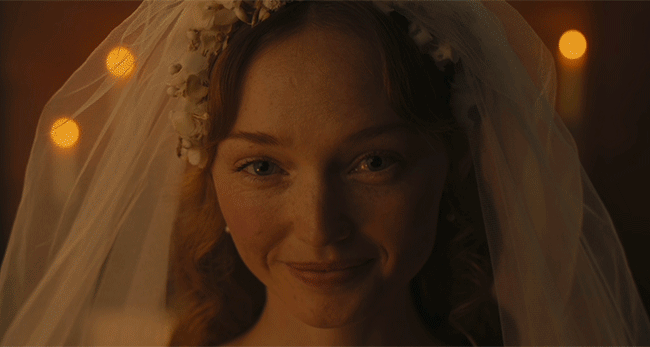
Edward’s internal landscape is governed by ghosts, chief among them his sainted first wife, Sarah (Scarlett DeMeo). Framed through Edward’s selective, romanticized memory, Sarah is an ethereal, largely mute apparition. She is the ultimate patriarchal fantasy: the blameless vessel who welcomes him to their marital bed, displays the bloodstained sheets as proof of her lost virginity, bears his children, and conveniently dies before her youth or agency can complicate his narrative. Sarah stands in stark contrast to the living women who populate his waking life:
- Abby: His frigid second wife, whom he views as entirely useless in both the bedroom and the nursery.
- Lizzie: His troubled, non-conforming daughter, whom he dismisses as "a tree that grew crooked"—a chillingly casual simile for a man whose life is defined by his collection of wood-cutting axes.
- Bridget: The Irish maid whom Edward treats with the casual cruelty of a half-trained animal, utilizing her body for convenient sexual relief while offering zero humanity in return.
Street-Level Reckoning and Transactional Sympathy
As the hours tick down toward his demise, Edward’s misogynistic worldview faces violent friction in the outside world. He suffers two distinct, humbling encounters that expose the fragility of his authority. First, he is beaten unconscious in the street with a parasol by a furious woman whose husband he drunkenly and ineptly chopped in half while attempting to "fit" the man for a premature casket.
Later in the night, a sex worker (played by Madilyn Sweetin) whom Edward overpays—recklessly tossing away a valuable ring gifted to him by Lizzie—takes pity on the bruised, blundering patriarch. She stays by his side, providing comfort, booze, and breakfast. True to form, Edward’s gratitude is entirely transactional; he repays her kindness by belligerently demanding the ring back, reinforcing his inability to form genuine human connections.
The Descent into Jack Torrance Territory
In the episode’s final act, Edward devolves into a would-be woman-killer himself. Charlie Hunnam masterfully leans into an eerie physical transformation. Blind drunk, wounded, clutching an axe, and vibrating with toxic fury, Edward stalks the corridors of his home like a caveman emerging from hibernation. After tumbling down a staircase and locking himself in a cellar, his escape unleashes unadulterated family-annihilator energy. He is a man possessed by the belief that he can reclaim control through violence.
The Climax: A Brutal Reversal
Edward’s reign of terror is brought to a visceral, bloody halt. Lizzie and Bridget turn the tables in a sequence that redefines the infamous murders. This time, Lizzie insists that Bridget take an active, equal part in the mutilation, reducing Edward’s head to a pulpy mass. As the blows rain down, flickering, hallucinatory images of family heirlooms flash before their eyes—with Edward bleeding out across Abby’s fainting couch. The episode fades to the distant, haunting sound of the ocean, leaving Edward to drift into nothingness and shattering any remaining illusion of a normal domestic future.
Supporting Context & Metrics: Analyzing the Monster Philosophy
The intense focus on Edward Borden—traditionally viewed as an unsympathetic, tragic casualty of American true crime lore—invites a broader analysis of co-creators Ryan Murphy and Ian Brennan’s overarching creative vision for the Monster anthology.
The Misfits and Outcasts Matrix
Critics and audiences often grapple with the discomforting sympathy the series occasionally extracts for historical monsters and villains. Beyond standard squeamishness over graphic violence and stylistic fatigue with Ryan Murphy’s maximalist aesthetic, the core unease stems from how Brennan deploys killers and victims alike as avatars for societal outcasts.
| Character Archetype | Societal Stigma | Series Portrayal & Subversion |
|---|---|---|
| The Patriarch (Edward) | Entitled authority, institutional power | Exposed as a fragile, paranoid tyrant trapped by his own misogynistic archetypes. |
| The Outcast Daughter (Lizzie) | Mentally unstable, queer-coded misfit | Transformed from a historical cipher into an agent of reclamation against systemic abuse. |
| The Marginalized Servant (Bridget) | Class exploitation, immigrant struggle | Elevated from background footnote to co-conspirator in liberation. |
By subtly queer-coding its central figures—framing their deviance as a product of societal rejection rather than inherent evil—the show deliberately complicates viewer sympathies. It refuses to offer clean binaries of absolute good versus absolute evil.
The Sociological Impact
According to recent cultural analysis metrics regarding true crime streaming habits, audiences increasingly demand psychological depth over simple procedural reenactment. Monster fulfills this appetite by exploring the roots of trauma. The underlying thesis of the series is deceptively simple: human beings are products of their environments, and our core emotional scars share striking similarities beneath surface-level differences.
The mechanisms that warp one person into a killer can forge resilience or quiet desperation in another. By placing characters like Edward Borden under an analytical microscope, Monster posits that even the most reviled figures in historical lore are worth examining, because their internal decay reflects the broader cultural sickness of their eras.
Official Statements and Creative Insights
While Ryan Murphy Productions maintains strict security regarding the unfolding narrative arcs of the anthology, insights from production notes and character studies illuminate the artistic choices driving The Lizzie Borden Story.
In behind-the-scenes features, Charlie Hunnam discussed the physical and psychological toll of embodying a historical figure defined by domestic tyranny. "Edward isn’t just a man of his time; he’s a man trapped inside his own rigid definitions of ownership," Hunnam noted. "He views his home as a kingdom and the women within it as subjects. When those subjects begin to think, act, and ultimately strike back, his entire reality fractures."
Co-creator Ian Brennan has repeatedly emphasized that the Monster anthology aims to investigate the architecture of violence rather than merely sensationalize its execution. By dedicating an entire episode to Edward’s internal monologue and deteriorating mental state, the creative team deliberately shifts the narrative power dynamic.
"We wanted the audience to sit inside Edward’s claustrophobic worldview—to feel the suffocating nature of his entitlement—so that when the explosion happens, it feels not just like a historical inevitability, but a necessary shattering of an intolerable status quo," production insiders revealed.
Future Outlook: The Evolution of True Crime Television
The critical and cultural reception of Monster: The Lizzie Borden Story signals a major evolution in how television handles historical true crime. Gone are the days of straightforward, sensationalized docudramas that treat victims and perpetrators as flat caricatures. Instead, contemporary prestige television is moving toward deeply psychological, feminist-leaning deconstructions of American mythologies.
Where the Genre Goes From Here
- Deconstructing Historical Narratives: Future true crime projects will likely continue to interrogate the oral histories and legal records passed down through patriarchal lenses, seeking out the silent perspectives of women, servants, and marginalized communities.
- Blurring the Lines of Sympathy: As demonstrated by the nuanced, often uncomfortable framing of figures like Edward Borden, audiences are proving increasingly receptive to complex, morally grey storytelling that challenges comfortable historical assumptions.
- The Rise of Domestic Horror: Rather than relying solely on external monsters, prestige series are increasingly turning their focus inward, exploring the home as a primary site of psychological terror and liberation.
As Monster continues to expand its cinematic universe of infamous figures, Episode 5 of The Lizzie Borden Story will likely stand as a watershed moment. It proves that even the most thoroughly documented historical chapters can be cracked wide open to reveal urgent, uncomfortable truths about power, gender, and the violence inherent in absolute control. Edward Borden’s world of madonnas and whores has finally crumbled, leaving behind a scorched landscape where the silenced have reclaimed their voices—and their vengeance.