By Zofia
Luxury Briefing Special Report
Executive Overview
For years, the existential health of London Fashion Week (LFW) has been measured in algorithms, viral moments, and the ephemeral metric of digital noise. Critics and analysts alike have frequently asked whether a physical runway show still matters if it fails to trend globally on Instagram, TikTok, or X within seconds of the models stepping onto the tarmac.
However, the Spring collections presentation upended that narrative completely. LFW closed its doors with the return of an asset infinitely more valuable to the bottom line than internet hype: serious, purchasing-power-wielding buyers.
According to data released by the British Fashion Council (BFC), accredited buyer attendance surged by 19% year-over-year for the spring season. Even more impressive was the 41% spike in international buyer attendance, signaling a robust re-engagement from global retail heavyweights.
Yet, this commercial resurgence came with a paradoxical caveat. While the front rows filled up with merchants ready to place orders, LFW’s online visibility experienced a steep decline. Digital analytics firms Lefty and Insights by Karla Otto reported a 57% year-over-year drop in social media posts dedicated to the week. Simultaneously, earned media value (EMV)—the holy grail of modern marketing metrics—plunged by 24%, settling at $27.3 million.
This stark divergence complicates the prevailing "London is back" media narrative. It suggests a fashion week that is arguably more useful, grounded, and commercially viable than it has been in years, but one where designers still face a grueling uphill battle to capture the digital attention of the masses. As the luxury landscape recalibrates toward tangible retail performance over vanity metrics, LFW’s latest season serves as a fascinating case study in the shifting definitions of fashion week success.
Detailed Chronology: The Anatomy of a Muted Digital Season
The journey of London Fashion Week’s spring season was defined by a quiet pivot away from spectacle-driven marketing toward intimate, business-focused presentations.
As buyers descended upon the British capital, the initial days of the schedule were characterized by a notable absence of the chaotic, influencer-driven mobs that typically clog the entrances of shows in New York and Paris. Instead, venues welcomed senior executives from the world’s most prestigious department stores and specialty boutiques.
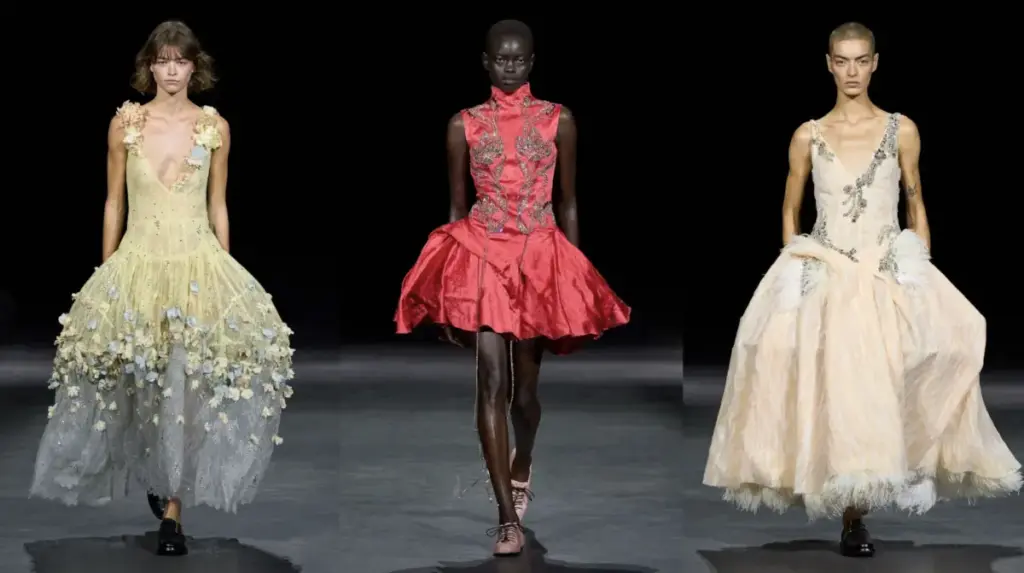
By mid-week, it became clear that the physical spaces were optimized for commerce rather than content creation. Major legacy houses—including Burberry, Erdem, Roksanda, Simone Rocha, and McQueen—unveiled collections that prioritized craftsmanship, tactile luxury, and wearable romance. Retailers were visibly responding to this shift.
However, the digital ecosystem told a different story. As the runway shows progressed, social listening platforms registered a sharp cooling off in digital chatter. Creator-led impressions shifted dramatically away from luxury flagships. Research from influencer marketing agency Billion Dollar Boy revealed that high-street giant M&S alone captured a staggering 39% of creator impressions among U.S. and U.K. accounts analyzed, with Mulberry following at 24%. Collectively, high-street retailers drove 58% of total creator impressions during the week, leaving luxury brands to fight over the remaining 42%.
For heritage luxury labels, the dip in digital resonance was stark. Burberry, which traditionally anchors LFW’s digital dominance, led the Instagram EMV rankings compiled by Lefty and Karla Otto with $10.8 million—a significant 36% decline from the previous year. Alexander McQueen generated $1.6 million (down 46%), while Mulberry’s much-anticipated Christopher Kane debut pulled in $388,000.
This chronological unfolding exposed a widening chasm: while retail coffers stood to benefit from a more focused, buyer-heavy week, the digital machinery that fuels modern luxury mindshare sputtered.
Supporting Context & Metrics: Decoding the Numbers
To fully grasp the significance of this season’s LFW, one must dissect the contrasting datasets provided by industry authorities and analytics firms. The numbers paint a picture of an industry caught in a transitional tug-of-war between old-world wholesale realities and new-world digital expectations.
The Buyer Boom vs. The EMV Slump
| Metric | Year-Over-Year Change | Source |
|---|---|---|
| Accredited Buyer Attendance | +19% | British Fashion Council (BFC) |
| International Buyer Attendance | +41% | British Fashion Council (BFC) |
| LFW Online Social Posts | -57% | Lefty & Insights by Karla Otto |
| Earned Media Value (EMV) | -24% ($27.3M total) | Lefty & Insights by Karla Otto |
| High-Street Creator Impressions | 58% share of total | Billion Dollar Boy |
| Luxury Brand Creator Impressions | 42% share of total | Billion Dollar Boy |
The metrics underscore a profound structural shift. For years, fashion weeks globally suffered from "influencer inflation"—events bloated by content creators who drove astronomical EMV figures but generated little to no direct revenue for the exhibiting designers. The 57% drop in online posts and 24% drop in EMV at LFW do not necessarily signal a failing fashion week; rather, they suggest a deliberate curation of the guest list. Brands and organizers traded digital noise for retail signal.
Yet, this creates a precarious financial balancing act. Emerging and independent designers rely heavily on earned media and digital reach to build brand equity, attract venture capital, and drive direct-to-consumer (DTC) e-commerce sales. When the digital spotlight dims by more than half, smaller brands missing out on legacy retail distribution can find themselves stranded, possessing critical acclaim from buyers but lacking the broad brand awareness required to sustain long-term growth.
Official Statements: Industry Leaders Weigh In
The tension between commercial utility and digital visibility prompted reflections from some of the most influential figures in global retail and design.
The Retail Perspective: Investing in Distinction
Simon Longland, Director of Buying for Fashion at Harrods, noted that the season’s strongest collections—spanning Erdem, Roksanda, Burberry, Simone Rocha, and McQueen—were united by a distinct return to romance, historical references, and a compelling tension between hyper-femininity and menswear-inspired tailoring.
"We continue to invest where we see the strongest expression of a designer’s vision," Longland explained. "Our clients come to Harrods for the extraordinary, so our focus remains on pieces that feel truly special, distinctive, and difficult to find elsewhere."
Highlighting Erdem as his standout collection of the week, Longland praised the house’s evolution: "It was unmistakably Erdem, but moved his language forward through new silhouettes, techniques, and an extraordinary level of craftsmanship. The interplay between masculine and feminine felt particularly relevant."
David Thielebeule, Fashion Director at Bloomingdale’s, echoed these sentiments while noting a broader thematic fragmentation across the London schedules. According to Thielebeule, the season was refreshingly devoid of singular, heavy-handed trends.
"London felt less about one big idea and more about designers sharpening their individual points of view," Thielebeule observed. "The commercial opportunity was clothes with personality and big imagination that still make sense in a woman’s wardrobe. London has always been brilliant at fantasy. This season, the most compelling moments were when that fantasy felt real and often even wearable."
The BFC’s Strategic Validation
British Fashion Council CEO Laura Weir viewed the influx of international buyers as a vindication of the organization’s strategic focus on commercial viability over superficial spectacle.
"A 41% increase in accredited international buyers matters because designers need customers as well as audiences," Weir stated. "To see major British houses choosing London alongside extraordinary emerging talent, retailers opening the industry to consumers, and international buyers discovering businesses they want to take into new markets is exactly what London Fashion Week should do."
The Designer’s Dilemma: Turning Interest into International Growth
While legacy department stores are writing orders, independent and emerging designers face the grueling operational hurdle of converting runway attention into sustainable international expansion.
Daniel Fletcher, Creative Director at Mithridate, is leveraging physical retail touchpoints to bridge the gap between runway fantasy and consumer trust. Operating out of Guangzhou, Mithridate launched a pop-up at Galeries Lafayette over the summer, mapped out a London pop-up for December, scheduled a flagship store opening in China for October, and secured its first U.S. wholesale account in Chicago.
"The challenge we face as a young brand is getting people to trust the quality and craftsmanship behind the clothes," Fletcher shared backstage. "It can feel so different when you see something on the runway compared to seeing it in a store. We want people to be able to feel the clothes, touch them, and see them in person."
Meanwhile, Susan Fang has charted a different trajectory for growth, navigating a diverse mix of categories and geographic markets. Fang reported that her ready-to-wear business is accelerating rapidly in South Korea, while made-to-order bridal demand has maintained a steady upward trajectory over a four-year arc.
"People are still ordering collections from four years ago," Fang noted. "I’m glad the clothes can feel timeless, particularly for special occasions." She added that the United States has firmly established itself as a premier custom-order market for her label, driven largely by bespoke wedding dress commissions.
Future Outlook: The Road Ahead for London Fashion Week
As the dust settles on the spring season, London Fashion Week stands at an intriguing crossroads. The event has successfully proven its ability to lure high-value buyers back into the room, validating its status as a vital engine for international retail trade. However, the sharp contraction in digital visibility and earned media value cannot be entirely brushed aside as a mere correction of vanity metrics.
The existential question facing the BFC, independent designers, and British fashion as a whole is whether a commercially successful week can coexist with modern digital relevance. In an era where consumer discovery happens overwhelmingly on social feeds, independent designers cannot survive on wholesale orders alone. They require a healthy digital ecosystem to drive baseline brand awareness, fuel direct-to-consumer sales, and justify the immense capital expenditure required to mount a runway show.
The next test for London Fashion Week will not be whether it can pack the front rows with even more international buyers, but whether its independent talent pool can successfully translate that renewed physical interest into deeper, long-term wholesale accounts, robust global stockists, and resilient businesses capable of holding the global consumer’s attention long after the runway lights go dark.
Industry Dispatches & Quick Hits
Executive Moves
- Marc Jacobs: Navigating leadership restructurings as the brand refocuses on its core DTC and digital strategies.
- Givenchy: Continuing its high-stakes creative and executive realignment following recent design changes.
- Repossi: Fine-tuning its executive team to accelerate expansion in the ultra-luxury fine jewelry sector.
News to Know
- Gucci’s Manufacturing Shifts: The Italian luxury house continues to face scrutiny and strategic adaptation regarding its global supply chain, including the production of select sneaker lines in China.
- The Sustainable Retail Push: High-street and luxury players alike are doubling down on circular fashion models as regulatory pressures mount across the UK and European Union.
Listen In
On a recent episode of the Glossy Fashion Podcast, Senior Fashion Reporter Danny Parisi and Editor-in-Chief Jill Manoff unpacked six seismic shifts observed at New York Fashion Week. The conversation explored the industry-wide pivot toward wearable collections, the surging integration of vintage pieces into contemporary marketing, increasingly immersive brand storytelling, and the packed party schedules that defined the week. The episode also investigated the fallout from former CFDA President and CEO Steven Kolb’s filmed altercation with a PETA protester. Listen to the full episode here.
Recommended Reading on Glossy
- The Vintage Boom: Why an increasing number of fashion brands are incorporating vintage fashion directly into runway collections, flagship store designs, and digital marketing campaigns.
- Social Commerce Expansion: Sephora’s official arrival on TikTok Shop—what does this signal about the platform’s growing influence over the prestige beauty market?
- Brand Platforms: A deep dive into Ugg’s new international “Born to Feel” brand platform as it aims to sustain its impressive commercial hot streak.
- Digital Detox: An exclusive look at Pinterest’s decision to sponsor a phone-free London Fashion Week show, challenging the industry’s addiction to screens.