Executive Overview
A decade after the lights went down at Madison Square Garden on August 28, 2016, the MTV Video Music Awards (VMAs) of that year stand as a monumental watershed in modern pop history. To revisit the 2016 ceremony is to gaze across a cultural chasm. It was an era when the center of the pop universe still held, pulling the biggest, most elusive names in music into a single arena for an unforgettable evening of high-stakes television.
The night was defined by career-defining triumphs, near-mythic performances, and unscripted drama that fans and cultural analysts still dissect ten years later. From Beyoncé’s paradigm-shifting Lemonade medley to Rihanna’s multi-act Video Vanguard coronation, the 2016 VMAs captured pop culture at its most concentrated, extravagant, and culturally vital.
Yet, looking back from the vantage point of the present, the 2016 show also marks a tragic turning point. It proved to be the final time an awards show could reliably assemble such a dense constellation of A-list superstars under one roof. In the decade since, shifting media consumption, the atomization of celebrity culture, and the rise of digital-first engagement have made such a gathering nearly impossible to replicate.
In this deep-dive retrospective—inspired by the Greatest Pop Stars podcast episode hosted by Andrew Unterberger and Billboard digital deputy editor Katie Atkinson—we examine the mechanics, cultural context, and lingering mysteries of the night the VMAs reached its absolute peak, and why pop music has never quite looked the same since.
Detailed Chronology: A Night of Unrivaled Spectacle
The 2016 VMAs were structured not merely as an awards ceremony, but as a rapid-fire succession of historical pop moments. Every segment felt engineered to push the boundaries of live television.
1. The Opening and the Omnipresence of Kanye West
The evening commenced with an unpredictable address from Kanye West, who was granted four completely unstructured minutes to do—literally—whatever he wanted. Fresh off the rollout of The Life of Pablo, West used his platform to muse on fame, violence in Chicago, and his complicated relationship with Taylor Swift, setting a tone of high-tension reality television where anything could happen. It was a stark reminder of the unique currency the VMAs held: an environment where a major artist could command live network airtime with zero guardrails.
2. Beyoncé’s Lemonade Masterclass
Midway through the evening, Beyoncé delivered what many critics and industry insiders still regard as the greatest live television performance of the 21st century. Spanning roughly 16 minutes, her Lemonade medley synthesized the anger, grief, empowerment, and political urgency of her seminal visual album.
Transforming the Madison Square Garden stage into a living gallery of Black female resilience, she moved seamlessly from "Hold Up" to "Sorry," "Don’t Hurt Yourself," "Formation," and "Pray You Catch Me." Armed with a baseball bat (and literal fire), Beyoncé did not just perform; she laid claim to the cultural throne. It raised the bar for award-show spectacles so high that subsequent productions have rarely even attempted to clear it.
3. Rihanna’s Four-Act Vanguard Coronation
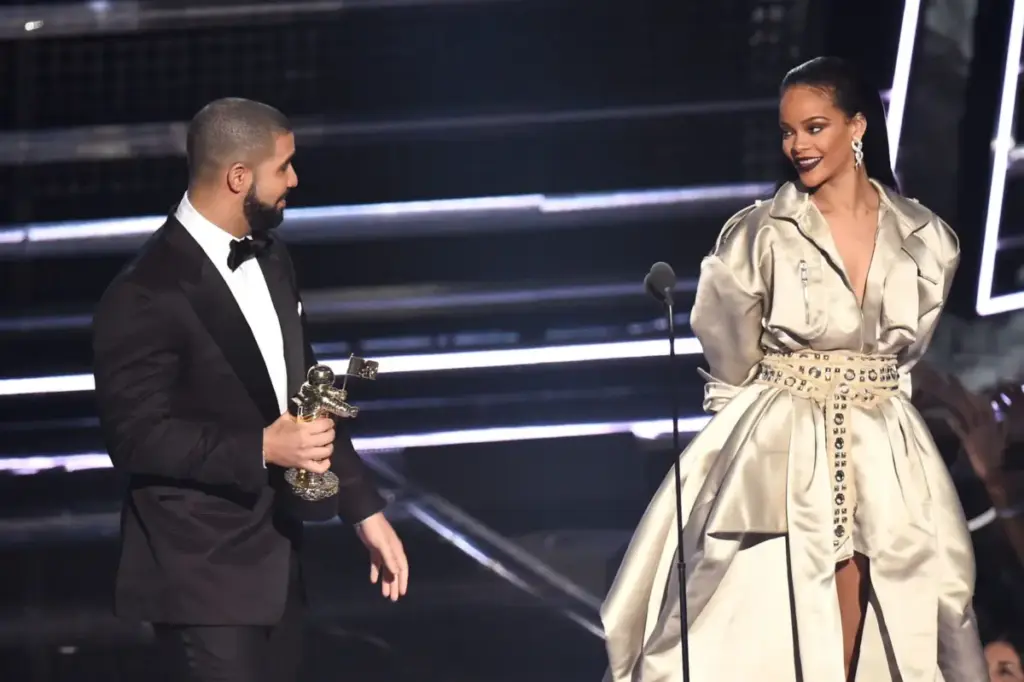
Rihanna’s receipt of the Michael Jackson Video Vanguard Award was broken down into four distinct musical medleys distributed across the broadcast. Tracing a decade-long trajectory from Caribbean-inflected dancehall queen to crossover pop juggernaut and boundary-pushing auteur, Rihanna proved the sheer breadth of her catalog.
Yet, the performance was inextricably linked to the night’s most viral romantic subplot: Drake. Entrusted with presenting her the award, Drake confessed to a national audience that he had been in love with Rihanna since he was 22 years old. As he leaned in for a celebratory kiss on the lips, Rihanna executed a masterclass in professional poise, expertly pivoting to accept the embrace on the cheek. The internet exploded instantly. The moment added a layer of modern folklore to both artists’ mythologies, cementing their status as pop royalty whose personal and professional lives remained a subject of intense global fascination.
4. The Counter-Narratives: Britney Spears and Nick Jonas
Not every high-profile moment landed its intended punch, however. Britney Spears returned to the VMA stage for the first time in nearly a decade to perform her comeback single "Make Me…" alongside rapper G-Eazy. While Spears looked energetic and fit, the performance suffered from a sense of severe mismatch. Sandwiched between Beyoncé’s masterclass and the relentless energy of the rest of the night, Spears’ performance felt muted, hampered by backing tracks and an awkward physical chemistry with G-Eazy—a misfire that fans and analysts still debate today.
Similarly, Nick Jonas brought a breezy, soulful performance of his track "Bacon" to the streets outside Madison Square Garden. Though critically praised for its fun, throwback R&B aesthetic, many felt the segment was sidelined in the broadcast, receiving a raw deal relative to the arena-shaking main stage productions.
Supporting Context & Metrics: The End of an Era for Music Television
To understand why the 2016 VMAs felt like the center of the pop universe, one must evaluate the macro-trends of the mid-2010s music industry.
- The Super-A-List Ecosystem: In 2016, streaming was rapidly ascending, but the traditional monoculture had not yet fractured. Pop stars still functioned as monolithic entities. Albums were major, synchronized global events, and physical appearances at tentpole events like the VMAs were mandatory chapters in an artist’s promotional cycle.
- Ratings and Reach: While linear television ratings were already beginning their gradual descent, the 2016 VMAs still drew millions of live viewers and generated billions of social media impressions. Twitter (now X) and Instagram were fully matured real-time engagement engines, yet they had not yet decentralized fandoms into hyper-niche, algorithmically sealed echo chambers.
- The Post-2016 Exodus: In the years following 2016, the industry fractured. Artists realized that surprise drop albums, direct-to-fan social media engagement, and massive stadium tours yielded higher returns on investment—both financially and reputationally—than high-stress, highly scrutinized live television performances. The logistics, creative compromises, and viral risks of events like the VMAs began to outweigh the rewards. Consequently, getting the likes of Beyoncé, Rihanna, Drake, and Kanye West under one roof today is practically an impossibility.
Official Statements and Critical Reflections
Reflecting on the 2016 broadcast a decade later, industry observers note that the show marked the final evolutionary stage of the traditional pop music ecosystem.
"The 2016 VMAs were the last time we saw the absolute titans of our generation occupy the exact same physical space, fighting for the same cultural real estate in real-time," notes Billboard digital deputy editor Katie Atkinson. "You look back at the setlist—Beyoncé, Rihanna, Britney, Kanye, Drake—and it reads like an impossible fantasy football draft of pop royalty. We didn’t fully realize at the time that we were watching the end of an empire."
Host Andrew Unterberger adds: "It raises fundamental questions about how pop stardom operates today. The monoculture has given way to a million subcultures. Can an award show ever feel that dangerous, that exciting, or that culturally central again? The evidence of the last ten years suggests a resounding no."
Future Outlook: Can the VMAs Ever Reclaim the Magic?
As MTV and other legacy networks grapple with the reality of cord-cutting and the migration of Gen Z audiences to platforms like TikTok, YouTube, and Twitch, the modern awards show faces an existential crisis.
The strategy in recent years has shifted toward viral moments, K-pop global fandom powerhouses, and internet-native creators. While these elements have kept shows like the VMAs commercially viable, they have failed to recreate the gravity of 2016. Today’s pop landscape is decentralized. Taylor Swift achieves unprecedented, historic stadium dominance largely on her own terms; Beyoncé commands the global stage via cinematic concert films rather than traditional network television; and Rihanna has transitioned into a beauty and fashion mogul.
The likelihood of capturing lightning in a bottle the way 2016 did—where the greatest artists of a generation collided in a single, high-stakes arena—grows dimmer with each passing year. The 2016 VMAs remain pop music’s last golden summit: a dazzling, chaotic, and utterly irreplaceable artifact of a time when the world stopped spinning to watch music television together.
A Note on Advocacy and Support
In keeping with the spirit of community engagement highlighted by the Greatest Pop Stars retrospective, please consider supporting organizations dedicated to the fight for transgender rights, healthcare access, and safety: