Executive Overview
The convergence of jewelry, metallurgy, and biometric data collection has accelerated at an unprecedented rate over the last half-decade. Among the pioneers of this market shift is Oura Health, a Finnish health technology company that popularized the form factor of the smart ring. Recently, the company introduced its latest iteration: the Oura Ring 5.
Priced at £399 ($399), this fifth-generation device promises to reconcile two traditionally competing priorities: the refined aesthetics of traditional jewelry and the robust monitoring capabilities of advanced health trackers. For individuals undergoing major life transitions—such as marriage—the question of how to accessorize the hand without looking encumbered by technology has become a central design challenge.
This review explores whether the Oura Ring 5 successfully overcomes the historical shortcomings of smart rings—namely, bulky dimensions, rapid battery degradation, and awkward charging mechanics—while assessing its position within the broader, hyper-competitive ecosystem of fitness wearables alongside competitors like the Whoop 5.0 and Garmin fenix 8.

Detailed Chronology: From the Wedding Altar to the Testing Grid
The Dual-Ring Dilemma
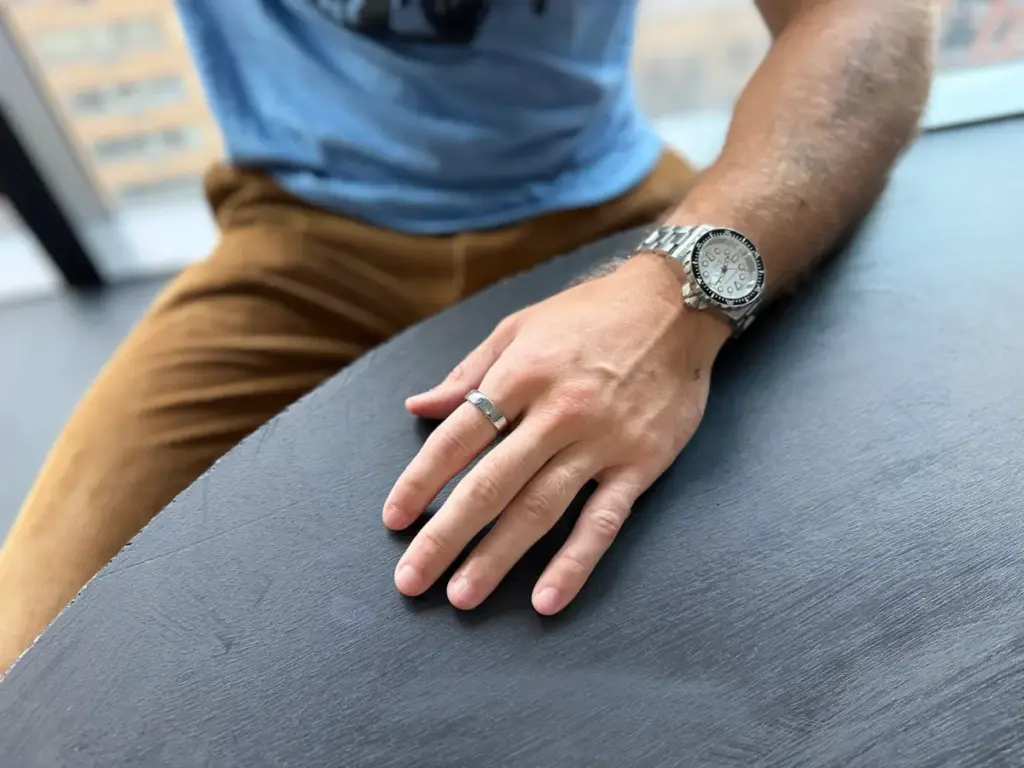
The journey of evaluating the Oura Ring 5 began at a personal crossroads. Following a wedding earlier this year, the introduction of a traditional wedding band to the left hand forced a reckoning with existing wearable technology. Previously, a silver, third-generation Oura ring occupied the index finger. Placed alongside a newly added wedding band, the limitations of the older generation hardware became starkly apparent.
The third-generation ring felt increasingly bulky, unwieldy, and heavy. More critically, its battery performance had degraded significantly, requiring frequent recharges that broke the passive monitoring cycle. This friction often reduced the device from an active health partner to a dormant piece of metal.
Opting for a non-traditional silver wedding band specifically to maintain visual harmony with existing tech accessories was a calculated compromise. However, the underlying question remained: Is the accumulation of multi-finger jewelry worth the data return, especially when alternative devices offer superior power persistence?

The Transition to Generation 5
Transitioning to the Oura Ring 5 immediately shifted these calculations. Over a rigorous multi-week testing period spanning daily routines, intense gym sessions, and race preparation, the device proved to be more than just a stylistic upgrade.
Unlike its predecessors, the fifth-generation ring integrates seamlessly into daily life. It no longer demands cognitive overhead regarding its physical presence on the hand. By reducing the physical footprint and stretching power retention cycles to nearly a week and a half, Oura has addressed the primary pain points that alienated casual and power users alike.
Supporting Context & Metrics: Analyzing the Hardware and Software
Form Factor and Ergonomics
The most striking physical attribute of the Oura Ring 5 is its reduction in physical scale. According to manufacturer specifications and practical validation, the Ring 5 is engineered to be 40 percent smaller than the Oura Ring 4, representing an exponential leap in miniaturization compared to the third-generation hardware.

- Weight and Profile: The slim profile ensures that the ring sits flush against the skin without catching on clothing, gym equipment, or daily objects.
- Workout Compatibility: While older models like the Gen 3 were routinely removed during high-friction movements—such as barbell curls, kettlebell swings, and farmer’s carries—the Ring 5 remained comfortably in place through nearly all standard gym routines. Only during extreme loads, such as heavy deadlifts where bar knurling pressures the fingers directly, did the necessity to remove the device arise.
- Aesthetic Integration: Placed on an adjacent finger to a standard metal wedding band, the Ring 5 does not clash visually. Its finish and geometry complement traditional jewelry rather than mimicking an intrusive piece of electronics.
Battery Longevity and Power Management
Battery degradation has been the Achilles’ heel of miniature wearables. Because internal volume is strictly limited, engineers are perpetually constrained by the energy density of available battery cells.
- The Generation 3 Shortfall: Previous iterations frequently demanded charging every two to three days. For a passive wearable meant to capture continuous sleep and recovery metrics, this short cycle often resulted in unmonitored windows while the device sat on a charger.
- The Generation 5 Breakthrough: During the evaluation period, the Oura Ring 5 consistently delivered eight to nine days of continuous use between charges. This represents a monumental leap forward, eliminating the charging anxiety that plagues the category.
However, the hardware update brought one minor logistical friction point: the charging base. Retaining the square charging puck introduced with the fourth generation, the footprint is noticeably larger than the classic circular chargers of the past. While easily accommodated on a dedicated nightstand, it lacks the effortless slip-into-a-dopp-kit convenience of its circular predecessor. Given the extended interval between charges, this minor spatial drawback is easily forgiven.
App Ecosystem and Passive vs. Active Tracking
Hardware is only as effective as the software translating its data streams. Oura’s application interface remains a standout feature in the health tech market.

- Interface Design: While rival platforms often lean heavily into stark, utilitarian data dashboards, Oura utilizes a welcoming visual language characterized by cool color palettes and clear, large-format typography. This design choice encourages engagement, prompting users to inspect metrics more frequently.
- Sleep and Readiness Tracking: In the weeks leading up to a major endurance race, daily monitoring of sleep architecture and physiological readiness proved invaluable. Trends over time are where Oura excels, making it an elite tool for longitudinal health analysis.
- The Passive Tracking Debate: The core philosophical divide in modern fitness tracking—passive versus active monitoring—remains evident here. Devices like smartwatches demand active engagement (initiating a workout on-screen), whereas rings record passively. While Oura has expanded its active tracking features, initiating these modes still requires pulling out a smartphone and navigating the app—a workflow testers often found clunky compared to wrist-based alternatives. For users who prefer real-time, glanceable feedback on demand, a smartwatch remains superior. For those content with reviewing aggregated trends post-hoc, Oura’s passive model is ideal.
Official Statements and Ecosystem Competitiveness
Oura positions its flagship wearable as the premier lifestyle and health ring on the market, backed by continuous refinement in sensor accuracy, algorithmic recovery scores, and battery chemistry. Industry observers note that while the smart ring category is growing crowded with entrants from legacy tech and fashion brands alike, Oura maintains an edge through its mature software ecosystem.
Subscription Model Considerations
No evaluation of Oura is complete without addressing the financial commitment. Beyond the upfront hardware cost of £399 / $399, users must factor in Oura’s ongoing membership model, which is priced at $5.99 per month or $69.99 annually. This fee unlocks the full breadth of personalized health insights, trend analysis, and advanced readiness metrics within the app.
Alternative Wearables in the Market
For consumers weighing whether a smart ring is the right choice, several alternative form factors and ecosystems compete directly for wrist and finger space:

- Whoop 5.0 Band: An exceptional choice for athletes prioritizing continuous strain and recovery tracking without the encumbrance of a screen or a ring. It operates purely on a subscription-first model and excels at active athletic optimization.
- Garmin fenix 8 (AMOLED): The gold standard for hardcore outdoor adventurers, endurance athletes, and data maximalists who demand real-time telemetry, onboard GPS, and unmatched battery longevity in a rugged smartwatch form factor.
Future Outlook
The trajectory of smart jewelry points toward absolute ubiquity. As sensor miniaturization continues, future iterations of smart rings will likely incorporate more advanced biometric markers—such as non-invasive glucose monitoring, advanced hydration tracking, and refined electrodermal activity sensors—without increasing physical dimensions.
The Oura Ring 5 establishes a new benchmark for what users should expect from a health ring: uncompromising battery life, featherlight ergonomics, and aesthetic compatibility with traditional jewelry. While it may not fully convert users who demand real-time, wrist-based workout metrics, its mastery over sleep architecture, recovery scoring, and passive health trends secures its place at the top of the smart ring hierarchy.
For anyone willing to embrace the ongoing subscription model and the philosophy of passive health tracking, the Oura Ring 5 is currently the most refined, unobtrusive biometric tracker available.