Executive Overview
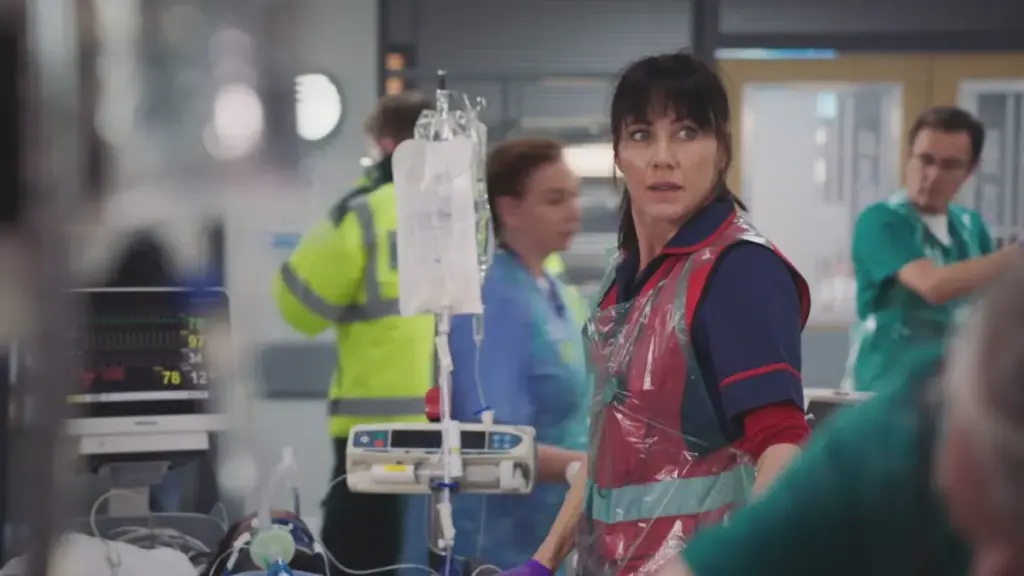
For forty years, the piercing wail of ambulance sirens and the frantic, high-stakes adrenaline of the emergency department have been a Saturday night staple in British households. The BBC’s flagship medical drama, Casualty, is officially marking its milestone 40th anniversary this week with a cinematic, high-octane double-bill that threatens to rewrite the history of Holby ED. Airing on Saturday, September 5, this landmark television event centers on a catastrophic disaster—a massive, skyline-lighting firebomb explosion at St James’ Hospital—that leaves the lives of beloved characters hanging precariously in the balance.
As television landscapes shift and streaming platforms alter viewing habits, few scripted programs can claim the cultural longevity, endurance, and profound societal impact of Casualty. Created by Jeremy Brock and Paul Unwin in 1986, the series has outlived political eras, economic shifts, and technological revolutions, continuously reinventing itself while retaining its core identity.
This special report explores the monumental 40th-anniversary event, the narrative pressures facing the Holby ED team, the profound real-world legacy of the programme, and exclusive insights from series leadership regarding what it takes to keep a titan of British drama running for half a century.
Detailed Chronology: The Anatomy of the 40th-Anniversary Disaster
The anniversary episodes promise to deliver some of the most dramatic and visually arresting sequences in the show’s illustrious history. Moving away from standard procedural formats, the BBC has invested heavily in creating a cinematic experience for viewers, culminating in a storyline that will alter the trajectory of the Holby Emergency Department for months, if not years, to come.
The Spark: Chaos at St James’ Hospital
The narrative unfolds across two interconnected special episodes. According to official synopses and promotional trailers released by the BBC, the trouble begins with an unprecedented security breach and a subsequent escalation of violence and danger within the healthcare facility.
The first episode logline sets a grim tone: "Lives hang in the balance as a huge firebomb lights up the skies of Holby." The sheer scale of the explosion at St James’ Hospital is designed to push emergency services to their absolute breaking point. Unlike localized trauma cases that usually populate a single shift, this disaster impacts multiple wards, trapping staff, patients, and visitors alike amidst collapsing infrastructure and raging fires.
The Aftermath: Leadership Under Fire
As the smoke clears and the true scale of the devastation becomes apparent, the surviving medical professionals are forced into survival mode. The human toll is immediate, forcing clinical teams to triage their own colleagues and friends.
The synopsis for the second anniversary installment shifts focus to the psychological and operational fallout: "As the team look to Dylan for guidance in their hour of need, does he have the strength to keep fighting?"
Dylan Keogh (played by William Beck), known for his acerbic wit, clinical brilliance, and deep-seated emotional resilience, will face his ultimate test. With the hospital infrastructure crippled and resources critically depleted, Dylan must step into a leadership vacuum. The narrative asks whether a man who often struggles with his own internal demons can shoulder the collective trauma of a shattered department and guide the remaining staff through the darkest night in Holby’s history.
Supporting Context & Metrics: The Cultural and Real-World Impact of Casualty
To understand the magnitude of Casualty‘s 40th anniversary, one must examine the staggering scale of the show’s production history and its unique intersection with real-world British society.
A Record-Breaking Production Legacy
Since its premiere on September 6, 1986, Casualty has broadcast thousands of episodes, making it the longest-running emergency medical drama television series in the world. Over four decades, the show has:
- Employed hundreds of actors, guest stars, and recurring cast members who have populated the fictional county of Wyvern and the city of Holby.
- Utilized thousands of gallons of theatrical fake blood and prosthetic injuries to simulate everything from minor lacerations to catastrophic trauma.
- Provided a career-launching platform for numerous high-profile British actors, including Kate Winslet, Orlando Bloom, Minnie Driver, and Jodie Comer, all of whom cut their teeth as guest stars in the Holby ED early in their careers.
The Real-World Pipeline: Medicine, Public Health, and Education
Beyond entertainment, Casualty functions as an unofficial public health educator. Series producer Liza Mellody notes that the drama’s commitment to authentic medical storytelling has yielded tangible, life-saving consequences in the real world.
"There are so many people that have said, ‘I became a nurse or doctor because of Casualty,’ or ‘I know how to do CPR because of Casualty,’" Mellody shares. The sociological phenomenon of the "Casualty generation"—healthcare professionals who trace their career inspiration directly back to Saturday night viewings—is well-documented by the UK National Health Service (NHS).

Furthermore, the program has frequently tackled sensitive social issues, ranging from domestic abuse and mental health crises to substance addiction and systemic NHS strain. By embedding these topics within high-adrenaline narratives, the show encourages viewers to seek medical evaluation or psychological support for symptoms they might otherwise ignore. Public health campaigns have repeatedly noted spikes in public health awareness following specific, high-profile storylines broadcast on the BBC.
Official Statements: The Vision Behind the Milestone
Maintaining a weekly drama for forty years requires a delicate balance of institutional memory and forward-thinking innovation. Series boss Liza Mellody spoke candidly about the philosophy driving the show into its fifth decade, emphasizing that the secret to Casualty‘s longevity lies in its profound respect for human imperfection.
"Our characters are human—they are flawed, but they do the best they can with what they have," Mellody explains. "We are telling human stories through the lens of medicine, adrenaline, warmth, joy, pain, and ultimately hope. It is a marvellous concoction for Saturday night viewing."
This synthesis of clinical precision and emotional vulnerability is what transforms standard medical emergencies into compelling drama. Mellody describes the standard 50-minute episode as "unmissable television," a status that the production team has fiercely guarded through rigorous research and consultation.
The Burden of Authenticity
While Casualty relies on dramatic license to heighten tension for Saturday night audiences, its production team operates under strict ethical and professional guidelines. The show maintains a dedicated advisory panel consisting of real-world paramedics, emergency room nurses, and trauma surgeons.
"With that comes a responsibility to be authentic," Mellody stresses. "We are a drama, but we have a huge medical team advising on the show, so what we portray is authentic with a twist of dramatic licence!"
This dedication ensures that while the explosions, car crashes, and firebombings are heightened for entertainment value, the medical procedures, triage protocols, and emotional realities of healthcare workers retain a grounded, respectful truth.
Future Outlook: Looking Beyond the 40th Year
As celebrations for the milestone weekend commence, conversations within the television industry naturally turn toward the future. In an era dominated by subscription video-on-demand (SVOD) platforms, algorithm-driven content, and fragmented viewing habits, linear television dramas face unprecedented competition.
Yet, Casualty occupies a unique space. By anchoring itself to the National Health Service—an institution that remains central to the British national identity—the show maintains an intrinsic relevance that few fictional universes can replicate. As long as there are emergency rooms, overworked staff, and human stories of survival, Casualty has a narrative well that will never run dry.
With the dust settling on the St James’ Hospital firebomb disaster, the immediate future of Holby ED will be defined by reconstruction, emotional healing, and structural changes within the hospital trust. Characters who survive the Saturday night event will carry psychological scars that will ripple through subsequent story arcs well into 2026 and beyond.
As Liza Mellody boldly declared when looking toward the horizon: "Bring on the next 40 years!"
Casualty’s 40th-anniversary double-bill airs on Saturday, September 5, on BBC One and BBC iPlayer. Dedicated fans can explore exclusive cast interviews, episode breakdowns, and behind-the-scenes teasers across major television news portals ahead of the broadcast.