Executive Overview
In a demonstration of persistent maritime vigilance, the UK Royal Navy has completed an intense, 72-hour operation tracking a flotilla of Russian warships and sanctioned cargo vessels as they transited through British waters. The operation, which stretched from the North Sea through the English Channel, underscores the escalating friction points in northern European waters as Moscow increasingly relies on aging, clandestine vessels to circumvent international trade restrictions.
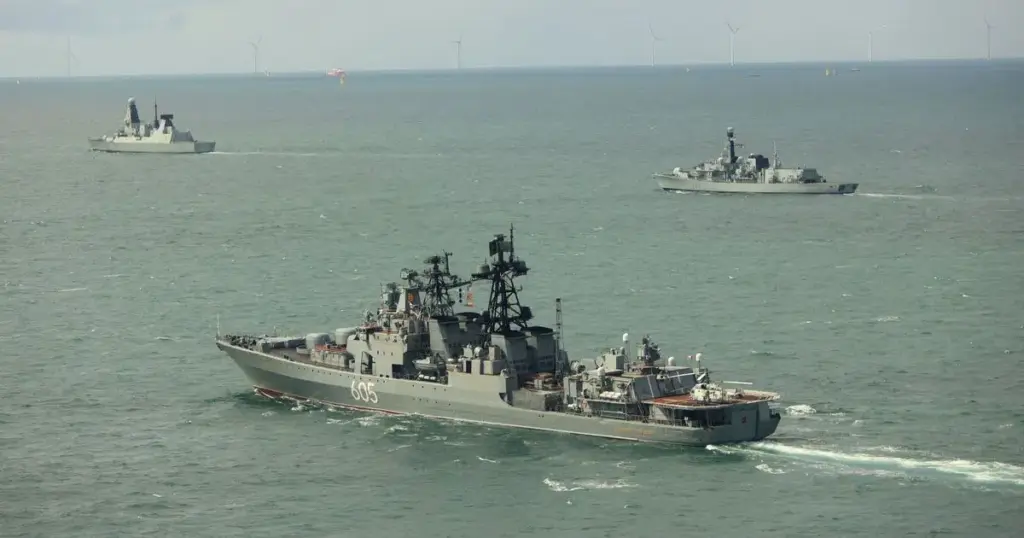
The three-day surveillance mission involved a coordinated multi-vessel task group, featuring the Type 45 destroyer HMS Duncan, the Type 23 frigate HMS St Albans, and the patrol vessel HMS Severn. Supported by embarked Merlin helicopters, the Royal Navy shadowed a Russian naval detachment centered on the destroyer Admiral Levchenko, which was escorting sanctioned cargo carriers General Skobelev and Sparta. In response to the rigorous British tracking posture, Moscow deployed supplementary naval assets—including the Neustrashimy frigate—to safeguard the convoy.
The operation unfolds against a backdrop of mounting geopolitical friction. It follows a 25 percent surge in Russian naval monitoring operations compared to previous years, reflecting a broader strategy by Western allies to disrupt Moscow’s evasion of oil sanctions designed to fund its ongoing war in Ukraine. Concurrently, the maritime showdown coincides with a fresh wave of incendiary rhetoric from the Kremlin, triggered by British diplomatic and military support for Kyiv. Despite heightened anxieties and implicit threats of retaliation from Moscow, Western defense officials remain steadfast, emphasizing that such rhetoric is a long-standing psychological tool intended to deter allied support rather than a precursor to direct military confrontation with NATO.
Detailed Chronology: The 72-Hour Maritime Operation
The high-stakes operation commenced late last week as maritime intelligence networks detected a Russian task group approaching the UK’s zone of strategic interest from the North Sea. The Royal Navy’s response was immediate and multi-layered, designed to maintain unbroken custody of the foreign warships and their accompanying commercial charges.
Day One: Interception and Identification
As the Russian convoy neared British territorial approaches, HMS Duncan and HMS St Albans made visual and radar contact with the primary Russian warships. At the heart of the formation was the Admiral Levchenko, a heavily armed Udaloy-class destroyer tasked with projecting power and providing security for the convoy. Trailing closely behind were the sanctioned cargo vessels General Skobelev and Sparta.
Recognizing the potential environmental and security risks posed by the sanctioned vessels—frequently referred to by maritime experts as part of Russia’s "shadow fleet"—the Royal Navy established a tight shadowing perimeter. To enhance tactical awareness beyond the horizon, embarked Merlin helicopters launched from the British warships, utilizing advanced sensor packages to monitor the formation’s speed, heading, and cargo status as it converged on the critical choke point of the Strait of Dover.
Day Two: Tactical Shifts and Kremlin Reinforcements
Entering the second 24-hour cycle, the operation intensified as the convoy navigated the congested waters of the English Channel. In a clear tactical reaction to the unrelenting British surveillance, the Russian naval command ordered reinforcements to the area. The Neustrashimy, a Neustrashimy-class frigate, was dispatched to bolster the formation’s escort screen, attempting to interpose itself between the Royal Navy shadows and the sanctioned cargo vessels.

Despite the added naval presence, the Royal Navy maintained its disciplined tracking posture. HMS Severn, optimized for offshore patrol and coastal surveillance, maintained close tabs on the newly arrived Neustrashimy, ensuring that every tactical maneuver by the Russian warships was documented and countered. Throughout this phase, the task group operated in close coordination with allied navies, exemplifying NATO’s collective approach to monitoring strategic waterways.
Day Three: Handover and Conclusion
As the Russian task group pushed past the Dover Strait and headed southwest, the intense 72-hour operation reached its final operational phase. Having safely shepherded and cataloged the convoy through critical UK-adjacent shipping lanes, the Royal Navy executed a planned handover of monitoring duties to a NATO ally off the coast of France near Ushant.
With the handover complete, British vessels resumed their high-readiness patrols, leaving Moscow in no doubt regarding the UK’s capacity to detect, track, and neutralize potential maritime threats along its maritime boundaries.
Supporting Context & Metrics: The Mechanics of the "Shadow Fleet"
The recent 72-hour operation is not an isolated incident; rather, it represents a busy new normal for the Royal Navy. Maritime security analysts point to a systematic escalation of Russian naval and commercial activity designed to test Western resolve and sustain wartime revenues through illicit means.
The Rise in Encounters
Data released by the Ministry of Defence highlights a stark upward trend in operational tempo. In July alone, Royal Navy assets spent a combined 21 days actively monitoring Russian warships in and around UK waters—representing a 25 percent increase in operational commitments compared to the same period in the previous year. These missions have required a continuous rotation of destroyers, frigates, and patrol vessels to manage the steady stream of Moscow’s naval assets traversing the North Sea and the Dover Strait.
Choking Off the War Economy
At the core of these operations is the phenomenon of the Russian "shadow fleet." Facing stringent international sanctions on its petroleum exports and financial networks in the wake of its invasion of Ukraine, Moscow has increasingly turned to a clandestine network of aging, poorly regulated commercial vessels. These ships frequently operate with opaque ownership structures, substandard safety equipment, and deactivated transponders to evade tracking.
By utilizing these vessels to transport oil and restricted supplies, Russia aims to generate the hard currency necessary to sustain its military apparatus. However, these practices present severe risks to maritime safety and the marine environment, particularly in densely populated and environmentally sensitive shipping lanes like the English Channel.

A Watershed Moment: The Seizure of the Smyrtos
The tension at sea has crossed the threshold from passive tracking to active intervention in recent months. In June, the Royal Navy and Royal Marines executed a landmark operation, boarding and seizing the oil tanker Smyrtos—a key component of the Russian shadow fleet. This unprecedented move marked the first time British military forces directly boarded an evasion vessel operating on behalf of Moscow, signaling a tougher, more assertive enforcement posture by the UK government and its international partners.
Official Statements and Strategic Assessment
The geopolitical dimensions of the Royal Navy’s recent operations have drawn sharp commentary from military leadership and defense analysts alike, emphasizing both the necessity of vigilance and the broader strategic calculus governing UK-Russia relations.
First Sea Lord General Sir Gwyn Jenkins addressed the operational realities following the conclusion of the mission, stressing that complacency is not an option in the current security environment.
"There is no room for complacency as shadow fleet vessels continue to pose an unacceptable risk to maritime security and the environment," General Sir Gwyn Jenkins stated. "Alongside our allies, this approach is forcing Moscow to divert Russian warships away from their core purpose. That is because Russia knows we stand ready to act again, should it be required."
Military officials have emphasized that by forcing the Russian Navy to allocate valuable warships—such as the Admiral Levchenko and Neustrashimy—to escort sluggish commercial cargo carriers, the UK and its allies are successfully degrading Moscow’s broader naval flexibility and operational bandwidth.
Geopolitical Fallout and Future Outlook
The maritime encounters coincide with a tense diplomatic week marked by pointed rhetoric from the Kremlin. The diplomatic friction was catalyzed by high-profile political visits to Kyiv, during which British representatives announced plans to provide Ukraine with advanced technological blueprints for long-range SCALP cruise missiles.
In response, senior figures in Moscow accused Western allies of "playing with fire," warning that continued military assistance to Ukraine crosses dangerous red lines. Former Russian foreign minister Andrei Fedorov went further, stating that he could not entirely rule out "semi-military" actions against Britain in retaliation, hinting at potential asymmetric threats directed at Western defense manufacturing infrastructure from obscured sources.

Despite these escalatory warnings, Western defense and intelligence officials have sought to maintain a calm and measured perspective. Officials briefing the press on Friday categorized the Kremlin’s statements not as an imminent threat of war, but as a continuation of long-standing Russian military doctrine. This doctrine traditionally leverages aggressive rhetoric to amplify public anxiety, divide allied resolve, and deter the provision of advanced weaponry to Ukraine.
"We do need to be careful to distinguish what is real from what is rhetoric designed to scare and deter us," a senior Western official noted. "Replaying Russian threats and heightening a sense of crisis is exactly what the Kremlin wants. Our assessment remains that Russia isn’t seeking direct confrontation with NATO."
Looking Ahead
As the conflict in Ukraine grinds on, the maritime theater surrounding the British Isles will likely remain a critical friction point. The Royal Navy’s successful execution of the 72-hour tracking operation demonstrates that the UK maintains the operational readiness, technical capability, and political will to safeguard its territorial waters.
Moving forward, defense planners anticipate that monitoring operations will remain at an elevated tempo. By maintaining seamless cooperation with NATO allies, enforcing sanctions compliance, and demonstrating zero tolerance for environmental and security hazards posed by shadow fleets, the UK aims to keep the pressure on Moscow’s war economy while deterring any miscalculation at sea.