Executive Overview
For over three decades, Jennifer Aniston has remained one of Hollywood’s most instantly recognizable icons. From her era-defining days as Rachel Green on Friends to her critically acclaimed work on The Morning Show, Aniston has commanded the global spotlight not just for her acting prowess, but for a physique and vitality that seem entirely immune to the traditional aging process. Yet, the narrative surrounding Aniston’s wellness journey has undergone a profound transformation. Gone are the days of punishing, high-impact routines and the exhausting cultural mantra of "no pain, no gain."
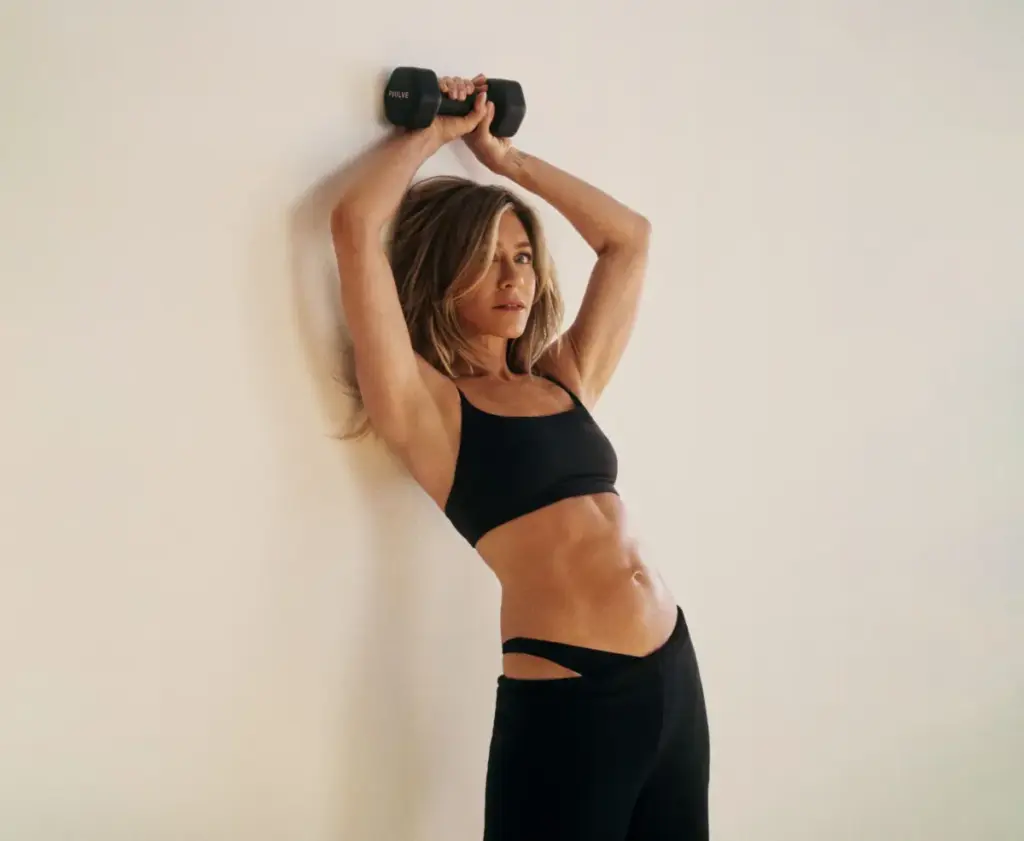
Instead, the Emmy Award-winning actress has emerged as a vocal advocate for a sustainable, science-backed approach to physical health: functional fitness. By aligning herself with the Pvolve method—a low-impact, resistance-based fitness program designed to mimic and support everyday human movement—Aniston has rewritten the rules of Hollywood wellness. Her philosophy is no longer rooted in aesthetic punishment, but in consistency, longevity, and listening to the body’s subtle cues.
This in-depth feature explores the physiological mechanics behind Aniston’s routine, the expert insights of her personal trainer Dani Coleman, the psychological shift required to abandon high-intensity burnout, and a detailed breakdown of the exact arms-and-abs movements that form the cornerstone of her age-defying regimen.
Detailed Chronology: The Evolution of Hollywood Fitness and Aniston’s Paradigm Shift
To truly understand Jennifer Aniston’s current fitness philosophy, one must examine the landscape of celebrity health over the past thirty years. When Aniston first captured international fame in the mid-1990s, the fitness industry was largely dominated by extreme methodologies. High-intensity step aerobics, grueling endurance running, heavy pounding on the pavement, and relentless gym sessions were the gold standard for maintaining a television-ready figure.
During the early stages of her career, Aniston was no stranger to this grueling paradigm. Like many of her peers, she subscribed to the traditional, punishing mindset that demanded endless hours of cardio and high-stress workouts. It was an era defined by physical depletion masquerading as health, where joints absorbed massive amounts of shock and recovery took a backseat to calorie burn.
However, over decades of trial and error, physical evolution, and navigating the natural changes that accompany aging, Aniston experienced a profound paradigm shift. Injuries, cumulative joint wear-and-tear, and the simple reality of a busy production schedule forced her to reevaluate what it truly meant to be fit. The turning point did not arrive in the form of a heavier barbell or a longer run, but through the discovery of functional training modalities that prioritized joint health, movement quality, and sustainability.
By integrating Pvolve into her routine several years ago, Aniston officially stepped away from the old guard of Hollywood fitness. The program—which utilizes controlled resistance, specialized bands, and precise angles—offered a stark contrast to her previous regimens. Rather than asking how much pain she could endure, Aniston began asking how well she could move. This chronological journey from high-impact exhaustion to mindful, intentional strength training mirrors a broader cultural awakening within the wellness space, shifting the focus from fleeting aesthetic metrics to lifelong functional independence.
Supporting Context & Metrics: The Science of Functional Fitness and Pvolve
To appreciate why Jennifer Aniston’s current routine yields such remarkable physical results, one must examine the underlying kinesiology. Functional fitness is designed to train and develop your muscles to make everyday activities easier, safer, and more efficient. Unlike traditional bodybuilding or isolated weight training—which often focuses on single muscles in a single plane of motion—functional fitness engages multiple muscle groups across all three planes of motion: sagittal (forward/backward), frontal (side-to-side), and transverse (rotational).
The Mechanics of Progressive Overload and Resistance
According to Dani Coleman, vice president of training at Pvolve and Aniston’s personal trainer, the secret to building upper body and core strength without joint destruction lies in intelligent programming.
"We build upper body and core strength through progressive overload, resistance, and dynamic movement in all three planes of motion," Coleman explains.
Progressive overload is a fundamental principle of strength conditioning that involves gradually increasing the stress placed on the musculoskeletal system during exercise. However, in the Pvolve methodology, this overload is not achieved by simply piling heavy plates onto a barbell. Instead, it is attained through strategic resistance using specialized equipment—such as resistance bands, stability balls, and weighted ankle or wrist components—combined with slower tempos, isometric holds, and precise physical positioning.
The Power of Intentional Movement
By eliminating momentum from the equation, practitioners are forced to rely entirely on muscular engagement. Rushing through repetitions allows secondary muscles and momentum to take over, diminishing the effectiveness of the exercise. When movements are slowed down and executed with total mental and physical control, the primary target muscles are forced to stabilize and execute the full workload.
"By focusing on the muscles doing the work, you can develop intentional strength that not only improves performance in your workouts, but also helps you look and feel your best in daily life," notes Coleman.
This emphasis on structural integrity directly translates to improved posture, reduced incidence of lower-back pain, enhanced balance, and a resilient core capable of supporting the spine through decades of daily living.
Official Statements & Expert Insights: Inside the Aniston-Coleman Dynamic
The professional relationship between Jennifer Aniston and Dani Coleman is built on a shared philosophy of holistic wellness and empathetic physical conditioning. In exclusive commentary, both icon and trainer shed light on the psychological and physiological pillars that keep Aniston committed to her routine.
Breaking the "No Pain, No Gain" Fallacy
For Aniston, stepping away from the cultural conditioning of high-intensity exhaustion was initially a mental hurdle. Decades of media messaging had programmed generations to believe that a workout was only effective if it left the participant completely depleted.
"I used to look at workouts where it had to be this intense, ‘no pain, no gain’ situation," Aniston reflects. "But the main takeaway over all the years of everything I’ve tried is just consistency. Don’t push it and listen to your body."
This revelation—that consistency vastly outperforms sporadic, hyper-intense bursts of exercise—has become the anchor of Aniston’s wellness philosophy. She emphasizes that the primary indicator of a successful workout is not how exhausted she feels, but how consistently she can show up for herself day after day.
The Mind-Mood Connection
Aniston notes that the most powerful motivator keeping her consistent is not an external aesthetic goal, but the immediate, undeniable impact that movement has on her mental health and daily energy levels.
"When I don’t work out, I feel such a difference," Aniston shares. "My mood dips, I don’t have as much endurance during the day, my clothes fit differently. You just don’t feel good because you’re not being good to yourself."
This psychological feedback loop underscores a vital truth supported by modern psychiatric and neurobiological research: physical movement is a potent regulator of neurochemicals, including endorphins, serotonin, and dopamine. For Aniston, working out is an act of self-preservation and mental clarity rather than an obligation to vanity.
Democratizing Fitness: The 15-Minute Rule
One of the most common barriers to entry in the fitness world is the perceived lack of time. In a bustling Hollywood production schedule, finding a free hour to commute to a high-end gym, change, work out, shower, and return can feel insurmountable. Aniston bypasses this obstacle entirely by lowering the barrier to entry.
Her strategic advice for maintaining momentum on overwhelmingly busy days is elegantly simple: "Wake up 15 minutes earlier and get it in. When you simplify it for yourself, it makes it more digestible."
By embracing micro-workouts and breaking down physical activity into manageable increments, Aniston proves that high-frequency consistency is far more attainable than people realize. This exact philosophy informs the design of the quick, highly efficient arms-and-abs routines that she frequently utilizes.
Jennifer Aniston’s Favorite Abs and Arms Moves
At the core of Aniston’s functional routine is a targeted focus on the upper body and core. As she notes, "This routine specifically targets arms and abs because that’s sort of our center of gravity—and our arms are what we see a lot. And I love a strong core. For me, core is everything."
Below is a detailed breakdown of the specific exercises utilized in Aniston’s regimen, complete with expert commentary from Dani Coleman on how each movement transforms the body.
Equipment Requirements
To execute this functional arms-and-abs routine at home or in the gym, practitioners will require:
- A high-density yoga or exercise mat
- An inflatable stability ball
- A medium-resistance resistance band
1. Curl Over Ball
- The Movement: Lying backward with the lower back supported by an inflatable stability ball, the practitioner performs controlled abdominal curls, moving through a full arc of flexion.
- Trainer Insight: "This move strengthens the abs through a fuller range of motion while the ball supports the lower back," explains Dani Coleman. By lifting the body over the curvature of the ball, the abdominal wall is forced to stretch and contract past the limitations of a traditional flat-mat crunch, recruiting deep-seated muscle fibers without placing undue shear stress on the lumbar spine.
2. Elevated Deadbug
- The Movement: Lying flat on the back with arms extended toward the ceiling and knees bent at a 90-degree angle (often elevated on a platform or ball for added feedback), the practitioner slowly lowers opposite arms and legs toward the floor while maintaining a completely rigid, braced core.
- Trainer Insight: "This is a powerful core stability move that improves coordination and teaches the body to stay steady while the arms and legs move in tandem," says Coleman. The exercise challenges the transverse abdominis—the body’s natural corset—preventing the lower back from arching as the limbs move away from the center of gravity.
3. Golf Swing
- The Movement: Utilizing a resistance band anchored securely to a side point, the practitioner initiates a rotational twisting motion that mimics the kinetic chain of a golf swing, generating power from the hips and core while pivoting through the feet.
- Trainer Insight: "This is a dynamic core exercise that strengthens the obliques while activating the outer hips for improved balance and stability," notes Coleman. Because daily life is filled with rotational movements and asymmetric lifting, training the transverse plane of motion is vital for injury prevention and athletic longevity.
4. Stability Ball Plank
- The Movement: A classic forearm plank executed with the elbows or feet placed on an unstable stability ball, requiring constant micro-adjustments to maintain a neutral spine.
- Trainer Insight: "This exercise takes the classic plank up a notch by adding instability, forcing the core to work harder to stay controlled," Coleman explains. The unpredictable nature of the ball recruits superficial stabilizers as well as deep core muscles that often remain dormant during static floor exercises.
5. Prone Back Extension With Lat Pull
- The Movement: Lying face-down on the mat, the practitioner lifts the upper chest and shoulders away from the floor while simultaneously drawing the elbows down and back toward the ribs (mimicking a lat pulldown motion against resistance).
- Trainer Insight: "This targets the muscles along the spine to build back strength, support better posture, and counteract the effects of long hours of sitting," says Coleman. In an era where millions of people spend hours hunched over desks, smartphones, and steering wheels, posterior chain activation is critical for reversing postural collapse and preventing chronic neck and shoulder pain.
Future Outlook: The Enduring Legacy of Mindful Movement
As Jennifer Aniston continues to set the cultural benchmark for health and vitality well into her fifties, her partnership with Pvolve and her commitment to functional fitness signal a broader, permanent shift in how society views aging and physical upkeep.
The era of punishing gym regimens, unsustainable caloric restriction, and high-impact joint destruction is steadily giving way to an era of longevity, intelligence, and anatomical respect. Aniston’s journey demonstrates that maintaining an elite physique and high energy levels does not require self-flagellation; rather, it requires patience, consistency, listening to the body’s physiological feedback, and prioritizing functional strength that serves everyday life.
For millions of individuals watching from afar, Aniston serves living proof that aging is not a process to be feared or aggressively fought with extreme measures, but an evolution to be supported with intelligent care. By trading the myth of "no pain, no gain" for the sustainable power of intentional movement, Jennifer Aniston has not only secured her own physical vitality for the decades ahead—she has charted a blueprint for healthy aging that will influence the wellness landscape for generations to come.