Executive Overview
For two vibrant days over the August bank holiday weekend, the postal codes of W10 and W11 transform into the beating cultural heart of the United Kingdom. This year, an estimated two million revellers converged upon the streets of west London to mark a monumental milestone: the 60th anniversary of the Notting Hill Carnival. What began as a defiant indoor response to racial terror and institutional marginalisation has evolved into Europe’s largest street festival—a colossal, multi-ethnic celebration of Caribbean heritage, British multiculturalism, and unbridled artistic expression.
Yet, beneath the glittering veneer of sequins, the thunderous basslines of legendary sound systems, and the intoxicating aroma of jerk chicken and rum punch lies a profound history of resistance. The carnival is not merely a party; it is a living archive of the British-Caribbean experience, born out of the crucible of the 1958 race riots and nurtured by generations of activists, artists, and working-class communities.
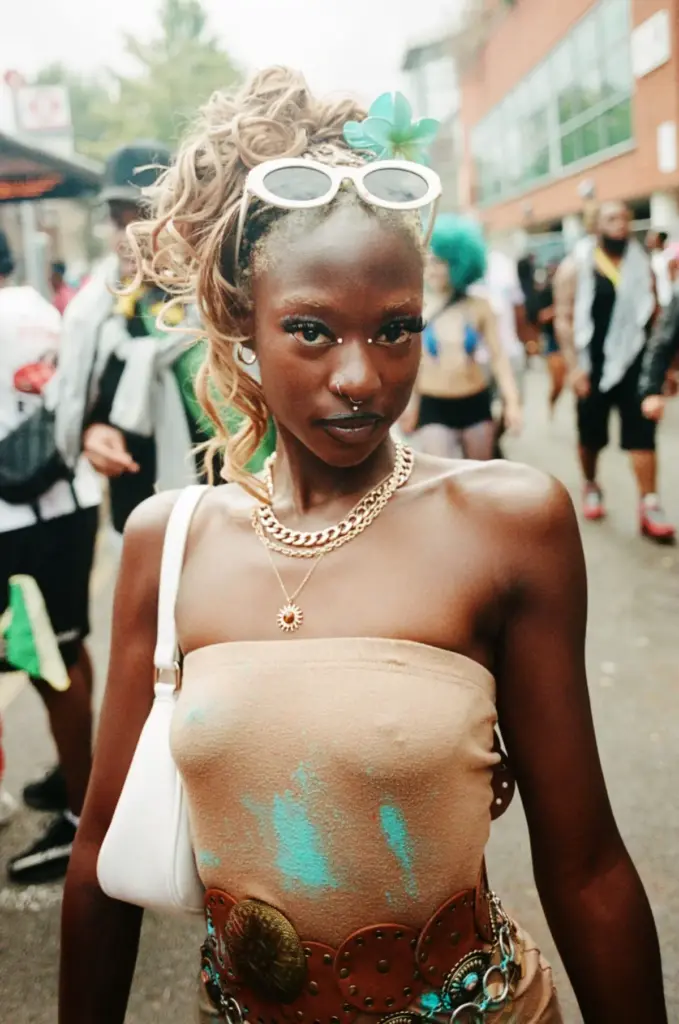
To capture the essence of this landmark diamond jubilee, acclaimed photographer Fabrice Bourgelle immersed himself in the sea of humanity, documenting the classic characters—the foundational aunties, the elaborate mas (masquerade) bands, and the elder Rastas—who infuse the festival with its enduring spirit of togetherness and style. Through a blend of historical depth, socio-political analysis, and vibrant street-style reportage, this feature explores how a Trinidadian-inspired tradition planted roots in the asphalt of west London to become a defining pillar of modern British identity.
Detailed Chronology: From St Pancras to the West London Asphalt
1959: The Seed is Planted by Claudia Jones
The genesis of the Notting Hill Carnival cannot be understood without examining the hostile racial climate of post-war Britain. In the summer of 1958, Notting Hill became the site of violent race riots, as white supremacist gangs—bolstered by the fascist White Defence League—waged a campaign of terror against newly arrived West Indian immigrants. Homes were attacked, and Black residents faced sustained, systemic violence.
In the wake of this trauma, the visionary Trinidadian-born journalist, communist, and activist Claudia Jones resolved to foster solidarity and uplift her community. Operating under the banner of the West Indian Gazette, Jones organised Britain’s first-ever indoor Caribbean carnival in January 1959 at St Pancras Town Hall. Broadcast on the BBC, the event featured steel-pan performances, a beauty pageant, and traditional Caribbean costumery. Jones famously coined the phrase, "A people’s art is the genesis of their freedom," establishing culture as a vital tool for political survival and community healing.
1966: Taking to the Streets with Rhaune Laslett
While Jones’s indoor celebrations laid the cultural groundwork, the transition to the open air came a few years later. In 1966, community activist Rhaune Laslett envisioned a multi-ethnic street festival designed to bring together the disparate communities of Notting Hill—a neighbourhood grappling with severe housing poverty, slum landlords, and racial tension.
Laslett invited the trailblazing Trinidadian steel-pan player Russell Henderson and his band to lead a modest neighbourhood procession. Henderson’s troupe marched through the streets of west London, channeling the rich pre-Lenten carnival traditions of Trinidad and Tobago. They were soon joined by early masquerade bands, whose participants donned handmade, elaborate costumes that defied the grey, austere backdrop of 1960s Britain.
The 1970s: The Sound Systems and Leslie Palmer Arrive
As the decade progressed, the carnival outgrew its humble local origins. A pivotal turning point arrived in the early 1970s under the directorship of Leslie Palmer. A visionary cultural programmer, Palmer injected institutional backing and commercial media attention into the festival, expanding its scope and scale.
Crucially, the 1970s marked the integration of massive Jamaican-style sound systems into the procession. Powered by towering speaker stacks playing roots reggae, dub, and early dancehall, these sound systems became mobile epicentres of auditory power. They added a distinctly urban, Jamaican-British edge to the Trinidadian foundation, creating a dynamic cultural synthesis. As Riann Phillip, a lifetime member of the Mangrove Steel Band and a contributor to Vogue, aptly notes: "The ingredients were West Indian to the bone, and they became distinctly London."
Supporting Context & Metrics: The Scale of Modern Carnival
To quantify the sheer magnitude of the Notting Hill Carnival is to understand its unmatched cultural and economic footprint in the United Kingdom. What started as a handful of musicians marching down a residential street has ballooned into a logistical behemoth that rivals global celebrations like the Rio Carnival and Mardi Gras in New Orleans.
Key Metrics and Operational Scale:
- Attendance: An estimated 1.8 to 2 million people descend upon Notting Hill over the two-day August bank holiday weekend, making it the largest street festival in Europe.
- Economic Impact: The carnival injects an estimated £100 million into the London economy, heavily supporting local hospitality, transport, and independent vendors.
- Logistical Footprint: The event requires the coordination of over 12,000 police officers, thousands of sanitation workers, and hundreds of St John Ambulance personnel to ensure public safety across the sprawling west London route.
- Artistic Participation: Dozens of official mas bands, over 30 static and mobile sound systems, and numerous steel-pan orchestras perform continuously throughout Sunday (Children’s Day) and Monday (Grand Finale).
The Socio-Political Battleground
Yet, metrics alone fail to capture the ongoing friction between grassroots culture and state management. For decades, the carnival has fought institutional attempts to curtail, relocate, or over-police the event. In the 1970s and 1980s, heavy-handed policing led to severe clashes, most notably the 1976 riots, which exposed deep-seated racial profiling within the Metropolitan Police.
Despite these hurdles, the carnival has persevered. It remains a contested space where marginalized communities assert their right to the city. Every note of soca, every rhythm of the iron and steel, and every flash of a sequined costume serves as a reminder that Black British history is not merely one of struggle, but of vibrant, unyielding joy and cultural triumph.
Official Statements and Artistic Perspectives
Capturing the spirit of the 60th-anniversary celebrations required an artistic eye capable of balancing historical reverence with contemporary street aesthetics. Enter photographer Fabrice Bourgelle, whose lens documented the living tapestry of this year’s milestone event.
"In its 60th year, it felt particularly important to keep those communities—and the beauty and fashion they bring to the streets—firmly in focus," Bourgelle reflects, discussing his visual documentation of the weekend. "My aim was to capture the classic characters, the aunties, the mas bands, and the elder Rastas bringing a spirit of togetherness and style. These are the custodians of the culture."
Bourgelle’s photographs, captured around towering sound systems, bobbing floats, and the steps of pastel-colored Victorian townhouses, serve as a modern archive. They chronicle a sartorial landscape that is as eclectic as it is unapologetically bold.
Reflecting on the evolution of the festival’s aesthetic, Riann Phillip emphasizes the unbreakable link between the diaspora’s roots and contemporary London style:
"When you look at the fashion on the streets today, you are seeing a generational dialogue. You see the traditional mas bands paying homage to Caribbean folklore alongside kids wearing cutting-edge London streetwear infused with island flair. It is a continuous loop of creation."
Official organizers, performers, and community leaders also utilized the 60th anniversary to reflect on the festival’s legacy of survival. Speeches and tributes throughout the weekend honored pioneers like Claudia Jones, Rhaune Laslett, and the activists of the Mangrove restaurant who fought police persecution in the infamous 1970 trial. The message was unequivocal: the carnival is an irreplaceable institution that must be protected, funded, and revered as a cornerstone of British national heritage.
Future Outlook: Preserving the Soul of Carnival in a Changing London
As the Notting Hill Carnival looks toward the decades ahead, it faces a complex set of contemporary challenges. Chief among them is the rapid gentrification of west London. The neighborhoods of North Kensington, Notting Hill, and Ladbroke Grove have experienced astronomical rises in property values and living costs over the past twenty years. This demographic shift threatens to displace the working-class Caribbean families who birthed and sustained the festival.
Furthermore, tensions persist regarding the commercialization of the carnival. Balancing the needs of grassroots sound system operators, mas designers, and steel-pan orchestras with the increasing demands of corporate sponsorship and local municipal regulation requires delicate diplomacy. Organizers must ensure that the event does not lose its subversive, community-led soul in exchange for corporate sanitization.
However, the overwhelming energy of this year’s 60th anniversary provides profound cause for optimism. The intergenerational transmission of knowledge was visibly alive on the streets: young children marching in junior mas bands alongside their grandparents; teenagers learning the intricate rhythms of the steel pan; and a new generation of designers fusing traditional Caribbean featherwork with contemporary sustainable fashion.
The sartorial display witnessed this weekend—a dazzling mash-up of national flags, string vests, crochet bikinis, fluttery boho tops, pedal pushers, miniskirts, cheetah print, sequins, ornate face gems, intricately twisted buns, two-tiered box braids, and Afro-braided mohawks, anchored reassuringly by practical dancing shoes—proved that the carnival’s creative pulse is stronger than ever.
As long as the steel pans ring out across west London and the heavy bass of the sound systems vibrates through the pavement, the Notting Hill Carnival will remain an indomitable beacon of freedom, unity, and joy. It stands not only as a monument to Britain’s Caribbean past, but as a vibrant, breathing blueprint for its multicultural future.