Executive Overview
Few television series have left as indelible an imprint on popular culture, fashion, and the discourse of modern romance as HBO’s Sex and the City. Over the course of its six-season run from 1998 to 2004, the Darren Star-created phenomenon became a cultural touchstone, transforming Sunday nights into an international event and turning its core cast—Sarah Jessica Parker, Kim Cattrall, Kristin Davis, and Cynthia Nixon—into global icons. A significant part of the show’s magnetic pull was its rotating door of high-profile celebrity cameos, featuring everyone from Matthew McConaughey and Bradley Cooper to Lucy Liu and Mikhail Baryshnikov.
Yet, among the glittering array of guest stars who walked through Carrie Bradshaw’s world, few appearances generated the same conversational gravity—or have aged quite as complexly—as alternative rock royalty Alanis Morissette’s guest spot in Season 3.
The “You Oughta Know” singer-songwriter, who had cemented her status as a generational voice just five years prior with her diamond-certified album Jagged Little Pill, was an avid, dedicated viewer of the show. Captivated by the trials and tribulations of Manhattan’s most famous sex columnist, Morissette took the unprecedented step of pitching herself directly to the writers’ room. Her goal? To catalyze a paradigm shift in Carrie Bradshaw’s romantic trajectory by suggesting a storyline that would briefly pull the protagonist out of her traditional heterosexual framework.
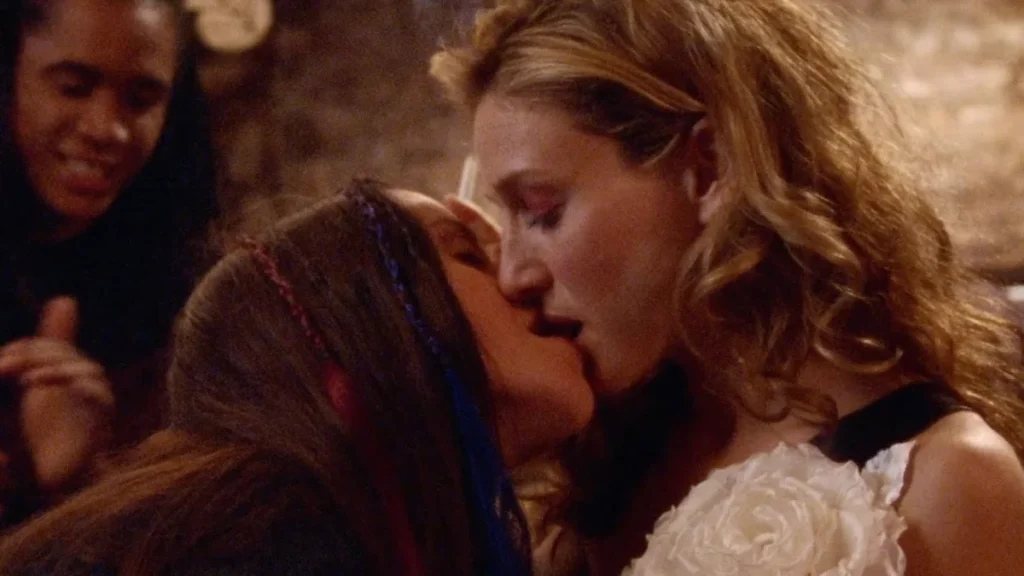
Appearing in the Season 3 episode “Boy, Girl, Boy, Girl…,” Morissette played Dawn, a bohemian partygoer who shares an unforgettable, game-of-chance kiss with Carrie. While the cameo was celebrated at the turn of the millennium as a daring foray into LGBTQ+ visibility on mainstream cable, a retrospective lens reveals a far more layered narrative. The episode sits at a fascinating historical crossroads: it highlights the revolutionary nature of queer representation on television during an era when the landscape was strictly heteronormative, while simultaneously exposing the casual biphobia and regressive tropes that defined late-1990s and early-2000s media.
This deep dive explores the genesis of Morissette’s iconic cameo, the cultural climate that birthed it, the behind-the-scenes machinations revealed by the artist herself decades later, and the enduring legacy of a moment that continues to spark debate among television historians and devoted fans alike.
Detailed Chronology: From Superfan to Script Revision
To fully understand how a 90s alt-rock icon wound up in a Manhattan loft playing spin-the-bottle with Carrie Bradshaw, one must examine the timeline of both Morissette’s career and Sex and the City’s creative peak.
By the year 2000, Sex and the City was hitting its creative stride. Season 3 marked a period where the writers began pushing boundaries, moving past standard romantic comedies to dissect the murkier, more uncomfortable nuances of modern dating. Concurrently, Alanis Morissette was transitioning from her explosive, angry-young-woman persona into a reflective, spiritually curious artist, having released her acclaimed fourth studio album, Supposed Former Infatuation Junkie, and contributing heavily to soundtracks.
Like millions of viewers around the globe, Morissette found solace and entertainment in the escapades of Carrie, Samantha, Charlotte, and Miranda. However, unlike the average viewer, Morissette possessed the cultural capital—and the sheer audacity—to bypass traditional casting agents and take her ideas directly to the source.
During a revealing appearance on Alex Cooper’s wildly popular podcast Call Her Daddy, Morissette pulled back the curtain on how the cameo came to fruition.
“I reached out to them, and I said, ‘Might it be a nice time for Carrie to experience a lesbian moment?’” Morissette recalled with a characteristic laugh, detailing her direct communication with the production team. To her surprise and delight, the writers did not dismiss the overture. Instead, they embraced the pitch with open arms, responding, “Why yes, we were thinking the same thing!”
This exchange led directly to the conceptualization of Season 3, Episode 4, titled “Boy, Girl, Boy, Girl….” In the episode, Carrie begins dating Sean (played by actor Eddie Cahill), a handsome, worldly man who upends her neatly categorized worldview by revealing that he is bisexual. For a show that prided itself on being on the cutting edge of sexual liberation, Carrie’s immediate reaction was startlingly regressive. She struggles immensely to comprehend bisexuality, openly questioning its validity in dating culture and famously dismissing it as a mere “layover to Gaytown.”
It was within this thematic exploration of sexual fluidity that Morissette’s character, Dawn, was deployed. Later in the episode, during an eccentric house party populated by Manhattan’s downtown arts scene, the guests engage in a high-stakes game of spin the bottle. When the bottle lands on Carrie, Dawn steps up. After brief hesitation, Carrie reassures herself and her partner that it’s “ok.” The resulting kiss is brief, awkward, and historically significant. Upon pulling away, Carrie delivers a line that has since achieved meme status among fans: she remarks that the kiss was “not bad” and memorably “tastes like chicken.”
While the production process was swift and collaborative, the ripple effects of the episode would echo for decades, transforming a brief thirty-second interaction into a masterclass in early-2000s television sociology.
Supporting Context & Metrics: The LGBTQ+ Landscape of Turn-of-the-Millennium Television
To evaluate the true weight of Morissette’s cameo, one must contextualize the media landscape of the year 2000. Today, prestige television is inundated with complex, nuanced, and intersectional LGBTQ+ characters. Shows like Pose, Euphoria, Heartstopper, and Schitt’s Creek have normalized diverse sexualities and gender expressions. However, at the turn of the millennium, the television ecosystem looked vastly different.
In 2000, the television landscape was cautiously dipping its toes into queer representation. Groundbreaking milestones like the groundbreaking sitcom Will & Grace (which premiered on NBC in 1998) and Ellen DeGeneres’s historic coming-out on both her sitcom and the cover of Time magazine in 1997 had cracked open a door. Yet, cable television—particularly HBO—was the true frontier for pushing sexual boundaries. Shows like Sex and the City and Oz were given the creative license to explore taboo subjects that broadcast networks wouldn’t dare touch.
Despite this creative freedom, bisexual representation was virtually nonexistent, and when it did appear, it was almost exclusively framed through a lens of confusion, deceit, or experimentation. Bisexuality was rarely treated as a legitimate, stable sexual orientation; instead, it was weaponized as a plot device to create dramatic tension before steering characters back into comfortable heteronormative binaries.
This is precisely where the critical duality of Sex and the City’s Season 3 storyline lies. On one hand, featuring an alternative culture icon like Alanis Morissette participating in same-sex exploration was a massive cultural statement. It signaled to millions of viewers that sexual fluidity was not something restricted to the fringes of society, but rather something experienced by cool, modern, metropolitan women.
On the other hand, the narrative framing surrounding Carrie’s interactions with both Sean and Dawn left much to be desired. Carrie’s biphobic commentary—“I’m not sure bisexuality exists. I think it’s just a layover to Gaytown”—was played for comedic effect rather than critically dismantled by the narrative. Furthermore, the framing of Dawn and Carrie’s kiss as a quirky party game underscored a trope wherein same-sex intimacy involving women was frequently catered to the male gaze or treated as a temporary, experimental rite of passage rather than a valid expression of desire.
Nevertheless, the cultural metrics of the time indicate that the episode was a massive ratings hit and a watershed moment for watercooler conversations. It forced millions of living rooms across America to confront conversations about sexual fluidity that they had previously been able to ignore.
Official Statements: Alanis Morissette Reflects on Queer Visibility
Decades after the cameras stopped rolling on her guest spot, Alanis Morissette remains fiercely proud of her contribution to Sex and the City, viewing her cameo through a philosophical and deeply empathetic lens.
During her comprehensive interview on Call Her Daddy with host Alex Cooper, the conversation naturally drifted toward the historical significance of the episode. Cooper emphasized the scarcity of authentic LGBTQ+ representation on television during the late 1990s and early 2000s, prompting Morissette to reflect on what it felt like to be on the frontline of that cultural shift.
“It’s amazing, yeah,” Morissette responded thoughtfully, pondering the evolution of societal norms surrounding gender and sexuality. She went on to articulate a broader, humanist philosophy regarding identity and expression, stating:
“Anything that opens up and pulls us out of the locked binary is a loving act, I think.”
This statement encapsulates the core ethos of Morissette’s career. From her scathing, emotionally raw anthems that dismantled the Madonna-whore complex in the mid-1990s to her later explorations of motherhood, mental health, and spiritual healing, Morissette has consistently positioned herself as an artist interested in dismantling rigid social constructs. Her willingness to insert herself into the Sex and the City universe was not merely a publicity stunt or a superficial pop-culture crossover; it was an intentional act of subversion designed to challenge the heterosexual hegemony of mainstream media.
While HBO executives and showrunner Darren Star may have approached the storyline with varying degrees of satirical cynicism, Morissette brought genuine emotional intelligence and counter-cultural credibility to the set. Her perspective, viewed through the modern prism of non-binary and pansexual awareness, proves that her instinct to challenge the binary was remarkably ahead of its time.
Future Outlook: The Legacy of Sex and the City’s Queerness and What Lies Ahead
As the Sex and the City universe continues to expand—most notably through Max’s continuation series, And Just Like That…—the franchise has been forced to reckon with its past missteps regarding representation, diversity, and inclusion.
When And Just Like That… premiered, it was met with intense scrutiny from fans and critics alike who noted that the original series had been glaringly white, cis-normative, and occasionally tone-deaf regarding the nuances of the LGBTQ+ community. In response, the revival made a concerted effort to course-correct, introducing characters of color and diving headfirst into non-binary representation through the character of Che Diaz (played by Sara Ramirez).
Ironically, the mixed reception to Che Diaz’s storylines on And Just Like That… proves that the franchise has always struggled with how to gracefully write about queer experiences without falling into caricature or heavy-handed didacticism. This historical throughline brings us right back to Alanis Morissette’s guest spot in Season 3.
Looking toward the future of television, the legacy of moments like Morissette’s cameo serves as both a cautionary tale and a celebration of progress. It reminds modern creators of the importance of authentic representation—ensuring that storylines involving bisexuality, pansexuality, and non-binary identities are written with input from the communities they seek to portray, rather than treated as exotic plot points designed to shock conservative audiences.
At the same time, the enduring fascination with “Boy, Girl, Boy, Girl…” demonstrates the profound power of pop-culture nostalgia. Fans do not remember this episode merely for its flaws; they remember it because it sparked conversations that needed to be had. It brought marginalized discussions out of the academic ether and placed them squarely on the television screens of millions of mainstream viewers, soundtracked by the cultural weight of an icon who refused to stay inside the lines.
Alanis Morissette may have only spent a single episode in the glittering, shoe-obsessed world of Carrie Bradshaw, but her presence fundamentally altered the ecosystem of the show. By simply asking a daring question—“Might it be a nice time for Carrie to experience a lesbian moment?”—she helped crack open a door that, however clumsily at first, could never be closed again. As television continues to evolve past the locked binaries of the past, the echoes of that single spin-the-bottle kiss remain a fascinating, complicated, and undeniably vital chapter in television history.