Executive Overview
In the hyper-competitive, digitally saturated landscape of twenty-first-century beauty, longevity is not a guarantee of relevance. For legacy cosmetics brands, survival requires a delicate and often precarious balancing act: honoring the historical equity that built their empires while aggressively dismantling outdated operational and creative paradigms to capture a digitally native, endlessly distracted consumer base.
No brand exemplifies this high-stakes balancing act quite like Revlon. Founded in 1939 by brothers Charles and Joseph Revson alongside chemist Charles Lachman—marking their entry into the market with a revolutionary, opaque nail enamel born out of the Great Depression—the company became an undisputed titan of the twentieth-century beauty industry. Over the decades, Revlon introduced iconic, category-defining products, most notably its daring, high-impact "Fire & Ice" lipstick of the 1950s. Yet, as the beauty paradigm shifted away from legacy drugstore shelves toward disruptive, social-first indie brands and digital-native vertical brands (DNVBs), Revlon found itself losing its cultural footing.
The strain of shifting consumer habits, compounded by macroeconomic pressures and supply chain disruptions, ultimately culminated in Revlon Inc. filing for voluntary Chapter 11 bankruptcy in 2022. Emerging in 2023 as a privately held entity under new ownership, and subsequently appointing Michelle Peluso as CEO in 2024, the 87-year-old brand was forced to confront an existential question: How does an institution reintroduce itself to a world that has fundamentally changed, without alienating the loyal consumers who built its foundation?
The answer, as detailed by leadership at the 2026 Advertising Week conference, lies in a strategic masterclass of reinvention. Spearheaded by North America President Dana Medema and executed in partnership with creative agency DonerColle Partners, Revlon launched its bold "Revlon Be Unforgettable" campaign. By tapping genre-defying multi-hyphenate Teyana Taylor and country music breakout star Megan Moroney as brand ambassadors, and ruthlessly modernizing its messaging for the era of the six-second ad, Revlon is proving that heritage is not an anchor, but a launchpad. This comprehensive report explores the anatomy of Revlon’s ongoing renaissance, examining its strategic pivot from generational marketing to routines-based positioning, its digital adaptation, and the broader macroeconomic currents reshaping the legacy beauty landscape.
Detailed Chronology: From the Fire & Ice Era to the Chapter 11 Pivot and Beyond
1939–1990s: The Golden Age of Color and Cultural Omnipresence
To understand Revlon’s modern turnaround, one must trace the architectural milestones of its nearly nine-decade history. Unlike many of its contemporaries that began in skincare or fragrance, Revlon staked its claim on color. The brand disrupted the cosmetics market by utilizing pigments rather than dyes for its nail enamels, creating rich, opaque finishes that had never been seen before.
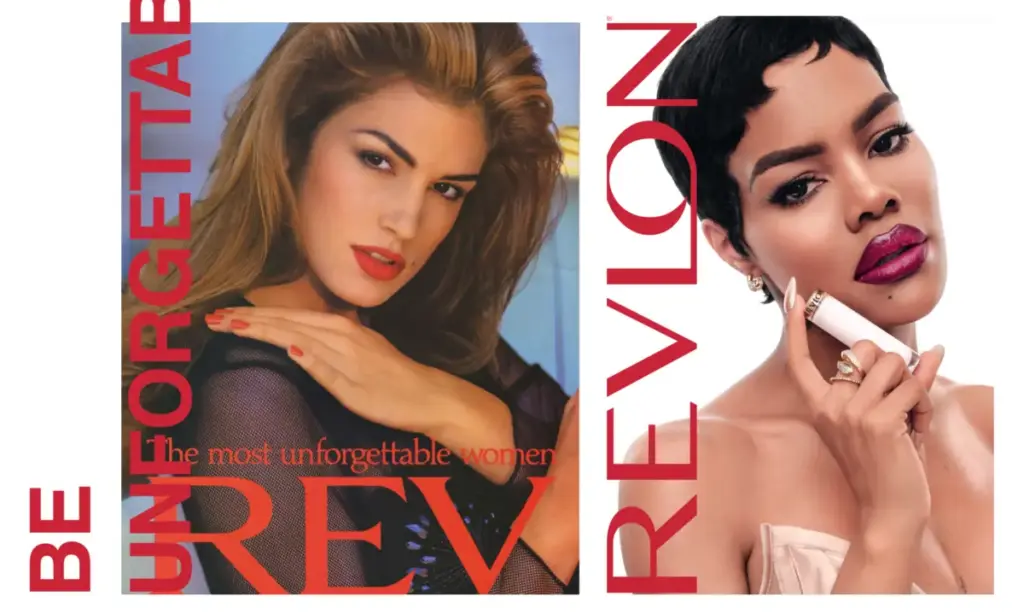
By the mid-twentieth century, Revlon was a dominant cultural force. The 1952 "Fire & Ice" campaign—featuring Dorian Leigh in a staggering sequined gown against a backdrop of fierce flames—married high-fashion editorial aesthetics with mass-market accessibility. Throughout the 1980s and 1990s, Revlon institutionalized the concept of the "Revlon Woman," securing cultural heavyweights and supermodels such as Cindy Crawford and Oprah Winfrey. These campaigns were defined by high-production-value television spots, sweeping orchestral scores, and, crucially, authoritative male voiceovers telling audiences who the most unforgettable women in the world were.
2000s–2022: The Digital Disruption and the Road to Bankruptcy
As the twenty-first century progressed, the beauty industry underwent seismic structural shifts. The democratization of media via YouTube, Instagram, and eventually TikTok eroded the traditional gatekeeping power of legacy television and print advertising. Consumers no longer looked exclusively to glossy magazine spreads or traditional supermodels for beauty inspiration; instead, they turned to peer-to-peer recommendations, beauty vloggers, and agile indie brands that could ideate, manufacture, and market products in a matter of weeks.
Revlon, constrained by legacy infrastructure and traditional retail distribution models primarily anchored in drugstores and mass-merchandise channels, struggled to keep pace. While the company maintained massive global footprint recognition, it suffered from a period of brand silence—a disconnect where the marketing failed to keep pace with the rapidly evolving cultural conversation.
The compounding pressures of mounting corporate debt, intense competition in the mass-market color cosmetics category, and severe global supply chain disruptions during the post-pandemic era proved insurmountable for the publicly traded entity. In June 2022, Revlon Inc. filed for Chapter 11 bankruptcy protection.
2023–Present: Private Restructuring, New Leadership, and the 2026 Renaissance
The bankruptcy restructuring, finalized in 2023, transformed Revlon into a privately held company under new ownership, freeing the brand from the intense quarterly reporting pressures of Wall Street and allowing for long-term strategic rebuilding. The appointment of Michelle Peluso as CEO in 2024 signaled a aggressive, digitally fluent chapter for the brand.
By April 2025, the internal cultural shift began manifesting outwardly. Revlon announced its landmark "Revlon Be Unforgettable" campaign, consciously reaching back into its archival DNA to pull forward elements that still resonated, while meticulously pruning away the patriarchal and structural deadwood of twentieth-century advertising.
Supporting Context & Metrics: Navigating the Saturated Legacy Landscape
Revlon’s strategic maneuver does not happen in a vacuum. Across the broader beauty sector, legacy brands are desperately fighting to recapture cultural relevance in a market saturated with celebrity-backed lines, influencer-founded empires, and rapid-fire trend cycles.
The Competitive Response Across the Legacy Sector
Other heritage brands have similarly leaned into high-profile contemporary talent to bridge the generational divide:
- Maybelline: In 2025, Maybelline tapped global pop icon Miley Cyrus as a brand ambassador to spearhead a massive modernization of its iconic "Maybe She’s Born With It / Maybe It’s Maybelline" equity.
- Bath & Body Works: Seeking to inject fresh energy into its core offerings, Bath & Body Works partnered with actress and entrepreneur Hilary Duff in July to launch a fruit-forward body-care line designed to capture millennial nostalgia balanced with Gen Z appeal.
- CoverGirl: Coty-owned CoverGirl has similarly pivoted its marketing architectures toward Gen X and millennial demographics to counter shifting revenue streams in core retail channels.
Rethinking the Target Consumer: Beyond Generational Silos
While much of modern marketing obsession is fixated on capturing Gen Z at all costs—often at the expense of alienating older, high-spending cohorts—Revlon’s leadership has consciously rejected generational pigeonholing.
According to Dana Medema, the brand’s North America president, trying to build a marketing funnel around a specific age demographic is a flawed exercise in the modern beauty ecosystem. Instead, Revlon has defined its core consumer through the lens of beauty routines and lifestyle mechanics.
"We’ve been experts in color. We have 72 shades of Super Lustrous [lipstick], so we are experts in color. But we’re probably not for the woman who is really trying to be involved in the category to the very, very extreme," Medema explained during her Advertising Week address.
Instead, Revlon has coined a distinct descriptor for its target audience: "efficient glam." This demographic encompasses consumers who value high performance, reliable quality, and streamlined application without requiring a multi-step, hour-long glam routine. Crucially, "efficient glam" transcends age brackets. It is a psychographic, not a demographic, resonating equally with a 22-year-old entering the workforce and a 60-year-old looking for effortless, polished daily elegance.
Official Statements & Creative Insights: Deconstructing the "Be Unforgettable" Campaign
The transition from a dormant heritage giant to an active cultural participant required a radical reimagining of both creative execution and copywriting. Jessica Henrichs, CEO at DonerColle Partners—the creative agency behind the "Revlon Be Unforgettable" campaign—offered deep insights into the strategic overhaul during Advertising Week.
Eradicating the Male Gaze
One of the most glaring anachronisms of Revlon’s twentieth-century advertising was its narrative voice. In many of the brand’s most famous historical commercials, a booming male voiceover would dictate the attributes of the "Revlon Woman."
"We wanted to bring women of substance to the table, women who were more than just beautiful," Henrichs noted. Reflecting on the past, she added bluntly, "[Some of the original ads] had a male voiceover, and I think we can all see now that was probably not the best call."
In the 2025–2026 campaign iterations, the dynamic shifts entirely. Ambassadors Teyana Taylor and Megan Moroney narrate their own ad spots, reclaiming narrative authority and projecting personal autonomy. By casting women who are celebrated for their multi-dimensional talents—Taylor as a visionary dancer, choreographer, director, and musician; Moroney as a powerhouse singer-songwriter—Revlon aligns its product line with modern feminist values of self-definition.
The Death of the Long-Form Tagline in the Age of the Six-Second Ad
Perhaps the most pragmatic hurdle in modernizing a legacy campaign is the contraction of human attention spans. The original twentieth-century tagline—"The most unforgettable women in the world wear Revlon"—was a masterclass in epic, sweeping brand positioning suited for 30-second television spots and glossy double-page magazine spreads.
In the digital ecosystem defined by TikTok, Instagram Reels, and unskippable pre-roll ads, that sentence is entirely unviable.
"We thought about the tagline, ‘The most unforgettable women in the world wear Revlon,’" said Henrichs. "We live in the era of the six-second ad, and so even that sentence wasn’t going to make the cut for today."
The solution was a ruthless exercise in editorial minimalism. The sprawling sentence was trimmed down to its punchy, imperative core: "Revlon: Be unforgettable." This agile restructuring allows the tagline to function seamlessly across digital display banners, micro-video formats, social media bios, and physical retail packaging.
Embracing History Without Standing Still
Despite these radical modernizations, Revlon’s leadership remains firmly opposed to burning down the brand’s history in the pursuit of transient trends.
"Heritage means you have history. There’s nothing wrong with being a heritage brand," Medema asserted. "There’s something wrong with standing still, but you have really rich history and just going back into those archives, not being afraid to kind of pull out things from the past and say, ‘Hey man, that’s still relevant today.’"
This philosophy is visible in how the brand treats its foundational products. Rather than constantly reformulating or chasing ephemeral, hyper-niche TikTok aesthetic trends, Revlon is leaning into the enduring equity of products like its Super Lustrous lipstick line—anchored by its staggering 72-shade range—proving that timeless utility beats transient hype.
Future Outlook: Can Legacy Drugstore Beauty Win the Long Game?
As Revlon looks toward the remainder of the decade, the brand’s ongoing turnaround serves as a crucial case study for the entire fast-moving consumer goods (FMCG) and beauty sectors. The path forward, however, is not without its hurdles.
The Challenges Ahead
- Channel Evolution: While drugstore and mass-merchandise retail remain powerful revenue drivers, consumer discovery has permanently migrated online. Revlon must continue to bridge the gap between digital discovery (via social media campaigns with Taylor and Moroney) and point-of-purchase conversion, whether on e-commerce platforms or physical shelves.
- Maintaining Momentum: A splashy campaign reintroduction is an effective catalyst, but sustained relevance requires continuous product innovation, agile supply chain management, and authentic community building that extends beyond paid celebrity endorsements.
- Competing with Indie Agility: Digital-first indie brands can conceptualize and drop a viral product in weeks. Revlon, with its massive global distribution network, must find ways to combine the institutional stability of an 87-year-old multinational with the cultural speed of a digital startup.
The Verdict
Revlon’s renaissance proves that heritage is not a death sentence in the modern beauty economy; rather, it is an untapped asset, provided brand stewards possess the courage to surgically strip away outdated tropes while doubling down on core utility.
By replacing male voiceovers with self-narrated storytelling, condensing sprawling taglines into six-second digital aphorisms, and shifting its target demographic from rigid age groups to the universal psychographic of "efficient glam," Revlon has successfully navigated the treacherous waters of bankruptcy restructuring to emerge leaner, sharper, and deeply attuned to the modern consumer.
As the beauty industry continues its relentless evolution, Revlon’s playbook offers a clear lesson for fellow legacy giants: respect your archives, honor your history, but never be afraid to rewrite the rules of engagement.