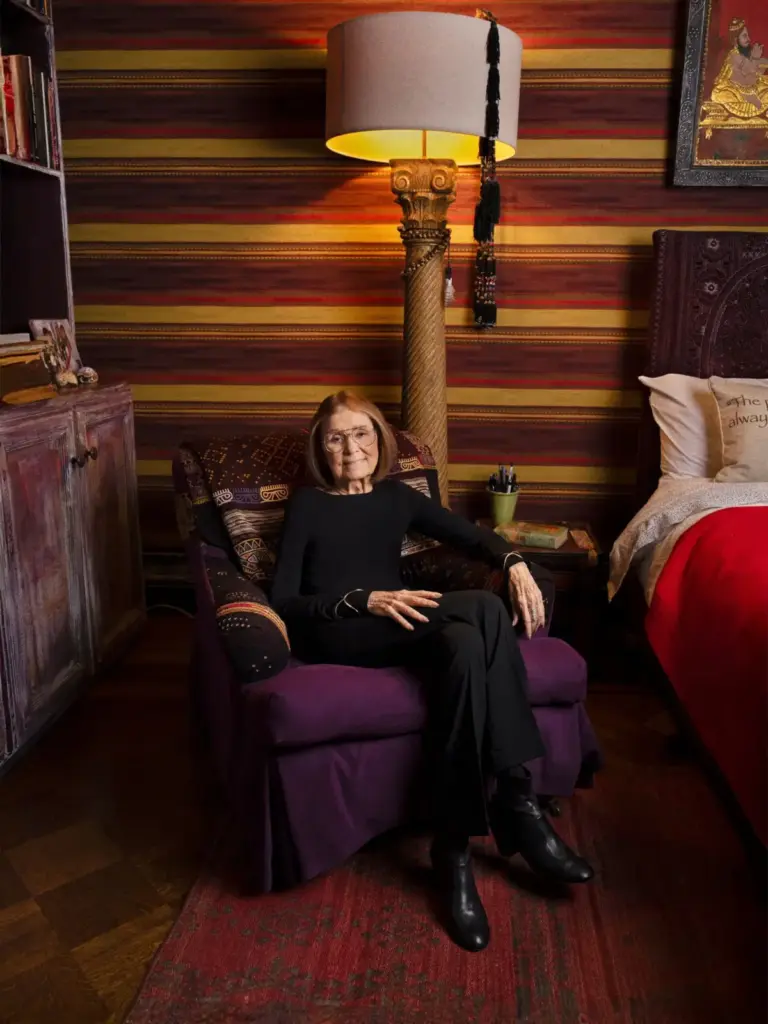
The passing of Gloria Steinem on September 2, 2026, at the age of 92, marked the end of an era for the global feminist movement. For more than six decades, Steinem served as a journalist, pioneering activist, and intellectual architect of modern women’s equality. Her death closes a monumental chapter in American social history, but her voice remains vividly alive through her final literary contribution, An Unexpected Life: A Memoir, published on September 22, 2026.
Six months prior to her passing, in a poignant retrospective collaboration, Steinem welcomed Glamour magazine into her iconic Upper East Side duplex in Manhattan. Entering her 92nd year while on set, surrounded by the vibrant hues of Frida Kahlo-inspired walls and a secluded brick patio, Steinem reflected on a life spent dismantling patriarchal structures, redefining media, and championing human autonomy. This feature captures not only her final extensive interview but also the enduring philosophy of a woman who fundamentally altered the social and political landscape of the twentieth and twenty-first centuries.
Detailed Chronology: From the 1960s Boom to a Lifetime of Defiance
To understand Gloria Steinem’s impact is to trace the trajectory of modern American journalism and activism. Her career began in an era when professional opportunities for women were rigidly circumscribed, yet Steinem carved out an unconventional path that bridged high culture, investigative reporting, and grassroots mobilization.
Early Career and the Birth of Glamour
Long before she became the co-founder of Ms. magazine and a household name, a young Steinem worked as a contributing editor for Glamour during the 1960s. Navigating the intersection of fashion, dating, and cultural conversation, she deployed a signature wit that quietly subverted expectations. With provocative headlines such as “Funny Ways to Meet Men on the Beach” (June 1963), “The Death of Cool and the Birth of Beyond-Cool” (October 1964), and “It’s a Young Man’s Game” (August 1965), she proved that cultural critique could be both deeply engaging and structurally subversive.
As a freelancer, she maintained a degree of professional independence that shielded her from the stifling confines of traditional, male-dominated newsrooms. She famously recalled walking out of a full-time position at the Ladies’ Home Journal—which dared to require her physical presence in an office—opting instead to walk down a sunlit street for an ice-cream cone and savoring the liberating feeling of self-determination. Later, at New York Magazine, she secured the freedom to work from home, covering vital social movements such as the California farmworkers’ struggle.
The Evolution of the Women’s Liberation Movement
Steinem’s footprint on the broader civil rights and feminist movements is immeasurable. Alongside formidable allies like civil rights lawyer Flo Kennedy and activist Dorothy Pittman Hughes, Steinem traversed the country, speaking against public-speaking terror and patriarchal norms. They demonstrated that meaningful activism stems from recognizing and valuing differences in race, class, and age rather than seeking comfort in ideological sameness.
Her recognition by Glamour as a Lifetime Achievement Woman of the Year in 2011 cemented her status as an enduring matriarch of the movement. Yet, true to her form, Steinem never viewed herself as an infallible oracle; she viewed herself simply as a participant in a collective, ongoing human evolution.
Supporting Context & Metrics: Inside the Upper East Side Sanctuary
The portrait of Gloria Steinem painted by Glamour‘s creative development team offers an intimate look at a life lived on her own terms. Visiting her Manhattan duplex felt like stepping into a romanticized version of old New York, complete with a spiral staircase, a cozy guest room fireplace, and a peaceful back patio.
Even domestic details bore the unmistakable stamp of her wry humor. In the guest room, alongside museum-worthy humanitarian awards and international travel souvenirs, sat a small exercise bike. True to her spirit, the bike was outfitted with a custom needlepoint lumbar pillow bearing the phrase:
"Being on the Best Sellers List Is the Best Revenge."
Taped to a nearby mirror was a paper calendar labeled “Gloria’s Cycling Marathon Tracker!”, logging 14 miles completed toward her cardio goals. These elements underscored a vital truth about the American icon: behind the towering intellectual and political legacy was a pragmatic human being committed to vitality, longevity, and self-care.
Official Statements and Reflections on Wisdom
During her final interview, Steinem offered profound reflections organized around key pillars of her life: career, love, style, aging, travel, and activism. Her insights challenge conventional societal scripts and urge individuals to embrace autonomy above all else.
On Career and Freedom
Steinem emphasized that freedom must be actively claimed:
"If they won’t give you the freedom, find it somewhere else… I kind of wish I’d known there were more outlets than I understood where freelancers can submit and hopefully publish essays on what interests them."
On Love and Feminism
Addressing misconceptions about romance, Steinem demystified the false dichotomy between feminism and partnership:
"It makes no sense to say that falling in love with a man is anti-feminist because being a feminist is about becoming an equal human being. If the American family is viewed as a hierarchy with the male patriarch at the top, then feminism is democratizing that structure… It’s all about choice and the power to make the choice."
On Aging and Autonomy
Rejecting the societal pressure to conform to youth-obsessed beauty standards, Steinem reframed the aging process as an unmitigated privilege:
"Aging is a gift. Aging gracefully makes it sound as if aging is an external event and you’re supposed to age in a certain way. I think you’re supposed to age however the hell you want to. To lie about one’s age, especially for women, is to conform to the idea that women are only okay when we are seen as sexual or reproductive."
On Travel and Independence
Reflecting on her post-college travels to a newly independent India—where she lived in a University of Delhi women’s dormitory—Steinem highlighted the transformative power of unfamiliarity:
"There’s something about traveling that requires you to be on your own and figure things out. I still fly coach. I mean, I understand that first class is more comfortable, but you’re going to get to the same place at the same time. So what’s the point?"
On the Ultimate Lesson
True to her lifelong ethos of self-determination, Steinem concluded her final interview with a characteristically subversive piece of advice:
"My advice for women now is don’t take my advice. Do what you love; do what you’re curious about. I’m living my life as best I can, but I don’t know your life, so I don’t want you to take my advice unless it feels like it fits your life."
Future Outlook: The Post-Steinem Era of Equality
As the world processes the loss of Gloria Steinem at age 92, the focus inevitably shifts to the future of the movements she helped build. The publication of An Unexpected Life: A Memoir on September 22, 2026, serves as a final guidebook and literary anchor for generations of activists, writers, and free-thinkers.
Steinem’s legacy is not preserved merely in archives, legislation, or history books; it lives on in the institutional frameworks she challenged and the individual consciousnesses she awakened. She proved that systemic change is not achieved by adhering to rigid blueprints, but by cultivating relentless curiosity, embracing diversity, and insisting on the absolute right to personal choice.
In a shifting political and social landscape, her parting challenge remains a guiding light: to question hierarchies, honor our differences, and live life entirely on our own terms. Gloria Steinem is gone, but the path she forged remains wide open for those willing to walk it.