Executive Overview
To say that navigating the modern fashion landscape as an independent, emerging designer is an uphill battle would be a profound understatement. The contemporary market is saturated to a deafening degree. Every single day brings a fresh ideological and financial skirmish—a grueling fight for attention, venture capital, venture-backed production lines, and, most importantly, the creative freedom to design without corporate constraint. If cultural observers received a dollar for every derivative clothing label that had no genuine reason to exist, the industry would be overflowing with capital.
Today, cutting through the omnipresent white noise of social-media-first labels, hyper-curated aesthetic micro-trends, and venture-backed celebrity start-ups is harder than ever. Yet, a resilient counter-movement is quietly taking root. The vanguard of young designers capturing the collective imagination of the industry’s elite are not merely garment makers; they are true artisans. They transcend the traditional confines of pure fashion design, seamlessly bridging fine art, structural architecture, and sculptural product design.
This new generation shares a distinct ethos: they refuse to rely on hollow runway stunts, manufactured social-media controversies, or algorithmic-first marketing ploys to buy eyeballs. Instead, they let uncompromising craftsmanship do the talking. Their fanbases read like a masterclass in modern cultural influence, having dressed nearly every avant-garde musician shaping today’s soundscapes, alongside the visionary tastemakers steering global purchasing habits. Whether they are operating entirely outside traditional retail distribution or making their debut on international fashion week calendars, their unwavering commitment to a singular, unfiltered vision keeps the industry coming back for more.
Detailed Chronology: The Rising Names Defining the Modern Movement
ATXV: The Party-Girl Whisperer
If the storied, conservative old guard of Milanese tailoring knows how to execute a pristine linen suit and a classic daytime dress, the new kids on the block are dragging us straight into the neon-lit abyss of the underground club scene. Founded by Antonio Tarantini, ATXV stands proudly at the vanguard of this movement. Since its inception in 2021, the label has quietly amassed a fiercely loyal following spanning the luxury fashion and global music industries.
ATXV specializes in slinky, tiered cotton separates and unapologetically sexy party dresses. These garments have become a staple for style icons like Charli xcx, Rosé, and Adéla. The Spring/Summer collections crystalize what makes the label so devastatingly covetable: layered slip dresses featuring razor-sharp cutouts and ethereal sheer paneling that inject structural intrigue while retaining strategic coverage, paired effortlessly with micro-tank tops and deconstructed silk uniform shirts. For the consumer looking to appear as undressed as humanly possible while artfully preserving their modesty, ATXV has established itself as the definitive modern obsession.
Andrew Curwen: The New Romantic
For every delicate daytime-dress brand emerging from New York’s sun-bleached studios, the natural order of the city requires a dark, brooding romantic to balance the scales and deliver on the gritty, nocturnal ethos for which Manhattan is historically famous. Enter Andrew Curwen.
Making his official debut on the New York Fashion Week schedule, Curwen unveiled a tightly curated, spellbinding collection of fantastical all-black corsetry, luscious spun-wisp knits, and decadent, dramatic gowns. His work successfully walks a razor-thin tightrope between light and dark, the undone and the hyper-refined, fantasy and harsh reality. Curwen counts 2hollis, Lady Gaga, and Slayyyter among his exclusive clientele—most notably crafting the iconic black rabbit custom look for Slayyyter’s "Brand New Chanel$" music video. The raw, unfiltered romance of his designs is firmly anchored by world-class tailoring and an elite technical capability to cater to the exacting, theatrical needs of pop royalty.
Gabe Gordon: The Downtown Freak
Operating his eponymous label since 2021, Gabe Gordon has long commanded the adoration of downtown cool-kids like Troye Sivan, PinkPantheress, and Dua Lipa. However, recent collections—conceived alongside his husband and established costume designer Timothy Gibbons—have elevated the brand’s conceptual scope and technical craftsmanship to dizzying new heights.
The label’s trajectory is perhaps best encapsulated by a vibrant visual language that feels akin to a fictional universe where Tonya Harding subleased an industrial loft in Bushwick. Think skater skirts, heavily corseted plaid tops, and cutesy, subversive knitwear—Gordon’s undisputed specialty—paired with prop ice skates and tousled, aggressively ’80s hair. Beneath the campy exterior lies an unyielding commitment to sustainability and intentional fabric utilization, ensuring zero material waste. Above all, it is the unapologetic whimsy, camp, and mordant humor shared by Gordon and Gibbons that sets them entirely apart in an increasingly corporatized American fashion landscape. Case in point: Gordon’s object collection, launched in partnership with Australian sexual wellness brand LBDO, featured a bespoke vibrating ring housed inside an intricate metal, egg-like sculpture.
TheVxlley: The In-Betweener
Who could have predicted that living grass would emerge as a premier luxury fashion textile of the 2020s? While numerous avant-garde creators have experimented with natural organic elements, none have executed it with the mesmerizing, theatrical precision of Daniel Del Valle’s TheVxlley. The brand sent shockwaves through the international fashion circuit with its porcelain teacup corsets and genuinely living, breathing silhouettes that effortlessly blur the boundaries between botanical sculpture and high-end costume design.
In an industry drowning in predictable floral prints, the literal integration of living flora breathes revolutionary life into classic dresses and skirts. Del Valle is self-taught, entirely fresh to the scene, and completely unafraid to shock. The formula is yielding extraordinary dividends: his radical silhouettes have already secured high-profile placements on cultural titans like Lady Gaga.
Patrick Taylor: The Sporty Knitter
It is a rare occurrence to encounter a fully functional, high-fashion lifejacket rendered entirely in fine merino wool. Yet, within the inventive universe of Patrick Taylor, the impossible becomes standard operating procedure. The British designer, who recently relocated his creative base to New York, channels his childhood—steeped in competitive sailing and alpine skiing—directly into a masterclass in knitwear innovation.
After cutting his teeth and making massive waves under Thom Browne, Taylor launched his independent venture, yielding oversized quarter-zip sweaters, intricately laced knit tops and shorts, and relaxed wide-leg denim. Earning a coveted spot on the New York Fashion Week schedule, Taylor introduced his inaugural womenswear offerings, signaling a thrilling evolution in his sartorial vocabulary.
Simon Carle: The Avant-Garde Minimalist
When global sensation Rosalía stepped onto the stage at the BRIT Awards alongside Björk, sharp-eyed fashion critics instantly zeroed in on the arresting garments worn by her backup performance troupe. The mastermind behind the looks? Simon Carle.
Carle works almost exclusively with vintage and deadstock textiles, masterfully deconstructing and reconstructing bras, basic tank tops, and hosiery into Martin Margiela-esque artifacts equipped with entirely new cycles of life. The crown jewel of his artisanal practice, however, is his revolutionary on-skin tattoo-clothing conceptualization. This was most famously demonstrated on Tyla, who wore a snakeskin-printed top meticulously molded directly to the contours of her body during Paris Fashion Week. Carle merges performance art, textile design, and advanced body modification in a remarkably refreshing manner, entirely avoiding derivative tropes and cliches.
Ilya Migmoon: The Modern Couturier
While the digital ecosystem of Instagram is frequently lamented as a corrosive force within contemporary culture, it concurrently serves as the ultimate discovery engine for obscured, generational talent. Enter Ilya Migmoon, whose meticulously curated grid functions simultaneously as a digital CV and a digital salon where stylists and celebrities fawn over his dramatic, heavily Victorian-coded constructions.
Envision ultra-tight corsetry paired with exaggerated side bustles, midi dresses completely blanketed in real feathers featuring structural wings protruding from the small of the back, and a ten-foot cathedral-length train constructed entirely out of human wigs. With tastemakers like Rosalía and Joey King already wearing his pieces, the global fashion ecosystem is urgently clamoring for a physical runway manifestation of his divine dark fantasies.
Tidjane Tall: The Parisian Peacock
The men’s fashion weeks in Paris serve a dual purpose: they allow editors to digest heritage collections from legacy houses, but more importantly, they provide a hunting ground to unearth the next dominant industry luminary. The Institut Français de la Mode seized upon this exact dynamic to showcase its graduating class, and the runaway star of the showcase was unmistakably Tidjane Tall.
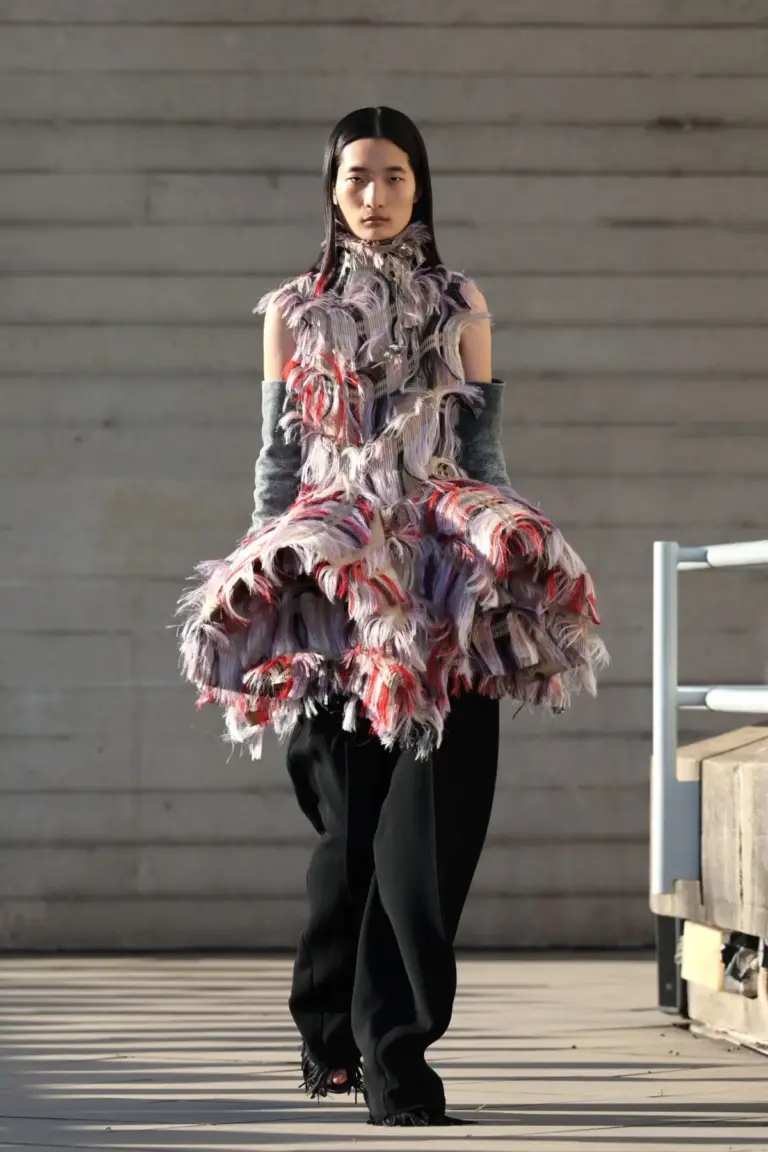
Debuting a tightly edited, devastatingly confident six-look collection, Tall opened with an explosive statement: fringed sheath tops engineered from laser-cut viscose crepe that mimics the exact hand-feel of supple leather, luxurious shearling accenting a plunging maroon dress, Swarovski crystals encrusting tight wool briefs, and an architectural black wool dress that belied his emerging status. The collection’s clarity of vision was instantaneous. Paloma Elsesser pulled Tall’s maroon dress for a high-profile Bulgari celebration during Couture Week, cementing his status as a maximalist maestro of modern staples.
A Letter: The Fabric Sculptors
For admirers of actor Emma Corrin, the delightfully camp polo dress featuring a structured red taffeta skirt and an exaggerated, wind-swept black bow remains an unforgettable sartorial moment. Originally designed under the moniker of Freddy Coomes alongside Matt Empringham, the design duo has officially rebranded under the sparse, evocative name A Letter.
While their official runway debut arrived at London Fashion Week, their geometric, architectural explorations of scarves, footwear, and dresses had already conquered the digital realm. Their conceptual reach extends to sculptural fine art—such as a single yellow silk rose meticulously sculpted and photographed resting in the mouths of close friends. Coomes and Matt Empringham treat wool and silk not merely as flat textiles, but as malleable mediums meant to be sculpted dynamically across the human form. Their commercially available pieces, such as the vibrant turquoise Francesca dress featuring an oversized chest bow, perfectly encapsulate their quirky, uncompromising design ethos.
Geordie Campbell: The British Humorist
What do contemporary contemporary dancers, queer British youth, and gritty boxers have in common? Beyond an assumed appreciation for Kylie Minogue, they serve as the eclectic psychological blueprint for Geordie Campbell’s debut ready-to-wear collection, Rough Pointe.
Drawing profound inspiration from Billy Elliot—a foundational queer British cultural text—and marrying it with nostalgic 1980s dancer knits, Campbell crafts garments that celebrate life’s peculiarities. By utilizing the disarming simplicity of durable denim, graphic T-shirts, and everyday workwear silhouettes, he produces a collection that is charmingly eccentric yet authentically British, entirely steering clear of cheap pastiche.
Supporting Context & Metrics: The Economics of Artisanal Survival
The structural shift toward independent artisanship is not happening in a vacuum; it is a direct financial and cultural reaction against the rapid homogenization of global retail. Industry analysts note that while corporate luxury houses face slowing organic growth driven by "fatigue pricing," independent studios operating on hyper-localized, direct-to-consumer, and celebrity-loan models are seeing an unprecedented surge in organic digital engagement.
| Designer | Primary Aesthetic Focus | Key Cultural Endorsements | Notable Innovation / Materiality |
|---|---|---|---|
| ATXV | Clubwear / Slinky Separates | Charli xcx, Rosé, Adéla | Sheer paneling, laser-cut slip dresses |
| Andrew Curwen | Gothic Romance / Dark Fantasy | Lady Gaga, Slayyyter, 2hollis | Spun-wisp knits, architectural corsetry |
| Gabe Gordon | Downtown Camp / Whimsy | Dua Lipa, Troye Sivan | Sustainable circular textiles, sex-wellness objects |
| TheVxlley | Organic Botanical Couture | Lady Gaga | Living grass integration, porcelain corsets |
| Patrick Taylor | Elevated Alpine Knitwear | Independent / NYFW Debut | Merino wool technical outerwear |
| Simon Carle | Avant-Garde Minimalism | Tyla, Rosalía | Upcycled deadstock, on-skin tattoo molding |
| Ilya Migmoon | Victorian Maximalism | Rosalía, Joey King | Extreme corsetry, hair-train construction |
| Tidjane Tall | Parisian Maximalism | Paloma Elsesser | Laser-cut viscose crepe, Swarovski crystal briefs |
| A Letter | Architectural Sculpture | Emma Corrin | Sculptural silk and taffeta molding |
| Geordie Campbell | British Working-Class Pastiche | Independent / London Scene | Subversive workwear, queer-textile translation |
Official Statements & Industry Perspectives
The rise of this artisanal rebellion has not gone unnoticed by the traditional pillars of fashion journalism and global curation. As international buyers pivot away from algorithmic trend-forecasting, the emphasis has shifted decisively back to the human element of garment construction.
"We are witnessing a fundamental fatigue among cultural tastemakers," notes a leading London-based fashion archivist and retail buyer. "Consumers no longer want an algorithmically optimized product designed by a board room. They want a point of view that feels dangerous, intensely personal, and deeply tactile. The designers breaking through today are unapologetic artists first and commercial entities second."
Furthermore, institutions like the Institut Français de la Mode have intensified their focus on incubating hyper-specialized technical talent rather than generalized commercial designers. By pushing graduates toward experimental material exploration—such as Tidjane Tall’s viscose-crepe leather illusions or Daniel Del Valle’s living botanical architectures—the educational pipeline is actively reinforcing the commercial viability of pure, unadulterated craftsmanship.
Future Outlook: Where Do We Go From Here?
As the international fashion calendar evolves, the division between corporate conglomerates and the independent artisanal vanguard will only widen. For the ten visionary creators highlighted here, the road ahead is fraught with the classic trials of scaling independent production without sacrificing creative autonomy.
However, the rapid democratization of high-impact digital storytelling, coupled with an increasingly sophisticated consumer base hungry for authenticity, provides a formidable tailwind. The future of fashion does not lie within the sterile boardrooms of multinational luxury conglomerates, but within the damp basement studios, shared apartments, and experimental workshops of New York, London, Paris, and beyond.
These young designers are proving that against all odds, a singular, uncompromising vision can pierce through the digital noise. They are not merely dressing the pop stars of today; they are single-handedly authoring the aesthetic archetypes of tomorrow.