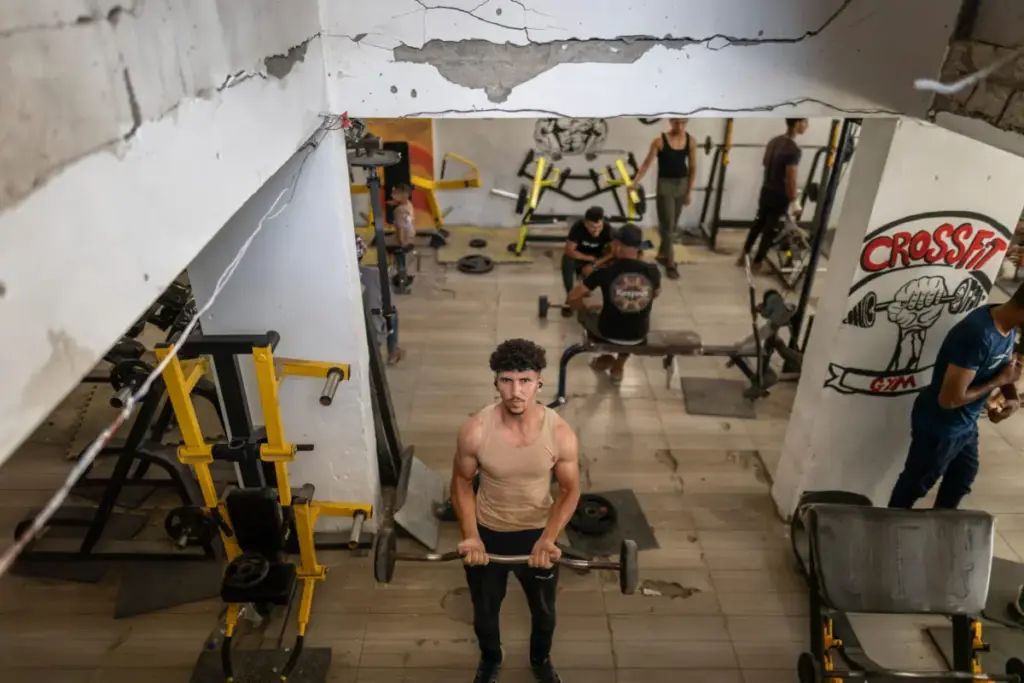
Amid the jagged landscapes of concrete blocks, twisted rebar, and the skeletal remains of multi-story structures in Khan Younis, a testament to human endurance operates in plain sight. The Champions Factory Gym—a subterranean haven reached by descending a staircase stripped of its surrounding walls—represents more than just a place to lift weights. Following nearly three years of devastating conflict that flattened the upper floors of the building and fractured the infrastructure of the Gaza Strip, this makeshift underground facility has become a vital epicenter for physical conditioning, psychological relief, and communal solidarity.
Devoid of reliable electricity and operating strictly within daylight hours, Champions Factory is led by Captain Mohamed Ziad al-Biss, a seasoned bodybuilding coach renowned for his staggering 419-pound bench press. Since May 2024, when footage first emerged of Al-Biss pressing iron amidst piles of rubble, the facility has undergone an improbable transformation. While the floor has been cleared and the equipment reorganized under streams of sunlight pouring through gaping structural holes, the cracked walls serve as an unyielding reminder of the harsh realities outside.
Yet, within these battered walls, a diverse cross-section of Gazan society—plumbers, electricians, tailors, construction workers, and cart drivers—gathers daily. For a nominal fee of roughly 40 ILS ($13 USD) per month, these men find an essential sanctuary. In a landscape where traditional avenues of employment, recreation, and basic survival have been upended, the members of Champions Factory view weightlifting not as a superficial pursuit of aesthetics, but as a physiological and psychological necessity. This feature explores how physical culture serves as a lifeline for individuals navigating unimaginable stress, chronic scarcity, and the profound psychological weight of ongoing conflict.
Detailed Chronology: From Destruction to Adaptation
The timeline of Champions Factory mirrors the turbulent history of the region over the past several years. Before the outbreak of the war, the gym served as a conventional neighborhood facility where local athletes pursued bodybuilding, powerlifting, and general fitness hobbies. The onset of hostilities brought systematic devastation to Khan Younis, reducing commercial shops, residential blocks, and community spaces to ruin.
The Onset of Conflict and Closure
When the conflict escalated, the upper three stories of the building housing Champions Factory suffered direct hits from bombings, reducing the superstructure to debris and cutting off all utilities, including electricity. For a prolonged period, the gym fell silent. The psychological and physical toll on the local population made organized athletics impossible; bodies and minds were overwhelmed by displacement, the search for safety, and the immediate threats to life.
The Spring 2024 Turning Point
A critical turning point occurred in May 2024. Captain Al-Biss captured national and international attention by sharing video footage of himself performing heavy bench presses surrounded by the literal ruins of his business. This defiant display of athletic commitment struck a chord, signaling that the spirit of physical culture in Gaza could not be easily extinguished.
Clearance and Community Resurgence
Following this viral moment, Al-Biss, alongside dedicated members, began the arduous task of clearing the debris. Without heavy machinery or municipal services, they removed tons of rubble by hand. While full architectural renovation remains out of reach due to blockades and a lack of construction materials, the interior was rendered functional. Stationary bikes, old-school weight racks, and dumbbells were salvaged, cleaned, and repositioned.
By late 2024 and into 2025, the gym experienced a surge in membership. Reopened under austere circumstances, it welcomed both veterans of the pre-war era and newcomers seeking an anchor in an unstable world. Today, while the building’s exterior remains a war zone casualty, the basement echoes with the rhythmic clanging of iron, marking a continuous, daily act of restoration.
Supporting Context & Metrics: The Socioeconomic Realities of Training in Gaza
To fully understand the significance of Champions Factory, one must examine the socioeconomic framework in which its members operate. The demographic makeup of the gym’s clientele spans various blue-collar trades, each bringing unique personal hardships to the weight room.
Economic Attrition and Employment
The regional economy has suffered catastrophic collapse. Unemployment is virtually absolute, leaving young men with few daily obligations or structured routines.
Mohammed Walid Al-Salami (Age 26): A tailor and electrical appliance repairman, Al-Salami struggles to secure consistent income to cover household expenses. Despite food scarcity and long working hours required just to scrape by, he commits to training four times a week.
Ibrahim Amer (Age 29): Working as a plumber, Amer notes that the physical demands of his trade are complemented, rather than replaced, by his time in the gym.
Shaaban Jaber Shaaban Al-Sheikh (Age 39): A construction worker, Al-Sheikh utilizes the gym to maintain the robust physical conditioning required for heavy manual labor, despite facing the direct impacts of displacement and localized famine.
Nutritional Deficits and Scarcity
Standard athletic paradigms—which emphasize caloric surplus, precise macronutrient splits, and specialized nutritional supplementation—are entirely absent in Gaza.
Members report severe scarcity regarding food availability. High-protein staples such as chicken breast, historically a dietary foundation for bodybuilders, are financially and logistically out of reach for the majority.
Nutritional supplements, including protein powders, creatine, and vitamins, are virtually nonexistent due to strict border closures and import restrictions.
Despite subsisting on whatever irregular provisions are available at home—varying unpredictably between basic grains, occasional fish, or meager portions of meat—the athletes refuse to use nutritional deficits as an excuse to abandon training.
Affordability as a Community Service
Recognizing the economic distress of the community, Captain Al-Biss has kept membership dues exceptionally low. At approximately 40 ILS ($13 USD) per month, the fees are structured to ensure that financial destitution does not bar anyone from accessing the facility. For young men like 22-year-old Abdulrahman Mohamed Jadallah and 17-year-old cart driver Nassim Khattab, this minimal cost provides daily access to an environment that deters isolation and despair.
Official Statements and Personal Testimonies
The psychological and philosophical motivations driving the members of Champions Factory are best articulated in their own words. Gathered through interviews conducted on-site, these testimonies highlight the profound therapeutic role that physical exertion plays under extreme conditions.
Captain Mohamed Ziad al-Biss (Gym Owner and Bodybuilding Coach)
"Sport represents a fundamental pillar for the whole world. But in Gaza, it needs to be a priority because it is a form of recreation. At this gym, we release energy, build our dreams, and build our bodies. We get out of the atmosphere of war and pressure.
Today, there is a huge demand for gyms in Gaza. Several have reopened across Khan Younis. I encourage young people to join sports clubs, give themselves a mental break, and escape the pressures and psychological stress that we are all living through.
I have competed in championships at the Gaza Strip level. I continue preparing for international competitions, but the border crossing remains closed to us. Food is scarce, nutritional supplements are scarce, but we have determination, and we continue moving forward."
Mohammed Walid Al-Salami
"Sports are not a luxury in Gaza, they are a necessity. They are the only way for us to release our negative energy and rebuild ourselves. The war took everything from us… It took the shop where I used to work, and it took the neighborhood where we used to train. We stopped doing sports for a long time, because our bodies and minds couldn’t handle anything more than that. When we started to feel a small sense of hope, we went back to the gym."
Abdullah Ahmed Khalil Al-Farra (Age 24)
"Right now, one of the most important things in Gaza is that—whether it’s football, weightlifting, or parkour—you need to release your energy. There’s no work, no trips with friends, no places to go. The Gaza Strip is finished. We spend the entire day at home. There’s no source of income… When it comes to exercise, my advice to people is to strive. If you have nothing to do today, come and train. Maybe God will open a new door and you’ll get a job opportunity. When that opportunity comes, you’ll need to be physically capable of doing the work."
Ibrahim Tamim Al-Lahham (Age 40)
"My training includes weightlifting and cardio exercises. Exercise gives me focus and energy. It helps me deal with the pressure and prepare my body for the demands of everyday life in Gaza. We are a people who deserve life, and exercise is one way of holding on to it."
Future Outlook: Challenges, Aspirations, and Global Solidarity
Looking ahead, the trajectory of Champions Factory Gym and its members remains inextricably bound to the broader geopolitical and humanitarian realities of the Gaza Strip.
Infrastructure and Material Needs
While the immediate physical space has been cleared of life-threatening debris, the long-term structural integrity of the building housing the gym is compromised. Without access to heavy construction materials, professional masonry work, or stable electrical grids, the facility remains vulnerable to the elements. Captain Al-Biss has launched international crowdfunding initiatives (such as support campaigns hosted on platforms like Chuffed) directed toward securing funds for structural reconstruction, equipment acquisition, and medical recovery support for injured athletes. The realization of these donations remains vital for upgrading the gym from a makeshift basement into a fully restored athletic center.
Athletic Ambitions Beyond the Blockade
Despite regional isolation, the aspirations of the coaches and athletes extend far beyond local workouts. Al-Biss maintains a rigorous personal training schedule with the ultimate goal of competing on international bodybuilding stages. However, the closure of border crossings effectively bars Gazan athletes from traveling to regional and global competitions. Overcoming this mobility barrier remains a central demand of the local athletic community, who seek international recognition and the opportunity to represent their homeland abroad.
The Enduring Spirit of Physical Culture
Ultimately, the story of Champions Factory is not merely one of structural damage or economic hardship; it is a profound demonstration of human agency. By choosing to lift weights in an environment marked by scarcity and destruction, the men of Khan Younis are actively reclaiming their bodily autonomy and psychological well-being. As Ibrahim Amer summarized for visiting journalists:
"The most important thing for a person is their health. Keep training and keep going. And put your trust in God."
In a landscape stripped of certainty, the iron inside Champions Factory provides an unyielding anchor, proving that the drive to move, build, and endure cannot be demolished.