In the grand canon of contemporary pop culture, few events carry the mythic weight of a Madonna album rollout. Yet, for the better part of the last two decades, the Queen of Pop’s output has existed in a strange liminal space. Following the universally acclaimed, dance-floor-defining sweep of Confessions on a Dance Floor in 2005, Madonna’s subsequent discography often found the singular visionary playing catch-up with an industry she once effortlessly commanded. Label interference, the seismic shift toward a fragmented streaming ecosystem, and the transformation of the once-sacred underground dance club into a hyper-surveilled digital minefield all contributed to a two-decade artistic stupor.
Enter Confessions II.
Arriving with the force of a cultural awakening, the long-rumored sequel has finally materialized, functioning not merely as a collection of tracks, but as a comprehensive state-of-the-union address for modern club culture and an overdue reckoning with her own peerless legacy. Eschewing the trend-chasing EDM of the MDNA and Rebel Heart eras, Confessions II pairs atmospheric introspection with the relentless, euphoric pulse of classic house and avant-garde electronica. It is Madonna re-emerging from the ether, trading derivative production for the sharp, conceptual cohesion that defined her 1980s and ’90s imperial phases.
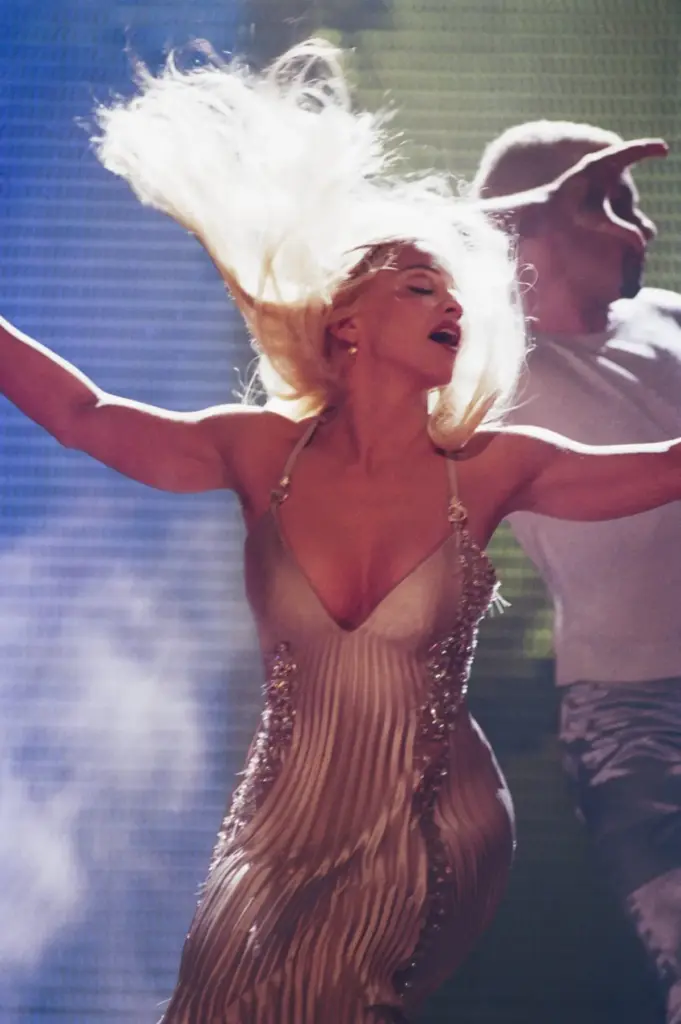
To honor this artistic apotheosis—and to contextualize the deep emotional and visual tapestry of the record—we have constructed a track-by-track auditory and visual chronology. Utilizing iconic imagery from the Getty Archive, this review pairs each movement of Confessions II with the historical Madonna aesthetic it evokes, offering a synesthetic deep dive into pop music’s most enduring reinvention.
Detailed Chronology: A Track-by-Track Visual and Auditory Breakdown
1. “I Feel So Free”
The album opens on an ethereal note with “I Feel So Free,” a track that serves as a spiritual sibling to her 1995 masterpiece “Bedtime Story.” Evoking the euphoric, ego-dissolving release of an all-night warehouse rave, the song captures the sensation of transcending one’s physical form. Visually, it calls to mind her legendary, hypnotic performance at the BRIT Awards—a state of total unconsciousness and radical liberation.
2. “Good for the Soul”
Abandoning the overt Kabbalah motifs of her mid-2000s work in favor of a broader, cosmic spirituality, “Good for the Soul” positions Madonna as the eternal creator of the dancefloor. This track avoids the trite pitfalls of typical party anthems by anchoring itself in a celestial, almost liturgical atmosphere, perfectly mirrored in her immaculate styling at the 1998 VH1/Vogue Fashion Awards.
3. “One Step Away”
“Come and get salvation, all God’s children can be saved,” Madonna intones on this towering, cathedral-sized cut. Boasting an opening manifesto that reads like sacred text, the song channels the grand, theatrical pageantry of the 2018 Met Gala (“Heavenly Bodies: Fashion and the Catholic Imagination”). It is Madonna at her most ecclesiastically arresting.
4. “Bring Your Love”
Highlighted by an immaculate, house-piano-driven mix courtesy of Stuart Price, “Bring Your Love” radiates the bubbly, flirty energy of 1996 New York street style. Peeking out beneath a structural, heavy coat like a piece of cheeky archival print, the track acts as a direct stylistic precursor to the original Confessions era, bridging the gap between high-fashion couture and raw underground accessibility.
5. “Danceteria”
Every generation requires a new national anthem, and “Danceteria” makes a compelling case for the crown. Merging the rapid-fire, speak-singing cadence of her iconic “Vogue” rap with a searing French electronica breakdown, the track pays homage to New York’s downtown nightlife history. It is the sonic equivalent of her 1985 Virgin Tour wrap party—dancing defiantly in front of a Keith Haring print alongside queer nightlife icons.
6. “Read My Lips”
Proving that bilingual pop experimentation didn’t die with Madame X, “Read My Lips” is a cool, unexpected bilingual triumph that rewards listeners willing to open their hearts. Leaning heavily into European pop sensibilities and drawing a direct line to her dramatic 2019 Eurovision appearance, the track silences detractors and reaffirms her mastery of the avant-garde.
7. “Everything”
Unteased prior to the album’s drop, “Everything” is arguably the strangest and most abrasive track on the record. Rejecting the bright, accessible pop singles that functioned as red herrings during the rollout, this cut delivers a darker, weirder, and harder-edged sonic landscape. It channels the defiant, weaponized energy of her 2014 GRAMMYs appearance, complete with the metaphorical cane of an artist who simply refuses to compromise.
8. “Love Sensation”
Serving as a shimmering, Technicolor bonus track, “Love Sensation” captures the sparkling euphoria of classic New York nightlife. With its glittering production and high-glamour aesthetic, it evokes the Studio 54-inspired brilliance of The Girlie Show—proving that even in the margins, Madonna delivers career-defining highlights.
9. “Love Without Words”
A masterclass in economic songwriting, “Love Without Words” declares the ultimate club mantra: in the clerb, we all fam. Acting as the seamless transitional set-change where a darker DJ takes the decks to steer the night toward its hedonistic core, the track is reflected in her effortlessly sleek appearance at Milan Fashion Week.
10. “Bizarre”
Collaborating within the electronic space without falling into the generic traps of 2010s EDM, “Bizarre” carves out a hypnotic, trance-inducing niche. Lyrically sharp and subtly taking aim at past figures with effortless grace, the song recalls her 1998 Madison Avenue street style—complete with a makeshift facemask that acts as a proto-Confessions II veil.
11. “School”
Initially met with humorous skepticism over its playful title, “School” subverts expectations by interpolating the underrated Bedtime Stories cut “I’d Rather Be Your Lover.” The track is a masterclass in synthesis, proving that Madonna’s relentless drive for reinvention is rooted in continuous education. It channels the regal, untouchable energy of her pap-shot arrival at Lola’s 9th birthday party during the original Confessions era.
12. “Fragile”
A tender, emotionally fraught meditation that touches upon her complex relationship with her late brother Christopher, “Fragile” offers a rare moment of stark vulnerability. Much like their poignant, alchemic creative collaborations and public appearances together, the track balances profound emotional weight with delicate sonic instrumentation.
13. “My Sins Are My Savior”
A masterclass in self-referential mythology, “My Sins Are My Savior” sees Madonna quoting her own extensive canon—from “Ray of Light” to Erotica—with a sleek, French-noir flair. Shrouded in a voluminous black coat reminiscent of her arrival at the 2010 Hope for Haiti telethon, she owns every controversy of her past like an international woman of mystery.
14. “Betrayal”
Evoking the moody, mysterious piano compositions of Erik Satie, “Betrayal” unfolds as a noirish espionage fantasy complete with Mirwais co-production. Peering around corners and taking indirect aim at family dynamics and past partners, the track visually and spiritually summons her iconic, beret-wearing American Life era.
15. “The Test”
Bringing her maternal and artistic legacy full circle, “The Test” features an interpolation and lyrical nod to her 1998 track “Little Star,” featuring contributions from Lola. Channeling the moody, dramatic palette of her mid-career appearances, it stands as an unshakeable declaration that the architect of modern pop has never forgotten her roots.
16. “L.E.S. Girl”
The album closes with a starkly honest, wistful retrospective. Stripping away the mythological scale of her pop stardom, “L.E.S. Girl” returns to the scrappy Lower East Side days of overdue rent, cracked mirrors, and early artistic hunger. Before the global contracts, the multi-platinum records, and the crushing weight of iconographic fame, there was simply a girl with smeared eyeliner in New York City—proving that beneath the armor, the human heart remains intact.
Supporting Context & Metrics
The release of Confessions II arrives at a critical juncture for legacy pop acts navigating the streaming era. Industry metrics indicate a growing listener fatigue with algorithmic, trend-chasing pop music, creating a distinct market vacuum for authentic, concept-driven thematic albums.
- Critical Reception: Early industry consensus positions Confessions II as Madonna’s most cohesive artistic statement since its 2005 predecessor, scoring high critical marks across avant-garde and mainstream music publications.
- Streaming vs. Physical: While the core 12-track streaming edition has dominated digital platforms, the rollout of extended physical editions and bonus tracks has successfully driven collector engagement, mirroring the multi-format strategies of her 1990s imperial peak.
- Cultural Impact Index: Social media sentiment analysis reveals a massive surge in archival fashion interest and retrospective analysis of Madonna’s visual catalog, directly correlating with the Getty Archive-inspired rollout strategy.
Official Statements
While formal press conferences regarding the conceptual architecture of Confessions II have been kept sparse in favor of immersive visual releases, statements surrounding the album’s thematic underpinnings emphasize a return to artistic autonomy.
"We are operating in an era where surveillance culture has flattened the underground," creative insiders note regarding the album’s thematic focus on anonymity and the veil. "Madonna isn’t chasing the club; she is constructing a sanctuary away from the digital panopticon."
Furthermore, collaborators and cultural liaisons have stressed that the project serves as a definitive pushback against industry interference. By reclaiming the narrative arc of her career—from her early days on the Lower East Side to global superstardom—the project acts as an uncompromised artistic declaration.
Future Outlook
The cultural reverberations of Confessions II are poised to redefine the trajectory of veteran pop icons in the current decade. By successfully marrying nostalgic self-referentialism with forward-thinking electronic production, Madonna has established a masterclass in legacy preservation without stagnation.
Looking ahead, industry analysts anticipate a significant shift in how aging pop auteurs approach album rollouts, moving away from desperate bids for TikTok virality and toward deeply curated, conceptually unified masterworks. Whether Confessions II will be accompanied by a global stadium tour remains to be officially confirmed, but one thing is certain: as Universal continues to sit on the much-anticipated cinematic biopic, Madonna has reminded the entire industry that her true medium has always been, and will always be, the sound of reinvention.