In the hyper-accelerated ecosystem of contemporary luxury fashion, where digital fatigue meets a relentless cycle of micro-trends, true tranquility is an anomaly. Yet, sitting in his Madrid showroom against the backdrop of a sweltering Paris heatwave over a Zoom call, 33-year-old Australian designer Edward Cuming embodies an unshakeable zen. The juxtaposition of the words "calm" and "fashion designer" rarely coexist in the same breath, let alone the same person. However, after seven years of meticulously charting a distinct course for his eponymous label, Cuming has unlocked a rare state of creative equilibrium.
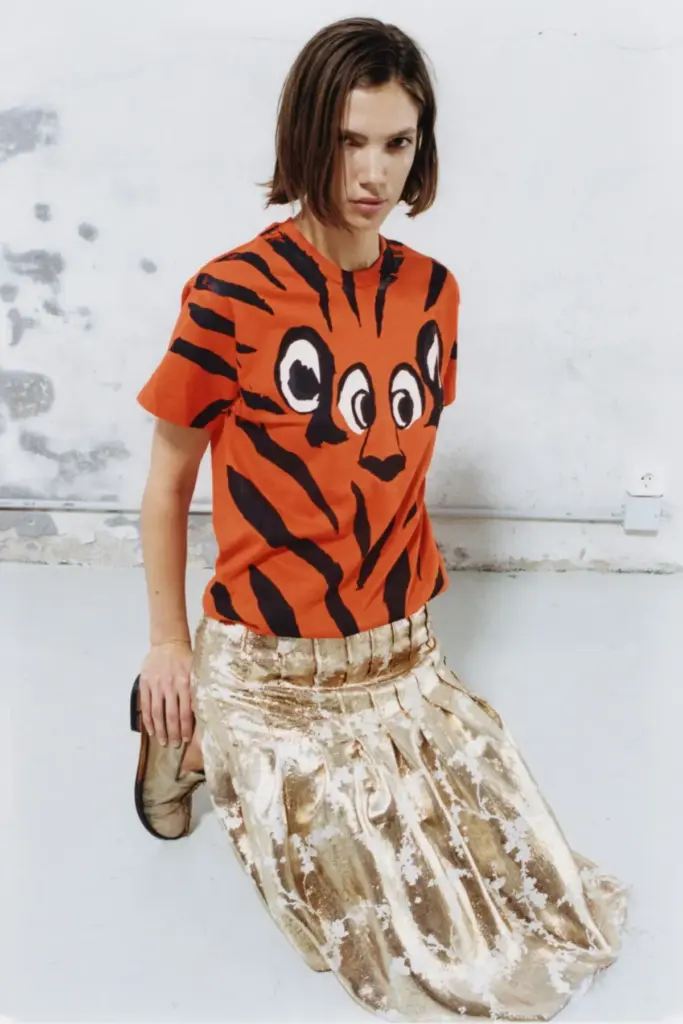
Over recent years, this quiet alchemy has captured the imaginations and wallets of style arbiters worldwide. From breakout actors like Ayo Edebiri to boundary-pushing musicians like Guitarricadelafuente, the fashion cognoscenti have bought heavily into Cuming’s universe. His aesthetic—a paradoxical blend of maximalist textures and classic foundational tailoring—defies easy categorization. It is a world where sequined leg warmers commingle with distressed button-downs, and where unstructured, unfinished hems interrupt crisp, architectural silhouettes.
Yet, beneath the vibrant chaos of his color stories and the intricate draping of his skirts lies a deeply pragmatic business philosophy. Cuming’s rise has been slow, deliberate, and entirely on his own terms. Rejecting the standard venture-backed playbook of rapid scaling and artificial hype, he has built an independent brand anchored in structural integrity, human touch, and an unwavering devotion to the craft of garment-making. As the label approaches a true 50/50 split between menswear and womenswear, Cuming’s modern, co-ed approach offers a blueprint for what a truly unisex brand can achieve in the 2020s.
Detailed Chronology: From Agricultural Roots to Central Saint Martins
Cuming’s entry into the world of textiles reads like a whimsical novel, born from a binary choice of high school curriculum. Growing up in Australia, a teenage Cuming found himself enrolled in an agricultural program. Looking for an escape from the farmyard, he asked administrators if he could switch to any other class. His options were severely limited.
“It was literal cow sh*t or tulle skirts,” Cuming reminisces with a laugh.
He chose the tulle. From his very first garment—a piece inspired by Tim Burton’s The Nightmare Before Christmas—he was entirely enraptured by the infinite narrative possibilities held within a roll of raw fabric. This nascent fascination eventually led him across the globe to London, where he enrolled at the prestigious Central Saint Martins (CSM). Immersed in the crucible of CSM’s rigorous design environment, Cuming honed a signature sensibility that translated immediately from the runway to the real world; his graduate collection generated immediate orders from elite contemporary boutiques.
Relocating his operations to Madrid, Cuming spent his early post-graduate years absorbing the mechanics of the industry before launching his brand in 2019. Starting primarily as a menswear venture, the label organically expanded to encompass women’s collections. Rather than treating womenswear as an afterthought or a secondary line, Cuming recognized that the two genders mutually inform one another. Today, his clothes are coveted by men shopping through cutting-edge digital retailers like Ssense and brick-and-mortar institutions like Los Angeles’s Departmento, alongside a parallel demographic of women doing precisely the same.
Supporting Context & Metrics: The Mechanics of Slow Growth
In an era defined by rapid-fire drops and aggressive social media marketing, Cuming’s strategic restraint stands out. When asked about the steady, incremental expansion of his business, the designer emphasizes that operational foundations always superseded abstract brand messaging.
"From the moment I took on the first production, I felt a big responsibility to do it right, make the clothes properly, deliver on time, and make sure everyone contributing to what I was doing was being given the attention they needed," Cuming explains. "My priority was building those foundations for how a business would run, as opposed to what the brand really meant."
Rather than constructing a massive enterprise before a sustainable market demand existed—a common pitfall in modern independent design—Cuming trusted that the design language he forged at CSM was strong enough to organically resonate with consumers. This slow-burn strategy is as much a reflection of his personal psychology as it is a business model. Remaining fiercely protective of his mental well-being, Cuming enforces strict personal boundaries, ensuring that his life outside the studio remains rich enough to sustain the rigorous demands of running an international label.
The Denim and Basics Foundation
Despite the maximalist surface impressions of his collections—characterized by random patches, jacquards, and explosive color pairings—Cuming insists that his brand is fundamentally anchored in classic, essential garments.
"The brand might not necessarily look like it’s rooted in classic pieces, but if you pick it all apart, it is," he notes.
This philosophy explains the foundational importance of denim within his collections. Working in tandem with his longtime stylist, Patricia Villirillo, Cuming shares a deep reverence for timeless staples like polo shirts, simple button-downs, and meticulously tailored trousers. Early on, the team recognized that introducing a robust denim offering was essential. Jeans provided the ultimate canvas to play with high-low contrasts, balancing the loud, theatrical elements of the runway with quiet, everyday wearability.
Embracing Imperfection in a Manufactured World
Perhaps the most defining technical hallmark of Cuming’s work is his rejection of clinical perfection. In a marketplace increasingly saturated by mass production and algorithmic uniformity—and more recently, AI-generated designs stripped of human agency—Cuming deliberately engineers a lived-in, tactile quality into his garments.
His approach to shirting exemplifies this ethos. Rather than utilizing standard garment-dyeing techniques, early collections involved sewing a patch of lining onto the back of a pristine white shirt and throwing it into a wash cycle, allowing the colors to bleed uncontrollably.
"I saw myself going mad if I was going to have to control these things," Cuming admits. "So I thought, let’s lean into that lived-in quality. Let’s lean into that nature of things being repeatedly used and washed and maybe even a little destroyed. Let’s lean into that as a type of luxury."
This philosophy extends to his finishings. Cuming and his team spend countless hours developing ways to fray fabrics while maintaining structural integrity—a process often far more labor-intensive than traditional manufacturing. Because mass-market textile factories frequently flatten these nuances through industrial scale, many Cuming pieces pass directly through his Madrid atelier for meticulous hand-finishing before ever reaching retail floors.
Official Statements & Design Philosophy: Domestic Spaces and Creative Reactivity
Cuming’s creative process is deeply reactionary, drawing parallels to how contemporary musicians approach album-making. Citing Charli xcx’s methodology of treating successive records as magnetic forces pushing in opposite directions, Cuming believes that a true designer must possess the confidence to radically pivot from season to season while maintaining an authentic core.
This dialectic is particularly evident in his use of color and texture. While he often enters a design cycle intending to create a visually calm, subdued collection, his studio instincts invariably take over.
"Water finds its own level somehow, but then you push yourself somewhere new in that process," he laughs, recounting how a self-proclaimed "calm" season invariably resulted in a riot of complex fabrics.
The primary catalyst for these unexpected color and texture combinations is remarkably domestic. Beginning around Fall/Winter 2022, Cuming’s collections found their conceptual bedrock in interior design spaces—specifically, the uncontrived, accidental beauty found within everyday home environments.
"I’m always looking at a domestic space and thinking, ‘Oh wow, that couch and that carpet and the spine of that book and that coffee cup together is heaven on earth,’" Cuming reveals. "That’s what I’m trying to create with every collection—it’s the highest possibility of being able to re-create those kinds of visual moments with what you’ve got on all the rails and just see what happens."
When asked about gender designations within his collections, Cuming offers a pragmatic yet progressive perspective. While wholesale buyers still demand binary categories for sizing, proportion, and pattern development, the designer views the men’s and women’s sides of his business as a symbiotic co-ed dialogue. Interestingly, because a significant portion of his menswear is acquired by female consumers, the boundary lines have dissolved to the point where the brand functions primarily as an egalitarian, 50/50 split.
"If we can’t say it in 12 looks, we’ve got to reevaluate what we’re doing at our scale," he notes, emphasizing the precision and edit-heavy discipline required to maintain a cohesive brand identity across genders.
Future Outlook: Global Expansion and Direct-to-Consumer Connection
As Edward Cuming looks toward the next half-decade, his ambitions are marked by the same measured pragmatism that defined his initial launch. Rather than chasing explosive, unsustainable conglomerate growth, his immediate benchmarks focus on deepening connections with his rapidly expanding international clientele.
A central pillar of this upcoming phase involves physical, in-person shopping experiences. Following a successful pop-up in Madrid last year—which allowed the designer to interact directly with the people wearing his clothes—Cuming is eager to bring similar curated retail experiences to cities around the globe. Operating out of Madrid places him slightly outside traditional fashion capitals like Paris, London, or Milan, but this geographic independence has fostered a fiercely loyal, organic community of wearers who discover the brand on their own terms.
"People don’t know the brand, and I’m always surprised when they do and they own pieces and they want to own more," Cuming reflects. "That’s a big focus for the next couple of years: to start taking that to cities around the world and giving them our version of that experience."
In an industry addicted to rapid-fire trends and artificial acceleration, Edward Cuming’s trajectory proves that true longevity belongs to those who build slowly, design with uncompromising humanity, and allow their creative instincts to naturally evolve.